

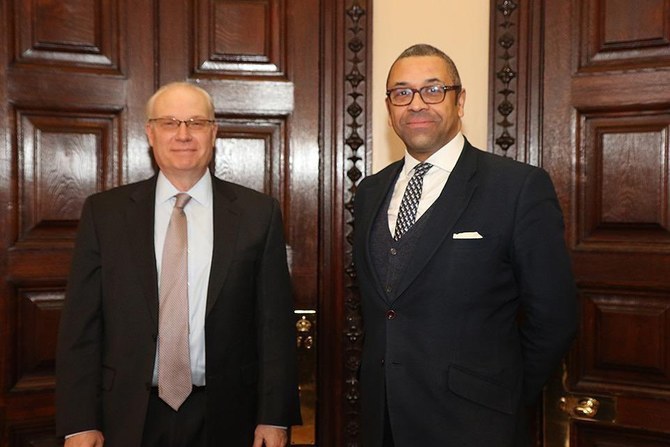

LONDON: The US envoy to Yemen Tim Lenderking held talks with senior UK and Gulf officials in London, as part of his first tour of 2022 to reinvigorate peace efforts in coordination with the UN.
During talks with the British Minister for Middle East and North Africa James Cleverly, the two sides stressed they are “committed to working together to advance a durable resolution to the Yemen conflict, help stabilize the economy, and support urgent steps to ease the humanitarian crisis.”
The US envoy also took part in a UK-hosted Quint meeting to discuss the situation in Yemen with senior representatives from Saudi Arabia, the UAE, Oman and Britain, along with UN special envoy Hans Grundberg.
Important meeting with US Special Envoy for Yemen @LenderkingTim today to discuss how we, the international community, can support @OSE_Yemen and all parties in working toward peace in #Yemen. pic.twitter.com/XOdVb1vtrl
— James Cleverly (@JamesCleverly) January 26, 2022
Lenderking was in Riyadh, the UAE and Oman last week, where he focused on the urgent need for de-escalation and the protection of all civilians, bringing the parties together to support a UN-led inclusive peace process, and doing more to address economic stability, humanitarian assistance access and fuel shortages, a State Department spokesperson told Arab News.
His visit comes as the Iran-backed Houthi militia have stepped up cross-border attacks against populated areas in Saudi Arabia and have attempted to strike the UAE capital twice in the last two weeks. The Houthis have also continued their brutal offensive on the Yemeni province of Marib, which has served as a safe haven for millions of internally displaced persons who have been fleeing the fighting since the conflict began in 2014.
The US has repeatedly pledged to continue to work with their partners in the region, including Saudi Arabia and the UAE, to help them defend against these deplorable Houthi attacks, the State Department said.
“The recent escalation of violence in the region poses a threat to all, and we must all work together to press the parties to return to dialogue,” #USEnvoyYemen Lenderking said in a meeting with Omani FM @badralbusaidi. @USEmbMuscat pic.twitter.com/QititoEAzL
— U.S. State Dept - Near Eastern Affairs (@StateDept_NEA) January 26, 2022
However, increased calls from regional allies are putting pressure on US President Joe Biden’s administration to relist the Houthis as a terrorist organization one year after it reversed a last-minute decision by former President Donald Trump to designate the militia.
“We will continue to work with our allies and partners in the region especially to promote accountability for the Houthis, for those Houthi leaders that have been behind these terrorist attacks,” the State Department said.
It added that the the Houthis’ redesignation as an “international terrorist organization” is “under review” and the US is expected to implement additional steps, including sanctions, to hold Houthi leaders accountable.
But when asked by Arab News about the possibility that the Biden administration will relist the militia, it said: “The United States remains committed to improving the humanitarian situation in Yemen and would have to fully consider the humanitarian implications.”
State Department spokesman Ned Price had also said that they not going to relent in designating Houthi leaders and entities involved in military offensives that threaten civilians and regional stability and perpetuate the conflict, who are responsible for some of the human rights abuses or the violations of international humanitarian law.
“When you talk about the humanitarian crisis, there is one actor that is primarily responsible for the suffering of the Yemeni people, the widespread suffering of the Yemeni people. And that is the Houthis,” Price told reporters at a press briefing.
He added they are using every appropriate tool to hold the Houthis to account.
The State Department reiterated the American condemnation of the Houthi attacks on Saudi Arabia and the UAE and said it remained committed to solving the Yemeni conflict.
“Helping advance a durable resolution that ends the conflict in Yemen, improves Yemeni lives, and creates the space for Yemenis to collectively determine their own future remains a top US foreign policy priority,” it said.


