



ISLAMABAD: With its first ice hockey tournament, Skardu Valley, the main gateway to Pakistan's highest peaks and glaciers, is trying to promote awareness on climate change, which is increasingly affecting the region's ecosystem.
Pakistan is home to 7,253 glaciers, with more glacial ice than any other country on earth outside the polar regions. But studies show that climate change is “eating" them away at a dramatic rate. Pakistan's northern region of Gilgit-Baltistan is home to most of the country's glaciers.
The Baltistan Ice Hockey Championship 2022 was held in Skardu on Tuesday and Wednesday, featuring four teams, each named after a glacier.
“First time in the history of Baltistan, we organized a mega event Baltistan Ice-Hockey Championship 2022,” Waqas Johar, assistant commissioner Skardu told Arab News on Wednesday. "We organized this two-day event to create awareness about climate change."
He said climate change is indeed a significant challenge for the region
"Climate change is real. It is a global challenge that threatens the very existence of the earth in the coming years. Gilgit-Baltistan, home to the largest glaciers outside the polar regions, is highly vulnerable to the adverse impacts of climate change. The fragile ecosystem of Gilgit-Baltistan needs urgent attention."
Besides its awareness raising goal, the championship also aimed at promoting winter tourism.
“Such events play a very important role for the promotion of winter tourism and awareness about climate change,” Gilgit-Baltistan Tourism Minister Raja Nasir Ali Khan told Arab News. “We have been celebrating winter festivals like ice-hockey, ice climbing, skiing etc. in Hunza and other districts of Gilgit region. Now, the first time we are organizing ice hockey in Skardu.”
Known for its picturesque landscapes, Gilgit-Baltistan, a mountainous area bordering Afghanistan and China is Pakistan’s favorite tourism destination and was listed by Forbes among the ten “coolest places” to visit in 2018.
"Gilgit-Baltistan is blessed and filled with natural beauties," Khan said. "Here is also lots of opportunities in the tourism sector not only in the summer."
The Baltistan Ice Hockey Championship has also attracted foreign visitors.
“I am visiting the Gilgit-Baltistan region to support communities coming outside in winter, learning about activities and sports they can do in winter,” Canadian High Commissioner in Pakistan Wendy Gilmour told reporters in Skardu, as she came for the competition on Tuesday.
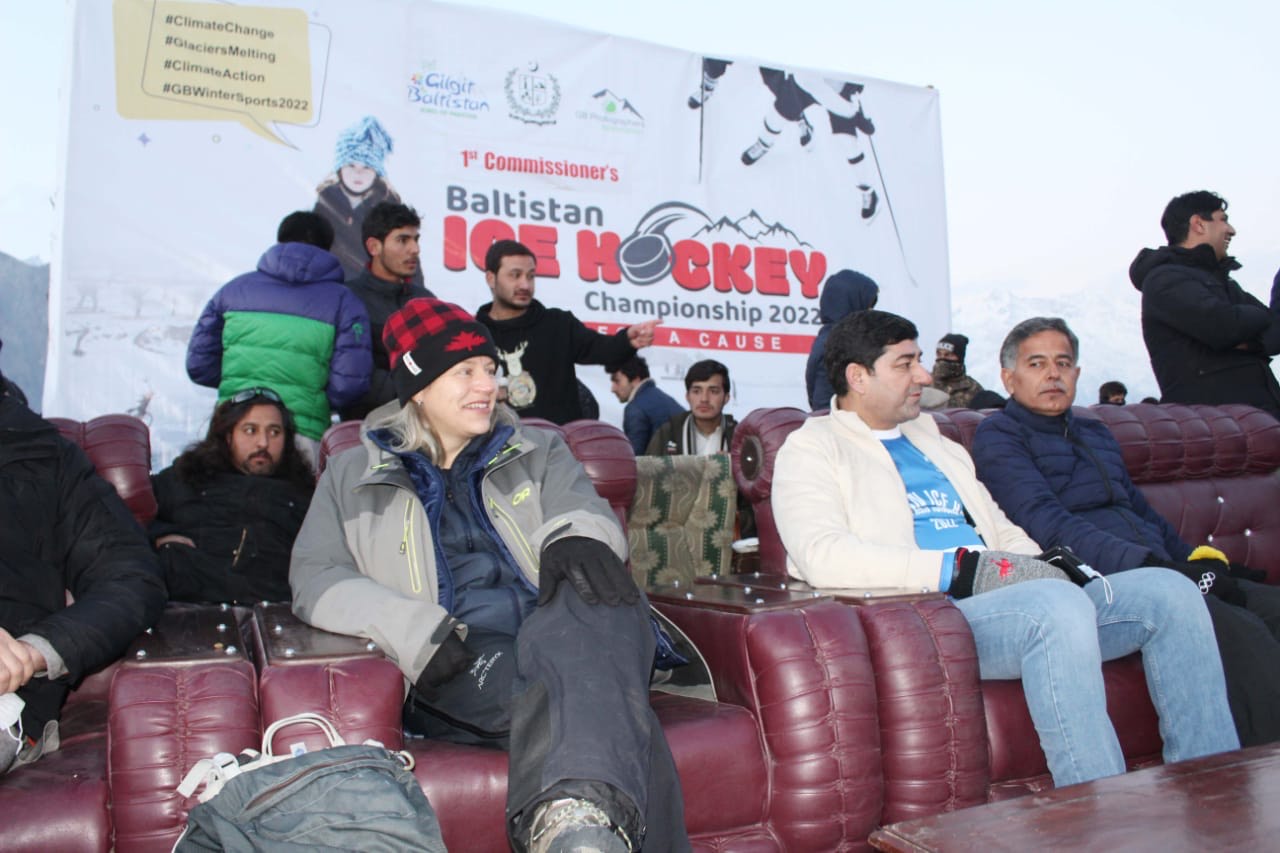
Canadian High Commissioner Wendy Gilmour and Gilgit-Baltistan Tourism Minister Raja Nasir Ali Khan watch a match during the Baltistan Ice Hockey Championship 2022 in Skardu district, Gilgit-Baltistan, Pakistan, on January 25, 2022. (Photo courtesy: Pamir Times)
“Ice-hockey is Canadian passion we are so pleased to see happen here in Gilgit-Baltistan. It’s such an amazing beautiful area. It’s very wonderful to see girls, boys and the youth of this region come outside, learn about their environment, learn about types of things that we can do in winter."
Muhammad Shareef Sadpara, ice hockey trainer, said there were plenty of opportunities for winter sports in the region, where future athletes could be groomed.
“If the governments’ support continues, residents of Baltistan region make the country proud through their talent," he said. "There is no dearth of talents among the people.”


