

Email contradicts UK PM’s claim over evacuation of animals from Afghanistan

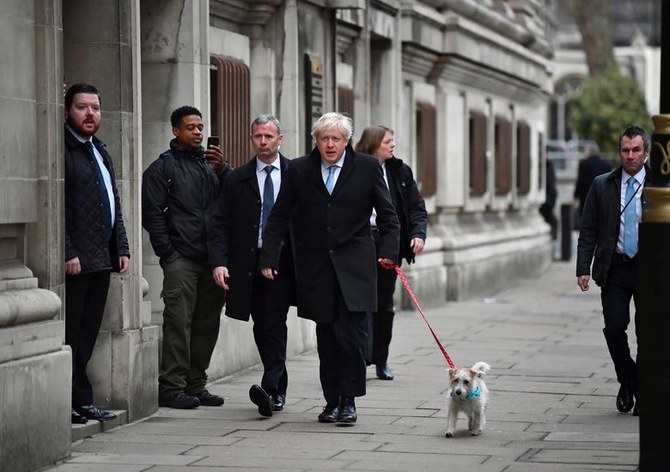
UK PM Boris Johnson walks with his dog Dilyn, London, England, Dec. 12, 2019. (Reuters)
Short Url
Updated 26 January 2022
Follow

Email contradicts UK PM’s claim over evacuation of animals from Afghanistan

  • According to email, Boris Johnson gave personal authorization despite his vehement denial
  • PM accused of prioritizing pets over Afghans who had worked for British govt 

LONDON: British Prime Minister Boris Johnson personally authorized the evacuation of 173 dogs and cats from Afghanistan, according to an email released on Wednesday. 

On Dec. 7, Johnson claimed that it was “complete nonsense” that he had intervened to have the animals evacuated, and that he had “no influence on that particular case,” adding: “Nor would that be right.”

Zac Goldsmith, a minister and member of the House of Lords, told parliamentary colleagues that Johnson’s statement was “entirely accurate,” which this email now contradicts. 

The email was sent on Aug. 25 last year by an official at the Foreign, Commonwealth and Development Office during the evacuation from Kabul.

Addressed to the department’s “special cases” team, the official wrote: “The PM has just authorised their staff and animals to be evacuated.”

The government and Johnson have come under fire from MPs and a Foreign Office whistleblower for allegedly reallocating military and governmental resources from rescuing Afghans to recovering pets. 

The founder of the Nowzad charity, former Royal Marine Pen Farthing, denies the claims. The charity chartered its own plane and put the animals in the hold, freeing up space for people, but civil servants and MPs said their presence meant that limited military resources were redirected to protect the convoy of animals. 

In December, former Foreign Office worker Raphael Marshall told MPs that the department had received “an instruction from the prime minister” to use “considerable capacity” to help Farthing.

During the airlift, Foreign Affairs Select Committee Chairman and Afghanistan veteran Tom Tugendhat criticized the decision to airlift the animals. 

But Farthing told the BBC: “At no time did any British soldiers leave Kabul airport to get me in, I’m dumbfounded that he’s said this to Parliament.

“As a charity, how many times do we have to tell people the truth? He said the government transported our animals. We left Kabul on a privately chartered flight, there was no government involvement.”


Australian bushfires raze homes, cut power to tens of thousands

Updated 58 min 1 sec ago
Follow

Australian bushfires raze homes, cut power to tens of thousands

  • PM Anthony Albanese said the nation faced a ‍day of “extreme and dangerous” fire weather, especially in Victoria, where much of the state has been declared a disaster zone

SYDNEY: Thousands of firefighters battled bushfires in Australia’s southeast on Saturday that have razed homes, cut power to thousands of homes and burned swathes of bushland. The blazes have torn through more than 300,000 hectares (741,316 acres) of bushland amid a heatwave in Victoria state since the middle of the week, authorities said on Saturday, and 10 major fires were still burning statewide. In neighboring New South ‌Wales state, several ‌fires close to the Victorian border were ‌burning ⁠at ​emergency level, ‌the highest danger rating, the Rural Fire Service said, as temperatures hit the mid-40s Celsius (111 degrees Fahrenheit). More than 130 structures, including homes, have been destroyed and around 38,000 homes and businesses were without power due to the fires in Victoria, authorities said. The fires were the worst to hit the state since the Black Summer blazes of 2019-2020 that destroyed an area ⁠the size of Turkiye and killed 33 people. “Where we can fires will be being brought ‌under control,” Victoria Premier Jacinta Allan told ‍reporters, adding thousands of firefighters were ‍in the field.
Prime Minister Anthony Albanese said the nation faced a ‍day of “extreme and dangerous” fire weather, especially in Victoria, where much of the state has been declared a disaster zone.
“My thoughts are with Australians in these regional communities at this very difficult time,” Albanese said in televised remarks from ​Canberra. One of the largest fires, near the town of Longwood, about 112 km (70 miles) north of Melbourne, has burned ⁠130,000 hectares (320,000 acres) of bushland, destroying 30 structures, vineyards and agricultural land, authorities said. Dozens of communities near the fires have been evacuated and many of the state’s parks and campgrounds were closed. A heatwave warning on Saturday was in place for large parts of Victoria, while a fire weather warning was active for large areas of the country including New South Wales, the nation’s weather forecaster said. In New South Wales capital Sydney, the temperature climbed to 42.2 C, more than 17 degrees above the average maximum for January, according to data from the nation’s weather forecaster.
It predicted ‌conditions to ease over the weekend as a southerly change brought milder temperatures to the state.