

Pakistan's ranking worsens on corruption perceptions index

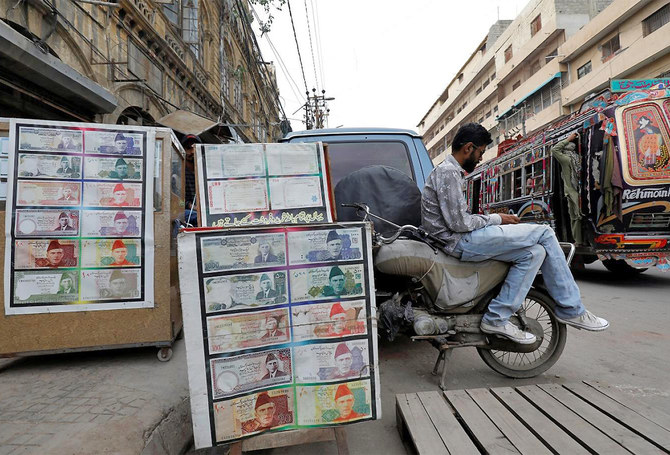
A money changer waits for customers as he sits on a bike beside a money exchange stall decorated with pictures of banknotes in Karachi, Pakistan, on September 30, 2021. (REUTERS/File)
Short Url
Updated 26 January 2022
Follow

Pakistan's ranking worsens on corruption perceptions index

  • Prime Minister Imran Khan’s adviser on political communication rejects the report, says it is written by the government’s political opponents
  • Pakistan‘s top opposition leader criticizes the ruling administration for ‘rampant corruption,’ mocks the prime minister by calling him ‘anti-corruption Mujahid’

KARACHI: An international civil society organization on Tuesday showed a significant rise in public distrust toward Prime Minister Imran Khan’s administration by releasing an annual index that ranks 180 nations on the basis of people‘s opinion regarding their anti-corruption efforts.
According to Transparency International’s Corruption Perception Index 2021, Pakistan dropped 16 spots to 140, compared to 124 a year before that.
CPI ranks countries and territories by perceived levels of public sector corruption according to experts and business people, using a scale of zero to 100, where zero is highly corrupt and 100 is very clean.
“The absence of rule of law and state capture has resulted in substantially low CPI 2021 score of Pakistan compared to CPI 2020,” Justice (r) Nasira Iqbal, vice-chair of Transparency International Pakistan (TIP), said in a statement.
She added there was no change in CPI 2021 scores of India and Bangladesh from CPI 2020.
India and Bangladesh were ranked 85 and 147, respectively, on the index.
While the present Pakistani administration has frequently claimed it is striving to end corruption in the country, Pakistan’s CPI ranking has consistently gone down in the last three years.
In 2019, the country was on 120. The next year it went down to 124 before declining further to 140.
In 2018, during the government of the Pakistan Muslim League-Nawaz (PML-N) party, Pakistan was on 117 out of 180 countries.
Reacting to the development, the Pakistani prime minister’s aide on political communication Dr. Shahbaz Gill shared a video by a local news channel which said that it visited Transparency International’s office in Pakistan but was not allowed to enter.
Gill said the managing director of the organization Adil Gilani was appointed as Pakistan’s ambassador to Serbia by the political rival of the present administration and former prime minister Nawaz Sharif, adding that the report “should be considered as written by the Sharif family.”

However, the country’s top opposition figure Shehbaz Sharif said in a Twitter post that corruption was “rampant in ‘Naya’ [New] Pakistan of ‘anti-corruption Mujahid’” while making a reference to the country under Prime Minister Khan.
“According to Transparency International, PTI [Pakistan Tehreek-e-Insaf] govt has broken all records of corruption in the last 20 years,” he added. “Among Asia-pacific region, Pakistan has unfortunately been ranked as the 5th most corrupt country.”
Referring to the performance of the former PML-N administration, he said corruption had decreased despite massive development projects in the country, adding it was the result of transparency, good governance and legal reforms.
“Now corruption has hit an all-time high despite the fact that no worthwhile development [work] has taken place [in the country],” he continued.

Pakistan Peoples Party vice president Sherry Rehman termed the report a “charge sheet against the government.”
“Transparency International’s Corruption Perceptions Index is a charge sheet against this government,” she said. “In 2020, Pakistan was ranked 124th in the Corruption Perceptions Index worldwide. Within a year, Pakistan has been ranked 140th.”

Referring to the recent resignation of the prime minister’s adviser on accountability, Rehman said it was clear that corruption had increased in Pakistan.
“Accountability is only for targeting [political] opponents,” she added. “International institutions are now uncovering the corruption of this government.”


Pakistan says 41 suspected militants killed in operations in restive Balochistan province

Updated 30 January 2026
Follow

Pakistan says 41 suspected militants killed in operations in restive Balochistan province

  • Military says intelligence-based raids carried out in Harnai and Panjgur districts
  • Islamabad repeats claim militants backed by New Delhi, an allegation India denies

ISLAMABAD: Pakistani security forces killed 41 suspected militants in two separate intelligence-based operations in the southwestern province of Balochistan, the military said on Thursday, alleging the fighters were linked to India. 

The operations were carried out in the districts of Harnai and Panjgur in Balochistan, Pakistan’s largest but least developed province and home to a long running separatist insurgency that frequently targets security personnel, government infrastructure and non-local residents.

“On 29 January 2026, 41 terrorists belonging to Indian proxy, Fitna al Khwarij and Fitna al Hindustan, were killed in two separate operations in Balochistan,” the military’s media wing, Inter-Services Public Relations (ISPR), said in a statement.

According to the ISPR, 30 militants were killed in Harnai district following a “heavy exchange of fire,” during which security forces also destroyed a cache of recovered weapons and explosives.

In a separate intelligence-based operation in Panjgur district, the military said 11 additional suspected militants were killed after security forces raided a hideout.

“Besides weapons and ammunition, looted money from bank robbery in Panjgur on 15 December 2025 were also recovered from the killed terrorists,” the statement said.
“The terrorists were involved in numerous terrorist activities in the past.”

Pakistan’s military and government frequently use the terms “Fitna al Khwarij” and “Fitna al Hindustan” to describe militant groups it associates with the Pakistani Taliban and alleged Indian support.

The ISPR said follow-up “sanitization operations” were underway to eliminate any remaining militants in the area, describing them as “Indian-sponsored terrorists.”

Islamabad has repeatedly accused India of backing separatist groups in Balochistan to destabilize Pakistan, an allegation New Delhi denies.

Earlier this month, Pakistan’s counterterrorism police said they killed five militants planning attacks on security forces and an attempt to block the Quetta–Sibi highway, a key transport route. On Jan. 25, the military also reported killing three militants, including a local commander, in an intelligence-based operation in Panjgur.

Balochistan is strategically important due to its vast mineral resources and its role as a transit corridor for the China-Pakistan Economic Corridor (CPEC), a multibillion-dollar infrastructure initiative linking Pakistan with China.

Separatist groups such as the Balochistan Liberation Army (BLA) accuse Islamabad of exploiting the province’s natural resources without fair local benefit, a claim the government rejects.