

Saudi Arabia, Thailand ‘turn new page in relations’ as prime minister visits

1 / 8
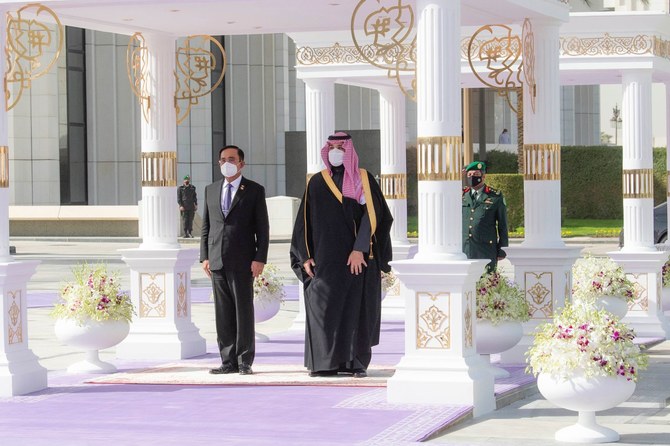
Saudi Crown Prince Mohammed bin Salman receives the prime minister of Thailand. (SPA)
2 / 8
3 / 8
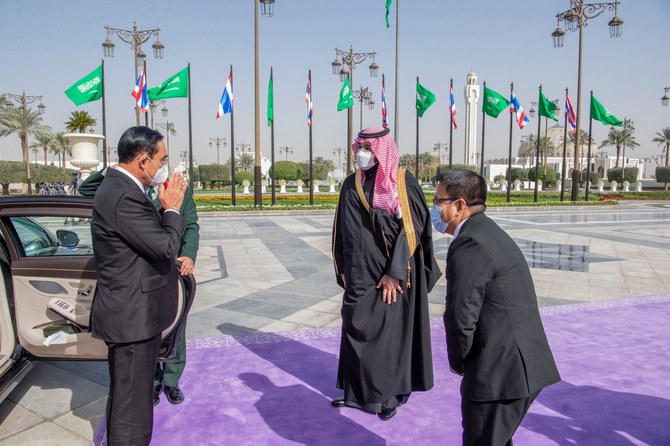
Saudi Crown Prince Mohammed bin Salman receives the prime minister of Thailand. (SPA)
4 / 8
5 / 8
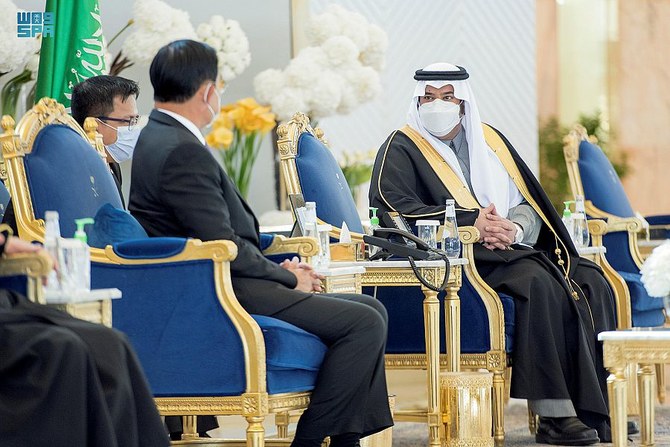
Upon arrival at the King Khalid International Airport, Chan-ocha was received by the deputy emir of Riyadh, Prince Mohamed bin Abdel Rahman. (SPA)
6 / 8
Upon arrival at the King Khalid International Airport, Chan-ocha was received by the deputy emir of Riyadh, Prince Mohamed bin Abdel Rahman. (SPA)
7 / 8
Upon arrival at the King Khalid International Airport, Chan-ocha was received by the deputy emir of Riyadh, Prince Mohamed bin Abdel Rahman. (SPA)
8 / 8
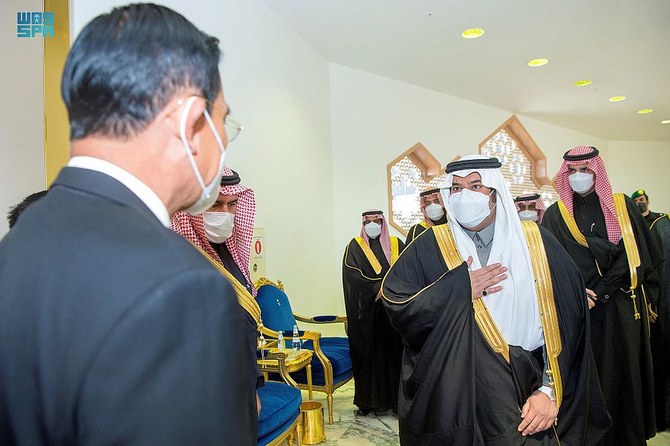
Upon arrival at the King Khalid International Airport, Chan-ocha was received by the deputy emir of Riyadh, Prince Mohamed bin Abdel Rahman. (SPA)
Short Url
Updated 25 January 2022
Follow

Saudi Arabia, Thailand ‘turn new page in relations’ as prime minister visits

  • Agreed to fully restore diplomatic ties and to exchange ambassadors in the near future, joint statement said
  • Saudia to resume direct flights to Thailand

RIYADH: Saudi Arabia and Thailand turned a new page in their relations on Tuesday, with a restoration of full diplomatic ties and a planned exchange of ambassadors.

The moves came as Thai Prime Minister Prayut Chan-o-cha arrived in Riyadh for a two-day official visit.

Prayut held talks with Saudi Crown Prince Mohammed bin Salman and other government ministers, discussed investment opportunities with ACWA power company chairman Mohammad bin Abdullah Abunayyan, and visited the Saudi capital’s Al-Turaif historical district.

In their talks, the crown prince and the prime minister stressed the keenness of the two countries on strengthening the ties of friendship between them and opening a new page in relations.

In a joint statement, the two countries affirmed the spirit of cooperation and shared decisions in order to revive the friendship and good relationship between them and their peoples, and agreed to fully restore diplomatic relations.

Prayut said his country attached the utmost importance to the ties of friendship with Saudi Arabia, and was keen to end all outstanding issues between the two countries. He expressed his sincere regret over the tragic events that occurred in Thailand in 1989 and 1990, and said the Thai government had made great efforts to resolve previous issues.

Thailand also stressed its commitment to the protection of Saudi diplomats in Thailand, in accordance with the Vienna Convention, and said it would raise previous issues with the competent authorities if new evidence surfaced.

The prime minister congratulated Saudi Arabia on its success in organizing and holding G20 summit meetings, and the positive decisions that resulted from them. The crown prince said he was confident that Thailand’s hosting of several economic forums this year would help achieve sustainable and balanced growth.

Later, Saudia airline, the Kingdom’s national carrier, said it would resume direct flights to Thailand in May.


Saudi Post issues commemorative stamp to mark Al-Faw’s UNESCO recognition

Updated 8 sec ago
Follow

Saudi Post issues commemorative stamp to mark Al-Faw’s UNESCO recognition

RIYADH: Saudi Post has issued a SR3 ($0.79) commemorative stamp to celebrate the registration of Al-Faw Archaeological Area on the list of UNESCO World Heritage Sites, making it the eighth Saudi site on this prestigious list.

Located south of Riyadh at the junction of a vast plain and the Tuwaiq mountain range, Al-Faw is strategically positioned along ancient trade routes connecting the southern Arabian Peninsula to its center and east.

The area in Wadi Ad-Dawasir, at the intersection of the Empty Quarter desert and the Tuwaiq mountain range, is home to almost 12,000 archaeological remains and has a history of human habitation stretching back more than 6,000 years.

The site features a landscape shaped over millennia by human interaction with the environment and which was abandoned in the 5th century AD owing to depleted water sources.

The commemorative stamps issued honor significant national and international events, highlighting key chapters of Saudi history making them collectible for philatelists, researchers, and heritage enthusiasts, the Saudi Press Agency reported.

UNESCO, while recognizing the site last year, has said the site was a strategic point on the ancient trade routes of the Arabian Peninsula, but was abruptly abandoned around the fifth century.

Archaeological remains uncovered at the site range from prehistoric times to the late pre-Islamic era, testifying to successive occupations by three different populations.

Features include paleolithic and neolithic tools, tapered structures, cairns and circular constructions, the sacred mountain of Khashm Qaryah, rock carvings, funeral cairns, an ancient water management system, and remains of the city of Qaryat Al-Faw.

Other Saudi sites on the UNESCO Heritage List are Al-Hijr (2008), At-Turaif in Diriyah (2010), Historic Jeddah (2014), rock art in the Hail Region (2015), Al-Ahsa Oasis (2018), Hima Cultural Area (2021), and Uruq Bani Maarid protected area (2023).