

Pakistan's COVID-19 positivity ratio above 10% for sixth consecutive day

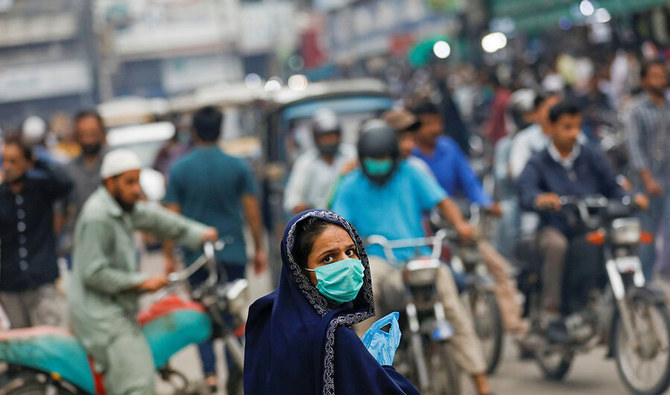
A woman wears a protective face mask as she walks along a road, as the outbreak of the coronavirus disease (COVID-19) continues in Karachi, Pakistan, July 7, 2020. (REUTERS/File)
Short Url
Updated 25 January 2022
Follow

Pakistan's COVID-19 positivity ratio above 10% for sixth consecutive day

  • Omicron-driven fifth wave of infections continues to sweep the South Asian nation
  • The country reported 17 fatalities and 6,357 new infections in the last 24 hours

ISLAMABAD: The coronavirus positivity ratio in Pakistan remained above 10 percent for the sixth consecutive day on Tuesday, with the omicron-driven fifth wave of infections sweeping the South Asian nation. 

The National Command and Operation Centre (NCOC), which oversees the country's pandemic response, recorded the virus positivity rate at 12.81 percent on Tuesday. 

The South Asian nation reported 17 fatalities and 6,357 new cases of coronavirus in the last 24 hours, according to official figures. 

Pakistan is currently battling the fifth wave of the pandemic, as officials maintain the fresh surge in the number of cases has been driven by the highly transmissible omicron strain. 

Pakistan’s planning minister Asad Umar, who also heads the NCOC, last week urged people not to take the omicron strain lightly. 

“More than two thousand people dying of covid daily in the US. So, when you hear omicron is mild, it can still kill you,” he said in a Twitter post. 

The minister said latest research showed booster dose provided significant protection against the disease. “So if it’s been 6 months since 2nd dose, get a booster,” he urged people. 

Pakistan has so far administered at least one dose of a coronavirus vaccine to 103,805,835 people, according to official figures.  

Over 80 million individuals have been fully vaccinated in the country.


IMF board to meet tomorrow to consider $1.2 billion disbursement for Pakistan

Updated 11 sec ago
Follow

IMF board to meet tomorrow to consider $1.2 billion disbursement for Pakistan

  • Pakistan, IMF reached a Staff-Level Agreement for second review of $7 billion loan program 
  • Economists view disbursement crucial for cash-strapped Pakistan as it tackles economic crisis

ISLAMABAD: The International Monetary Fund’s (IMF) Executive Board will meet tomorrow, Monday, to consider and approve a $1.2 billion disbursement for Pakistan, according to the global lender’s official schedule. 

The meeting takes place nearly two months after the Fund reached a Staff-Level Agreement (SLA) with Pakistan for the second review of its $7 billion Extended Fund Facility (EFF) and the first review of its $1.4 billion Resilience and Sustainability Facility (RSF). 

The SLA followed a mission led by IMF’s Iva Petrova, who held discussions with Pakistani authorities during a Sept. 24–Oct. 8 visit to Karachi, Islamabad and Washington, DC.

“The International Monetary Fund’s (IMF) Executive Board will convene on Dec. 8 to consider Pakistan’s request for a $1.2 billion disbursement under the Extended Fund Facility (EFF) and the Resilience and Sustainability Facility (RSF), according to the Fund’s updated schedule,” the state-run Pakistan TV reported on Sunday.

Economists view IMF’s bailout packages as crucial for cash-strapped Pakistan, which has relied heavily on financing from bilateral partners such as Saudi Arabia, China and the United Arab Emirates, as well as multilateral lenders including the IMF, World Bank, Asian Development Bank and Islamic Development Bank. 

The South Asian country has been grappling with a prolonged macroeconomic crisis that has drained its financial resources and triggered a balance of payments crisis. Islamabad, however, has recorded some financial gains since 2022, which include recording a surplus in its current account and bringing inflation down considerably. 

Speaking to Arab News last month, Pakistan’s former finance adviser Khaqan Najeeb said the $1.2 billion disbursement will further stabilize Pakistan’s near-term external position and unlock additional official inflows. 

“Continued engagement also reinforces macro stability, as reflected in recent improvements in inflation, the current account, and reserve buffers,” Najeeb said. 

Pakistan came close to sovereign default in mid-2023, when foreign exchange reserves fell below three weeks of import cover, inflation surged to a record 38 percent in May, and the country struggled to secure external financing after delays in its IMF program. Fuel shortages, import restrictions, and a rapidly depreciating rupee added to the pressure, while ratings agencies downgraded Pakistan’s debt and warned of heightened default risk.

The crisis eased only after Pakistan reached a last-minute Stand-By Arrangement with the IMF in June 2023, unlocking emergency support and preventing an immediate default.