

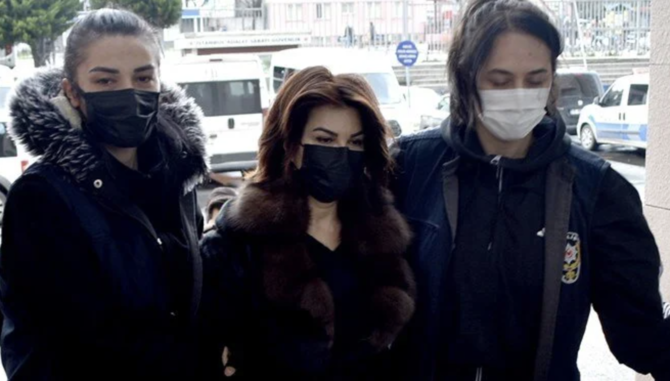
Turkish court orders imprisonment of journalist Sadaf Kabas for ‘insulting’ Erdogan

Kabas, who was taken into custody as part of an investigation launched against her on the charge of insulting the President, was referred to the court for processing. (Anadolu)
Short Url
Updated 23 January 2022
Follow

Turkish court orders imprisonment of journalist Sadaf Kabas for ‘insulting’ Erdogan

  • The law on insulting the president carries a jail sentence of between one and four years

ANKARA: A Turkish court on Saturday ordered well-known journalist Sedef Kabas to be jailed pending trial on a charge of insulting President Tayyip Erdogan, CNN Turk said, targeting her with a law under which tens of thousands have been prosecuted.

Police detained Kabas at around 2 a.m. (2300 GMT) and took her first to Istanbul's main police station before transferring her to the city's main courthouse, where a court subsequently ruled in favour of her formal arrest, the broadcaster said.

The alleged insult was in the form of a palace-related proverb that Kabas expressed both on an opposition television channel and on her Twitter account, drawing condemnation from government officials.

"The honor of the presidency's office is the honor of our country... I condemn the vulgar insults made against our president and his office," Fahrettin Altun, head of Turkey's Communications Directorate, wrote on Twitter.

Merdan Yanardag, chief editor of the Tele 1 channel on which Kabas made the comment, sharply criticised her arrest.

"Her detention overnight at 2 a.m. because of a proverb is unacceptable," he wrote on Twitter. "This stance is an attempt to intimidate journalists, the media and society."

The law on insulting the president carries a jail sentence of between one and four years.

Last October, Europe's top human rights court called on Turkey to change the legislation after ruling that a man's detention under the law violated his freedom of expression.

Thousands have been charged and sentenced over the crime of insulting Erdogan in the seven years since he moved from being prime minister to president.

In 2020, 31,297 investigation were launched in relation to the charge, 7,790 cases were filed and 3,325 resulted in convictions, according to Justice Ministry data. Those numbers were slightly lower than the previous year.

Since 2014, the year Erdogan became president, 160,169 investigations were launched over insulting the president, 35,507 cases were filed and there were 12,881 convictions.


Trending: BBC report suggests sexual abuse and torture in UAE-run Yemeni prisons

Updated 02 February 2026
Follow

Trending: BBC report suggests sexual abuse and torture in UAE-run Yemeni prisons

  • The investigation was produced by British-Yemeni BBC journalist Nawal Al-Maghafi

LONDON: A recent BBC video report diving into what it says was UAE-run prison in Yemen has drawn widespread attention online and raised fresh questions about the role of the emirates in the war-torn country.

The report, published earlier this month and recently subtitled in Arabic and shared on social media, alleged that the prison — located inside a former UAE military base — was used to detain and torture detainees during interrogations, including using sexual abuse as a method.

The investigation was produced by British-Yemeni BBC journalist Nawal Al-Maghafi, who toured the site, looking into cells and what appear to be interrogation rooms.

Al-Maghafi said the Yemeni government invited the BBC team to document the facilities for the first time.

A former detainee, speaking anonymously, described severe abuse by UAE soldiers: “When we were interrogated, it was the worst. They even sexually abused us and say they will bring in the doctor. The ‘so-called’ doctor was an Emirati soldier. He beat us and ordered the soldiers to beat us too. I tried to kill myself multiple times to make it end.”

Yemeni information minister, Moammar al Eryani also appears in the report, clarifying that his government was unable to verify what occurred within sites that were under Emirati control.

“We weren’t able to access locations that were under UAE control until now,” he said, adding that “When we liberated it (Southern Yemen), we discovered these prisons, even though we were told by many victims that these prisons exist, but we didn't believe it was true.”

The BBC says it approached the UAE government for comment, however Abu Dhabi did not respond to its inquiries.

Allegations of secret detention sites in southern Yemen are not new. The BBC report echoes earlier reporting by the Associated Press (AP), which cited hundreds of men detained during counterterrorism operations that disappeared into a network of secret prisons where abuse was routine and torture severe.

In a 2017 investigation, the AP documented at least 18 alleged clandestine detention sites — inside military bases, ports, an airport, private villas and even a nightclub — either run by the UAE or Yemeni forces trained and backed by Abu Dhabi.

The report cited accounts from former detainees, relatives, civil rights lawyers and Yemeni military officials.

Following the investigation, Yemen’s then-interior minister called on the UAE to shut down the facilities or hand them over, and said that detainees were freed in the weeks following the allegations.

The renewed attention comes amid online speculation about strains between Saudi Arabia and the UAE over Yemen.