1 NYPD officer killed, 1 severely injured in Harlem shooting

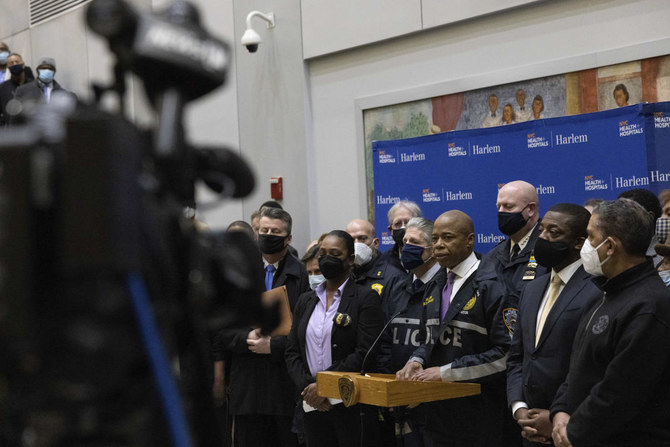
New York City Mayor Eric Adams, center, denounced the spate of violence against the New York Police Department. (AP)
Short Url
Updated 22 January 2022
Follow

1 NYPD officer killed, 1 severely injured in Harlem shooting

  • Call for federal authorities to do more to round up stolen guns like the one used in Friday’s shooting

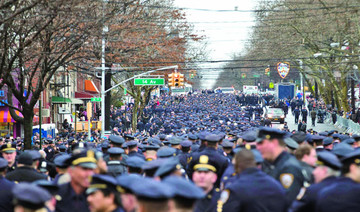
NEW YORK: A New York City police officer was killed and another critically wounded Friday night while answering a call about an argument between a woman and her adult son, officials said, making four officers shot in the city in as many days.
Just three weeks into their jobs, Mayor Eric Adams — a former police captain himself — and Police Commissioner Keechant Sewell stood before the media at a Harlem hospital, denouncing the spate of violence against the New York Police Department.
“Countless officers lined this hallway after carrying him in and grieve for their brother while praying with everything they have for the other” officer, Sewell said. “I am struggling to find the words to express the tragedy we are enduring. We’re mourning, and we’re angry.”
Adams said, “This was just not an attack on these brave officers. This was an attack on the city of New York.”
Adams called for federal authorities to do more to round up stolen guns like the one used in Friday’s shooting inside a Harlem apartment.
“There are no gun manufacturers in New York City,” he said. “We don’t make guns here. How are we removing thousands of guns off the street and they still find their way into New York City, in the hands of people who are killers?”
Authorities said the officers, along with a third officer, went to the apartment on 135th Street after a call came in from a woman needing help with her son, identified by police as Lashawn J. McNeil, 47.
Authorities said the officers spoke with the woman and another son, but there was no mention of a weapon. Then two of them walked from the front of the apartment down a narrow, 30-foot (9-meter) hallway.
NYPD Chief of Detectives James Essig said McNeil swung open a bedroom door and opened fire at the officers, striking them.
The officer who was killed was identified as 22-year-old Jason Rivera, who joined the force in November 2020, and the wounded officer as Wilbert Mora, 27, who’s been with the NYPD for four years.
As McNeil tried to flee, a third officer who’d stayed with McNeil’s mother in the front of the apartment shot at McNeil and wounded him in the head and arm, Essig said.
McNeil is alive and hospitalized in critical condition, NYPD spokesperson Lt. John Grimpel said, correcting earlier reports that he had been killed. Sewell and Adams did not take questions at the hospital press conference.
McNeil’s last known address is in Allentown, Pennsylvania, about 90 miles (145 kilometers) west of New York City.
McNeil was on probation for a 2003 drug conviction in New York City. He also had several out of state arrests. In 1998, he was arrested in South Carolina for unlawfully carrying a pistol, but records show the matter was later dismissed. In 2002, he was arrested in Pennsylvania for assaulting a police officer, Essig said.
Police said the gun used in Friday night’s shooting, a .45-caliber Glock with a high-capacity magazine capable of holding up to 40 extra rounds, had been stolen in Baltimore in 2017.
Friday night’s shooting happened in a street-level apartment in a six-story apartment building on a block between two iconic Harlem avenues: Malcolm X Boulevard and Adam Clayton Powell Jr. Boulevard.
It came three nights after an officer was wounded in the leg in the Bronx during a struggle with a teenager who also shot himself. On Thursday, a narcotics detective was shot in the leg on Staten Island.
Under Adams, the NYPD has reinstated a plainclothes anti-crime unit aimed at getting guns off the streets. The unit had been disbanded in 2020 over concerns it accounted for a disproportionate number of shootings and complaints.
The NYPD has also partnered with prosecutors, city and federal agencies in recent months on a task force that meets daily and works to track gun violence, accelerate gun tracing and build cases against shooters and gun traffickers.


Justice Department faces hurdle in seeking case against Comey as judge finds constitutional problems

Updated 4 sec ago
Follow

Justice Department faces hurdle in seeking case against Comey as judge finds constitutional problems

WASHINGTON: The Justice Department violated the constitutional rights of a close friend of James Comey and must return to him computer files that prosecutors had hoped to use for a potential criminal case against the former FBI director, a federal judge said Friday.
The ruling from US District Judge Colleen Kollar-Kotelly represents not only a stern rebuke of the conduct of Justice Department prosecutors but also imposes a dramatic hurdle to government efforts to seek a new indictment against Comey after an initial one was dismissed last month.
The order concerns computer files and communications that investigators obtained years earlier from Daniel Richman, a Comey friend and Columbia University law professor, as part of a media leak investigation that concluded without charges. The Justice Department continued to hold onto those files and conducted searches of them this fall, without a new warrant, as they prepared a case charging Comey with lying to Congress five years ago.
Richman alleged that the Justice Department violated his Fourth Amendment rights by retaining his records and by conducting new warrantless searches of the files, prompting Kollar-Kotelly to issue an order last week temporarily barring prosecutors from accessing the files as part of its investigation.
The Justice Department said the request for the return of the records was merely an attempt to impede a new prosecution of Comey, but the judge again sided with Richman in a 46-page order Friday that directed the Justice Department to give him back his files.
“When the Government violates the Fourth Amendment’s prohibition on unreasonable searches and seizures by sweeping up a broad swath of a person’s electronic files, retaining those files long after the relevant investigation has ended, and later sifting through those files without a warrant to obtain evidence against someone else, what remedy is available to the victim of the Government’s unlawful intrusion?” the judge wrote.
One answer, she said, is to require the government to return the property to the rightful owner.
The judge did, however, permit the Justice Department to file an electronic copy of Richman’s records under seal with the Eastern District of Virginia, where the Comey investigation has been based, and suggested prosecutors could try to access it later with a lawful search warrant.
The Justice Department alleges that Comey used Richman to share information with the news media about his decision-making during the FBI’s investigation into Hillary Clinton’s use of a private email server. Prosecutors charged the former FBI director in September with lying to Congress by denying that he had authorized an associate to serve as an anonymous source for the media.
That indictment was dismissed last month after a federal judge in Virginia ruled that the prosecutor who brought the case, Lindsey Halligan, was unlawfully appointed by the Trump administration. But the ruling left open the possibility that the government could try again to seek charges against Comey, a longtime foe of President Donald Trump. Comey has pleaded not guilty, denied having made a false statement and accused the Justice Department of a vindictive prosecution.
The Comey saga has a long history.
In June 2017, one month after Comey was fired as FBI director, he testified that he had given Richman a copy of a memo he had written documenting a conversation he had with Trump and had authorized him to share the contents of the memo with a reporter.
After that testimony, Richman permitted the FBI to create an image, or complete electronic copy, of all files on his computer and a hard drive attached to that computer. He authorized the FBI to conduct a search for limited purposes, the judge noted.
Then, in 2019 and 2020, the FBI and Justice Department obtained search warrants to obtain Richman’s email accounts and computer files as part of a media leak investigation that concluded in 2021 without charges. Those warrants were limited in scope, but Richman has alleged that the government collected more information than the warrants allowed, including personal medial information and sensitive correspondence.
In addition, Richman said the Justice Department violated his rights by searching his files in September, without a new warrant, as part of an entirely separate investigation.
“The Court further concludes that the Government’s retention of Petitioner Richman’s files amounts to an ongoing unreasonable seizure,” Kollar-Kotelly wrote. “Therefore, the Court agrees with Petitioner Richman that the Government has violated his Fourth Amendment right against unreasonable searches and seizures.”