

Sudanese judges, US denounce deadly crackdowns on protests

Young women and men take to the streets of Khartoum to protest against the killings of dozens in a crackdown since last year’s military coup. (AFP)
Short Url
Updated 22 January 2022
Follow

Sudanese judges, US denounce deadly crackdowns on protests

  • Military leader Gen. Al-Burhan announces appointment of 15 Cabinet ministers amid call for dialogue

KHARTOUM: Sudanese head of judiciary and judges condemned violence against anti-military protesters in a rare public statement, while the US said it would consider unspecified steps against those holding up efforts to resolve Sudan’s political crisis.

At least 72 civilians have died and more than 2,000 have been injured as security forces have cracked down on frequent demonstrations since a military takeover on Oct. 25, according to medics aligned with the protest movement.
Angered by the killing of seven civilians earlier this week, protesters took to the streets once more on Thursday in eastern Khartoum and other locations across Sudan.
Military leaders have said that the right to peaceful protest is protected and have commissioned investigations into the bloodshed.
The violence has deepened the deadlock between pro-democracy groups and the military leadership.
In a statement, Sudan’s ruling council affirmed the need for national dialogue, a technocratic Cabinet, and adjustments to a transitional constitutional document negotiated after the ousting of former leader Omar Bashir in a 2019 uprising.
The document formed the basis for a power-sharing arrangement between the military and civilians that was halted by the coup.

BACKGROUND

Military leaders have said that the right to peaceful protest is protected and have commissioned investigations into the bloodshed.

After a failed bid by former Prime Minister Abdalla Hamdok to salvage some civilian control following the coup, the UN has been trying to facilitate dialogue between opposing factions.
Late on Thursday, military leader Gen. Abdel Fattah Al-Burhan announced the appointment of 15 Cabinet ministers, most of whom had been promoted to acting roles by Hamdok.
No prime minister or defense or interior ministers were named.
The coup drew condemnation from Western powers that largely froze badly needed economic assistance to Sudan.
That assistance would only be restarted if violence ended and a civilian-led government was restored, visiting US Assistant Secretary for African Affairs Molly Phee and newly appointed special envoy David Satterfield said.
Condemning the use of force on protesters, they “made clear the United States will consider measures to hold accountable those responsible for failure to move forward” with a political transition and an end to violence, a US statement said.
A statement from 55 Sudanese judges to the judiciary chief said military leaders had “violated agreements and covenants since the Oct. 25 coup, as they have carried out the most heinous violations against defenseless protesters.”
They called for an end to the violence and a criminal investigation.
In response, the head of the judiciary said in a statement that the ruling sovereign council must do the utmost to prevent violations.
“We in the judiciary affirm that we will not hesitate to take the measures we have at hand to protect the lives and constitutional rights of citizens,” the statement said.
Separately, more than 100 prosecutors announced they would stop work from Thursday to call for security forces to cease violations and lift a state of emergency. They said prosecutors had been unable to carry out their legal duty to accompany police to protests and determine the acceptable use of force.
It is unusual for Sudan’s judges and prosecutors to make public statements about the conduct of the security forces.
Asked for comment, acting Information Ministry Minister Nasreldin Ahmed noted that Gen. Al-Burhan had ordered an investigation into protester deaths on Monday and a probe was underway.
Protesters in the capital could be seen pulling up paving and barricading a main road and several side streets.
One, a student named Taysir, said they were doing so to protect themselves from security forces.
She dismissed Gen. Al-Burhan’s moves to appoint a caretaker Cabinet.
“He doesn’t want to give up, but we don’t want to give up either,” said another protester, who gave her name as Muzan.

Sudan ‘lost all sources of revenue’ in the war: finance minister to AFP

Updated 3 sec ago
Follow

Sudan ‘lost all sources of revenue’ in the war: finance minister to AFP

  • Ibrahim said the government is eyeing deals for Red Sea ports and private investment
  • Gold production is rising year-on-year, but “unfortunately, much of it has been smuggled... across borders”

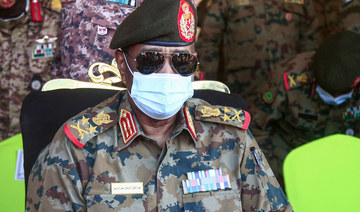
PORT SUDAN: Widespread destruction, massive military spending and plummeting oil and gold revenues have left Sudan’s economy in “very difficult times,” army-aligned finance minister Gibril Ibrahim said, nearly three years into the army’s war with rival paramilitary forces.
In an interview with AFP from his office in Port Sudan, Ibrahim said the government is eyeing deals for Red Sea ports and private investment to help rebuild infrastructure.
This week, Sudan’s prime minister announced the government’s official return to Khartoum, recaptured last year, but Ibrahim’s ministry is among those yet to fully return.
Dressed in combat uniform, the former rebel leader said Sudan, already one of the world’s poorest countries before the war, “lost all sources of state revenue in the beginning of the war,” when the Rapid Support Forces overtook the capital Khartoum and its surroundings.
“Most of the industry, most of the big companies and all of the economic activity was concentrated in the center,” he said, saying the heartland had accounted for some 80 percent of state revenue.
Ibrahim’s ex-rebel group the Justice and Equality Movement once battled Khartoum’s government but it has fought on the army’s side as part of the Joint Forces coalition of armed groups.

- Smuggling -

Sudan, rich in oil, gold deposits and arable land, is currently suffering the world’s largest humanitarian crisis, with over half of its population in need of aid to survive.
Gold production is rising year-on-year, but “unfortunately, much of it has been smuggled... across borders,” he said.
Of the 70 tons produced in 2025, only “20 tons have been exported through official channels.”
In 2024, Sudan produced 64 tons of gold, bringing in only $1.57 billion to the state’s depleted coffers, with much of the revenue spilling out via smuggling networks.
Agricultural exports have fallen 43 percent, with much of the country’s productive gum Arabic, sesame and peanut-growing regions in paramilitary hands, in the western Darfur and southern Kordofan regions.
Sudan’s livestock industry, also based predominantly in Darfur, has lost 55 percent of its exports, he said.
Since the RSF captured the army’s last holdout position in Darfur in October, the war’s worst fighting has shifted east to the oil-rich Kordofan region.
While both sides scramble for control of the territory, the country’s oil revenues have dropped by more than 50 percent — its most productive refinery, Al-Jaili near Khartoum, severely damaged.

- ‘Reconstruction’ -

Determined to defeat the RSF, authorities allocated 40 percent of last year’s budget to the war effort, up from 36 percent in 2024, according to Ibrahim, who did not specify amounts.
Yet the cost of reconstruction in areas regained by the army is immense: in December 2024, the government estimated it would need $200 billion to rebuild.
Authorities are currently eyeing public-private partnership, with firms that “are ready to spend money” including on infrastructure, Ibrahim said.
Sudan’s long Red Sea coast has over the years drawn the interest of foreign actors eager for a base on the vital waterway, through which around 12 percent of global trade passes.
“We will see which partner is the best to build a port,” the minister said, listing both Saudi Arabia and Qatar as “the main applicants.”
The Russians, for their part, had also wanted “a small port where they can have supplies,” he said, adding that “they didn’t go ahead with that yet.”
As the war rages on, Sudan shoulders a massive public debt bill, which in 2023 reached 253 percent of GDP, before falling slightly to 221 percent in 2025, according to figures reported by the International Monetary Fund.
Sudan has known only triple-digit annual inflation for years. Figures for 2025 stood at 151 percent — down from a 2021 peak of 358.
The currency has also collapsed, going from trading before the war at 570 Sudanese pounds against the dollar, to 3500 in 2026, according to the black-market rate.
Ibrahim, 71, first joined the government in 2021 as part of a short-lived transitional administration. He retained his position through a military coup later that year.
He is among several Sudanese officials sanctioned by Washington in its attempt to “limit Islamist influence within Sudan and curtail Iran’s regional activities.”