

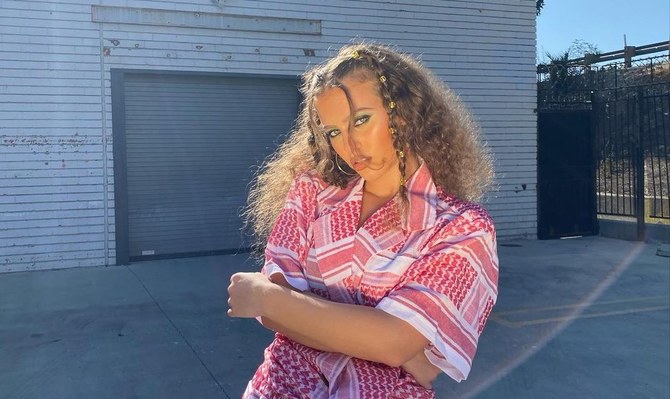
Palestinian-Chilean singer Elyanna joins Spotify program with new collaboration

The new collaboration sees the 19-year-old upcoming star team up with veteran Tunisian rapper and composer Balti on a single titled “Ghareeb Alay.” (Instagram)
Short Url
Updated 20 January 2022
Follow

Palestinian-Chilean singer Elyanna joins Spotify program with new collaboration

DUBAI: Palestinian-Chilean singer and songwriter Elyanna has joined Spotify’s fourth Radar installment in the Middle East, the music streaming platform announced on Thursday.

Radar is an emerging-artist program spotlighting rising talent from around the globe. Some of the program’s most popular collaborations include “Is It On” by K-pop sensation AleXa and Kuwaiti-Saudi-based artist Bader Al-Shuaibi, and “Hadal Ahbek” by viral A-pop star Issam Alnajjar, featuring Canadian DJ duo Loud Luxury and Iraqi-Canadian singer and songwriter Ali Gatie.

The new collaboration sees the 19-year-old upcoming star team up with veteran Tunisian rapper and composer Balti on a single titled “Ghareeb Alay” (“A Stranger to Me”). The track, which fuses urban pop with reggae, will drop on Jan. 21.

In a statement, Elyanna said: “While ‘Ghareeb Alay’ characterizes the story of a love song, it’s much deeper than that. It reflects change, both around us and within.

“For me, it is about being an immigrant, an artist, and a young female at the beginning of my journey. Everything and everyone feels new and strange.”

On Tuesday, the singer teased 16-seconds of the song on her Instagram and wrote to her 440,000 followers, “who’s readyyyyyy?”

On his excitement about the collaboration, Tunisia’s rap pioneer said: “‘Ghareeb Alay’ is one of my all-time favorites. Together with Elyanna, we’ve managed to bring forward a new style of Arabic urban pop backed by Spotify’s vision for local talents.”


Mini op-ed: Recognising a shift in how people relate to wellness, self-care

Updated 05 March 2026
Follow

Mini op-ed: Recognising a shift in how people relate to wellness, self-care

DUBAI: I have spent nearly a decade working in the beauty industry in Saudi Arabia and the UAE, and Ramadan always has a way of prompting change; in habits, in priorities, and in the routines people have been carrying without question. Speaking from my own corner of the industry, one of these habits is often hair removal.

Saudi Arabia’s beauty and personal care market was valued at about $7.56 billion in 2025 and is set to grow to an estimated $8.03 billion in 2026. Within that growth, personal care encompassing the daily (sometimes unglamorous) routines hold the largest share. But market size alone does not tell the full story. A study conducted at King Abdulaziz University Hospital, Jeddah, found that three quarters of Saudi women experienced complications from temporary hair removal methods, including skin irritation, in-grown hairs and hyperpigmentation. A separate 2025 study published in the Majmaah Journal of Health Sciences found that laser hair removal was both the most considered and most commonly undergone cosmetic procedure among Saudi respondents, yet dissatisfaction with cosmetic procedure outcomes was reported by nearly half of all participants. The numbers point to a gap not in demand, but in results. 

When I launched a specialized electrolysis practice in the UAE in 2016, it was with a clear gap in mind; safe, regulated, permanent hair removal for the region’s specific needs. The range of hair types here and the prevalence of conditions such as polycystic ovary syndrome, or PCOS, demanded a method that works across all of them.  Electrolysis is the only method recognized by the US Food and Drug Administration and American Marketing Association as achieving true permanent results, regardless of hair color or type. 

Despite this, awareness in Saudi Arabia remains limited. Part of this is familiarity, laser has dominated the conversation for years, and electrolysis, which requires more sessions and a licensed electrologist’s precision, has struggled to break through. Part of it is education. Many clients who come to us have never heard of electrolysis; they come because they have exhausted everything else. 

Right now, Saudi Arabia is in the middle of a genuine transformation in how people relate to wellness and self-care. The beauty market is maturing, consumers are asking harder questions of the brands they choose and Vision 2030 has not just shaped the economy, it has shaped how Saudis are showing up in their own lives. In that context, the idea of choosing permanence over repetition lands differently.
 
Mariela Marcantetti is a beauty industry entrepreneur based between Saudi Arabia and the UAE.