

Indonesian militant linked to Bali bombings jailed for 15 years

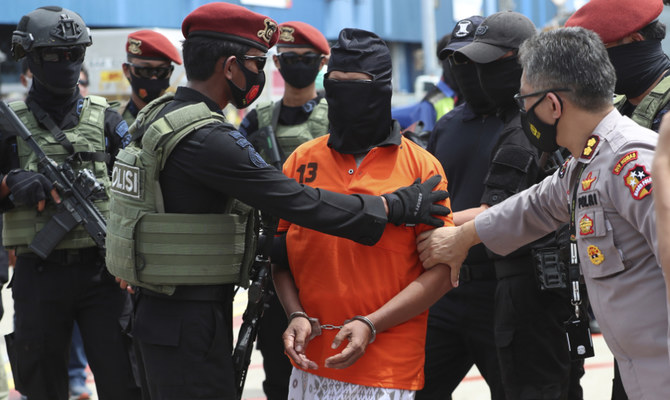
Police escort suspected militant Zulkarnaen, center, who is also known as Aris Sumarsono, upon arrival at Soekarno-Hatta International Airport in Tangerang, Indonesia. (AP/File)
Short Url
Updated 19 January 2022
Follow

Indonesian militant linked to Bali bombings jailed for 15 years

  • Zulkarnaen sentenced on terrorism charges after being labeled a ‘key asset’ for radical group
  • Extremist leader with ties to Al-Qaeda arrested in December 2020 after evading capture for 18 years

JAKARTA: A former commander of a militant group linked to the 2002 Bali bombings was sentenced to 15 years in prison on terrorism charges by an Indonesian court on Wednesday.

Arif Sunarso, known as Zulkarnaen, was a commander of Jemaah Islamiyah, or JI, a Southeast Asian group with ties to Al-Qaeda.

The group was blamed for bomb attacks on two nightclubs that killed 202 people on the Indonesian holiday island of Bali in 2002.

Zulkarnaen was arrested in December 2020 after evading capture for 18 years.

In its verdict on Wednesday, the East Jakarta District Court said the 58-year-old was “proven guilty of committing terrorism and is sentenced to 15 years behind bars.”

Zulkarnaen was convicted of withholding information and sheltering another militant. The sentencing did not relate directly to the 2002 attacks.

Indonesian prosecutors had demanded a life sentence for Zulkarnaen, describing him as a “key asset” for JI due to his experience in training militants in Afghanistan and the Philippines.

Zulkarnaen became the group’s operations chief following the arrest of his predecessor, Encep Nurjaman, known as Hambali, in Thailand in 2003.

During his trial, which began last September, Zulkarnaen said that he had led JI’s military wing but was not involved in the Bali bombings.

Asludin Hatjani, Zulkarnaen’s defense lawyer, told Arab News that he believed the sentence was disproportionately severe.

“Based on the evidence presented in the trial, the 15-year sentence is too long,” Hatjani said. “In the verdict, (Zulkarnaen) was not convicted because of the Bali bombing case, but rather his involvement as a member of JI, because JI is an illegal organization.”

However, Thiolina Marpaung, a survivor of the 2002 attack, said the verdict came as a disappointment.

“He should have been given life in prison,” Marpaung said. “He spent 18 years as a fugitive and didn’t surrender of his own accord. That means he still had bad intentions.”

Nasir Abbas, a former senior member of JI who is working with the Indonesian government on deradicalization programs, said it was important that Zulkarnaen be deradicalized as he was still a respected figure among JI militants. “It’s important to deradicalize him before he is allowed to mingle with other terrorism convicts or general prisoners,” Abbas told Arab News.
Noor Huda Ismail, a former member of the militant group Darul Islam and now an expert on militancy and deradicalization, said Zulkarnaen’s case demonstrates JI’s vast network and its determination to protect key members. 

"JI threat will not go away with this verdict," he added.


Militants kill 6 officers and a civilian in ambushes on police vehicles in northwest Pakistan

Updated 2 sec ago
Follow

Militants kill 6 officers and a civilian in ambushes on police vehicles in northwest Pakistan

  • Assailants ambushed a police vehicle and killed one officer in Kohat — When police reinforcements arrived minutes later, they launched another attack and killed five more officers and a civilian
  • No group claimed responsibility for this week’s attacks, but suspicion may fall on the Pakistani Taliban, also known as Tehrik-e-Taliban Pakistan, or the TTP
PESHAWAR, Pakistan: A pair of attacks on police vehicles by suspected militants killed at least six police officers and a civilian in northwest Pakistan on Tuesday, authorities said.
The assailants ambushed a police vehicle and killed one officer in Kohat, a district in Khyber Pakhtunkhwa province. When police reinforcements arrived minutes later, they launched another attack and killed five more officers and a civilian, police official Kamran Khan said.
Separately on Tuesday, a suicide bomber detonated explosives at a police post in Bukkur, a district in eastern Punjab province, killing two officers and wounding four others, police official Shahzad Rafiq said.
He provided no further details and only said officers were still investigating.
No group immediately claimed responsibility for the attacks, which have increased across the country in recent months.
President Asif Ali Zardari condemned the attacks in Kohat and Bukkur and offered condolences to the victims’ families.
The latest violence followed an attack on a paramilitary post in Karak on Monday, when a drone loaded with explosives wounded several officers. The attackers later ambushed two ambulances transporting the wounded, killing three officers and burning their bodies before fleeing. The driver of the second ambulance transported several wounded officers despite suffering burn injuries and authorities recovered the remains of the three officers.
No group claimed responsibility for this week’s attacks, but suspicion may fall on the Pakistani Taliban, also known as Tehrik-e-Taliban Pakistan, or the TTP. The TTP is separate from, but closely allied with, Afghanistan’s Taliban. Islamabad has accused the group of operating from inside Afghanistan, a claim the TTP and Kabul deny.
Pakistan’s military said it killed at least 70 militants on Sunday in strikes along the Afghan border, targeting hideouts of Pakistani militants blamed for recent attacks inside the country.