

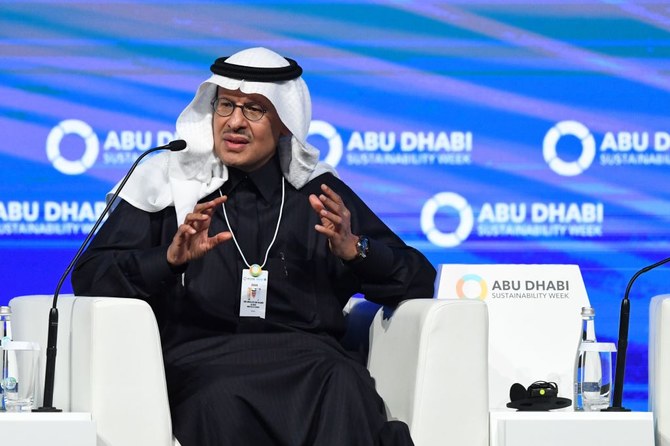

RIYADH: Saudi Arabia will dominate the green hydrogen market even if some may not like this idea, the Kingdom's energy minister Prince Abdulaziz bin Salman has said.
Speaking in a session during the Davos agenda organized by the World Economic Forum, the minister said the world has a generous amount of energy to exploit, whether from fossil fuels or from renewable sources.
He stated that the Kingdom needs to let all countries decide their own choices regarding resources of energy, based on their national resources and abilities.
Prince Abdulaziz said that some people do not like the idea of the Kingdom dominating in the green hydrogen market, but that will happen eventually and he hopes the world will accept it, because Saudi Arabia will keep exports of green and blue hydrogen at a cheap level.
The circular carbon economy is the main pillar of the Kingdom’s green initiative, and ministers are trying to apply its 4 R’s — reduce, reuse, recycle and rethink, Prince Abdulaziz said,
The minister stated that the Kingdom’s Nationally Determined Contribution that was announced as part of the Saudi Green initiative will reduce emissions by 278 million tons.
Carbon will be a material to be reused, not a material to be disposed of, stressing the importance of recycling, he added.
Prince Abdulaziz said that there is a need to make sure we create the right environment for green and blue hydrogen.
Saudi Arabia is cooperating with the world to move its markets to a larger international scale, find a market for green hydrogen, and there is a new term called ‘pink hydrogen’ [produced using nuclear power] that may be produced in the Kingdom, he added.
The ministry is recruiting young Saudi ladies that are happy to see pink coming along, he said satirically.
Prince Abdulaziz also noted that the Kingdom will have a field day with blue hydrogen, because “again we are the cheapest cost producer of gas, we are doing huge investment on shale gas in Saudi Arabia,” he explained.
An amount of that gas will be dedicated to the use of blue hydrogen production, he also added.


