

Pakistani capital on high alert after deadly militant attack

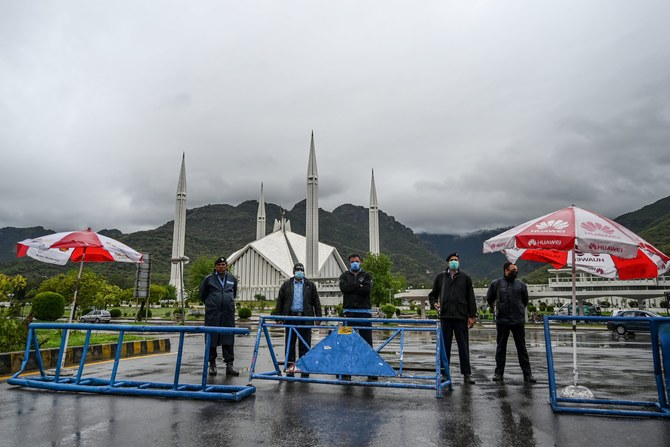
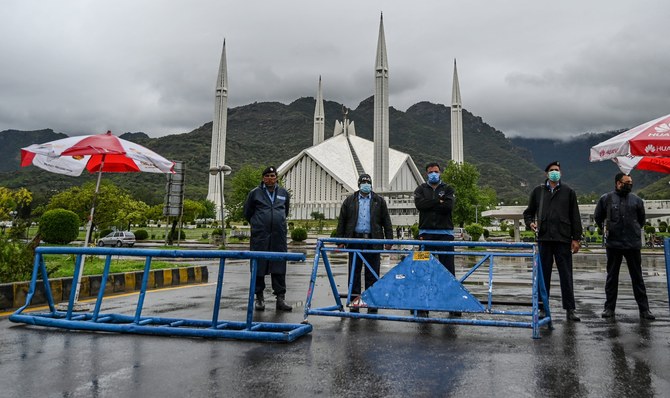
Policemen wearing facemasks stand guard at a checkpoint beside the Grand Faisal Mosque during a government-imposed nationwide lockdown as a preventive measure against the COVID-19 coronavirus, in Islamabad on March 27, 2020. (AFP/ File)
Short Url
Updated 20 January 2022
Follow

Pakistani capital on high alert after deadly militant attack

  • On late Monday, two militants on a motorbike opened fire killing a police officer and injuring two others in the center of Islamabad 
  • Militants often target security forces in Pakistan, but the country’s capital has largely been peaceful in recent years

ISLAMABAD: The Pakistani government has put the federal capital Islamabad on high alert after a recent militant attack in which an officer was killed and two others injured, police said on Wednesday.

Militants often target security forces in Pakistan, but the country’s capital has largely been peaceful in recent years.

On late Monday, two militants on a motorbike opened fire on police officials who were patrolling the city. Pakistan’s interior minister, Sheikh Rashid Ahmed, who on Tuesday attended the funeral of the officer killed in the attack said both militants were killed during the shootout.

The minister did not share more details about the incident, but the proscribed Tehreek-e-Taliban Pakistan, or TTP, issued a statement claiming responsibility for the assault.

Inspector Naeem Iqbal, a spokesperson for the Islamabad Police, told Arab News on Wednesday that the Pakistani capital ” has been put on high alert after the terrorist attack.”

“A comprehensive strategy has been devised to avoid recurrence of the attacks on police officials,” he said, adding that 55 police have been killed in the city in different militant attacks in the past seven years.

“The overall law and order in the federal capital is under control,” Iqbal said. “We are implementing snap-checking and carrying out combing operations in different areas of the city to apprehend the criminals.”

The TTP, which is a separate movement from the Afghan Taliban, has fought for years to overthrow the government in Islamabad and rule with its own brand of Islamic law. In December, the group declared an end to a month-long cease-fire, accusing the Pakistan government of breaching terms including a prisoner release agreement and the formation of negotiating committees.

Earlier this month, the head of the Pakistan army’s media wing said armed operations against the group had been relaunched since the end of the cease-fire.

Khawaja Khalid Farooq, a former chief of National Counter-Terrorism Authority told Arab News the militant group is now trying to show its strength after talks with the government had failed.

“They have adopted a hit and run approach to target Islamabad police to create a scare in the federal capital,” he said, adding that different militant groups have joined their hands lately to target security forces across the country.

He expressed doubt over the possibility of any major attacks, but said militants were still a challenge for the country’s security apparatus.

“Militant groups in Pakistan have weakened over the years in the wake of military operations, but we should acknowledge that their sleeper cells still exist to carry out sporadic terror activities,” Farooq said.

“Regular operations against the militants based on intelligence information can help deal with the challenge.”

Security analyst Gen. (Retd.) Ejaz Awan said the Islamabad attack was an isolated incident.

“This is neither a trend, nor a fresh wave of militancy in Pakistan,” he told Arab News. “People should not panic. Our vigilant and brave security forces have already broken the backbone of the militants.”

Best known in the West for attempting to kill Malala Yousafzai, the schoolgirl who went on to win the Nobel Prize for her work promoting girls’ education, the TTP has killed thousands of military personnel and civilians over the years in bombings and suicide attacks.

Among its attacks was a 2014 assault on a military-run school in Peshawar, Khyber Pakhtunkhwa, which killed 149 people, including 132 children.


Pakistan Air Force conducts successful test of air-launched cruise missile

Updated 6 sec ago
Follow

Pakistan Air Force conducts successful test of air-launched cruise missile

  • The indigenously developed ‘Taimoor’ missile has a range of 600 kilometers and carries a conventional warhead
  • The missile is designed to fly at low altitudes, which enables it to evade hostile air, missile defense systems

ISLAMABAD: The Pakistan Air Force (PAF) has successfully conducted a test of an air-launched cruise missile, ‘Taimoor,’ the Pakistani military said on Saturday, marking another significant milestone in advancement of national aerospace and defense capabilities.

The indigenously developed Taimoor weapon system is capable of engaging enemy land and sea targets with high precision. The missile has a range of 600 kilometers and carries a conventional warhead.

The missile test comes months after a brief but intense military conflict between Pakistan and India in which the nuclear-armed neighbors exchanged missile and artillery fire and deployed drones and fighter jets.

Equipped with state-of-the-art navigation and guidance system, Taimoor is designed to fly at very low altitudes, enabling it to effectively evade hostile air and missile defense systems.

“Its precision-strike capability significantly enhances the conventional deterrence and operational flexibility of Pakistan Air Force, further strengthening the country’s overall defense posture,” said the Inter-Services Public Relations (ISPR), the military’s media wing.

“The successful flight test underscores the technical maturity, innovation and self-reliance achieved by Pakistan’s defense industry.”

The missile’s launch was witnessed by senior officers of the armed forces along with distinguished scientists and engineers, who played a pivotal role in the development of this advanced weapon system.

PAF’s Air Chief Marshal Zaheer Ahmed Baber Sidhu congratulated the scientists, engineers and the entire PAF team on this remarkable achievement, lauding their professional excellence, dedication and unwavering commitment to strengthening Pakistan’s defense capabilities.

“The air chief reaffirmed that such accomplishments are a testament to the nation’s resolve to achieve technological self-sufficiency and maintain a credible conventional deterrent in the evolving regional security environment,” the ISPR said.

“The successful test of the Taimoor weapon system reflects Pakistan Air Force’s continued pursuit of operational readiness, technological superiority and national security objectives.”

Pakistan has placed greater emphasis on battle readiness in recent months. On Dec. 15, Pakistan Navy test-fired surface-to-air missile in the northern Arabian Sea.

Prior to that, Chief of Defense Forces Field Marshal Asim Munir visited frontline garrisons of Gujranwala and Sialkot to observe a field training exercise involving tanks and drones, where he had highlighted the importance of technological adaptability, saying modern warfare required agility, precision, situational awareness and rapid decision-making.