

Punjab leads in performance among Pakistani provinces — survey 

Pakistanis gather in front of the Minar-e-Pakistan, the historic monument for the struggle for independence, ahead of the country's Independence Day in Lahore on August 13, 2013. (AFP/FILE)
Short Url
Updated 19 January 2022
Follow

Punjab leads in performance among Pakistani provinces — survey 

  • 51 percent of respondents satisfied with Punjab chief minister’s performance in terms of development
  • Chief minister of Sindh was seen as performing worst in the same field, with only 38 percent approval

ISLAMABAD: The Punjab chief minister’s approval ratings in terms of performance in the past three years are the highest among all Pakistani provincial chiefs, a recent survey by the Institute for Public Opinion Research has found.
The study was conducted between Dec. 22, 2021 and Jan. 9, 2022, involving 3,769 respondents in Punjab, Khyber Pakhtunkhwa, Sindh and Balochistan.
The Punjab chief minister, Usman Buzdar, was elected to the post after the Pakistan Tehreek-e-Insaf (PTI) party won the general elections 2018.
IPOR said: “45 percent of the Respondents from Punjab said CM Punjab Sardar Usman Ahmed Khan Buzdar (is) performing better in his province, 41 percent from KP said CM KP Mehmood Khan, 38 percent from Sindh said CM Sindh Murad Ali Shah and 32 percent from Balochistan rated Mir Abdul Quddus Bizenjo performance as better.”
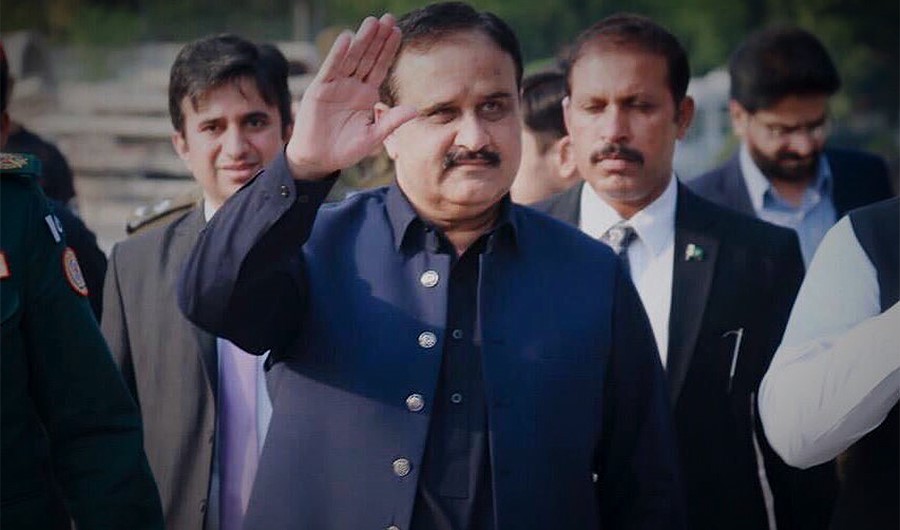


The undated file photo shows Punjab Chief Minister Sardar Usman Buzdar. (Photo courtesy: social media)

Buzdar has been often criticized by the opposition for what they refer to as lackluster performance, while Prime Minister Imran Khan has often backed him saying he spearheads important public development projects.
The survey showed Buzdar ahead of other provincial chief ministers in terms of development, with 51 percent of respondents expressing their satisfaction. He was followed by the Khyber Pakhtunkhwa chief who scored 48 percent, Balochistan chief with 43 percent, while the chief minister of Sindh was seen as performing worst, with only 38 percent approval.
About 86 percent of respondents said they were satisfied with Punjab’s public education facilities. In Khyber Pakhtunkhwa, around 80 percent were in favor of the local government, in Balochistan 62 percent, and in Sindh 58 percent.
Seventy-two percent of respondents were satisfied with Punjab’s public health facilities, followed by Khyber Pakhtunkhwa at 67 percent, Balochistan at 56 percent, and Sindh at 53 percent.
Punjab ranked second highest in terms of services provided by the provincial government, with 61 percent of respondents expressing satisfaction. Khyber Pakhtunkhwa topped in this category with 69 percent, while Balochistan and Sindh scored 54 percent and 50 percent respectively.


Pakistan to unveil austerity plan on Monday as Middle East conflict drives oil price surge

Updated 08 March 2026
Follow

Pakistan to unveil austerity plan on Monday as Middle East conflict drives oil price surge

  • The development follows an increase of Rs55 ($0.20) per liter in prices of petrol and diesel in Pakistan this week
  • PM Shehbaz Sharif promises ‘maximum relief’ to people as soon as ‘this difficult phase passes’ and economy stabilizes

ISLAMABAD: Pakistan is set to unveil an austerity plan tomorrow, Monday, as surging global oil prices, driven by United States and Israeli strikes on Iran, mount pressure on Prime Minister Shehbaz Sharif’s government to curb spending and stabilize the economy, the PM’s office said on Sunday.

The development follows an increase of Rs55 ($0.20) per liter in the prices of petrol and diesel in Pakistan this week as the Strait of Hormuz, which supplies a fifth of the global oil consumption, faces disruptions due to US-Israeli strikes on Iran and Tehran’s counter attacks on US interests in the Gulf region.

Pakistan’s Petroleum Division was directed to submit daily stock reports, while the country’s Oil and Gas Regulatory Authority (OGRA) was tasked with maintaining strict market oversight, officials said this week, as oil rose above $90 a barrel globally, the highest in years.

Sharif on Sunday presided over a meeting to review measures to stabilize the economy amid the Middle East conflict, with officials saying global supply disruptions and price fluctuations may have an impact on Pakistan, according to the prime minister’s office.

“In view of the recent international situation, timely implementation of measures is essential for the country’s economic stability,” Sharif was quoted as saying at the meeting. “The government is constantly monitoring the situation and all necessary decisions will be taken to provide all possible stability to the national economy.”

Earlier in the day, Pakistan’s Finance Minister said that Islamabad was preparing alternative plans to manage the financial impact of rising oil prices.

Speaking at the meeting, Sharif said the austerity measures must protect the interest of the people.

“All government employees and ministers will have to adopt austerity,” he said. “In the current difficult times, it is important to ensure wise use of national resources and as soon as this difficult phase passes and the economy becomes more stable, the government will provide maximum relief to the people.”

Instructions regarding austerity and simplicity will not be applicable to the industry and agriculture sectors so that the country’s production, exports and food security are not affected, according to Sharif’s office.

Several suggestions and recommendations based on austerity and simplicity were presented at the meeting, which were reviewed in detail by participants.

“The briefing was informed that the country has adequate reserves of diesel, petrol and other petroleum products and the government has made advance arrangements to deal with any emergency,” Sharif’s office said.