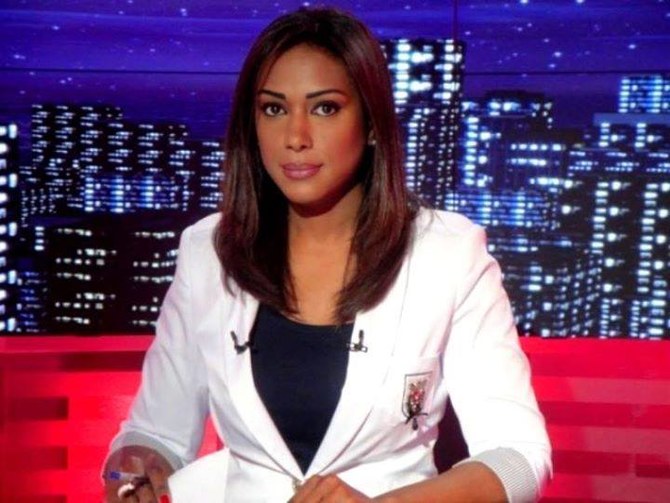

BEIRUT: Hate-filled, misogynist, and racist tweets have targeted a Sudanese TV anchor following a report on her show that criticized the Lebanese government, including Hezbollah leader Hassan Nasrallah.
The fury targeting Dalia Ahmad came after she described the country’s long-reigning party officials as crocodiles during her show “Fashet Khalq” on Lebanon’s Al-Jadeed news channel.
#DogBreedImprovement was trending in Lebanon in Arabic after vicious tweets sent out by Hezbollah loyalist accounts attacked Ahmad and the color of her skin.
“You’d be sitting under the safety of God when a black dog comes and starts barking, you want to hit it but then it appears not to be a dog but a black female dog from Sudan,” read a tweet from a profile featuring a photo of the slain Iranian military commander Qassem Soleimani.
بتكون قاعد بأمان الله بيجي كلب أسود بصير ينبح بتقوم بدك تضربو بيطلع مش كلب بيطلع كلبة سودا من السودان#تحسين_نسل_الكلب
— علي الرضا حساب جديد ابو جواد (@vHaa4vZoKbMyG3i) January 14, 2022
“May God curse the sperm that settled in the womb of the mother of those who offend you, Mr. Nasrallah #DogBreedImprovement,” read another tweet in Arabic. The account’s profile has the word Hezbollah in Arabic with a yellow heart next to it.
لعنَ الله النُّطفةَ التي إستقّرت في رَحِمِ أمِّ من يُسئ إليك سيدي نصرالله.#تحسين_نسل_الكلب pic.twitter.com/6rNLfxiIYK
— Fatima (@Fatimakhalill7) January 15, 2022
Another tweet read: “Without #hizbollah Dalia Ahmed would have been offered for sale in the slave market, along with her ilk, by ISIS.”
“Never in my life have I bullied or criticized the creation of our Lord, but this despicable woman, because her heart and tongue are so black they are reflecting on her ugly and malicious face,” read a tweet from @KassemHala555, which had a black smiley face emoji at the end and two images of Ahmad.
انا بحياتي ما تنمرت ولا بقبل انتقد خلقة ربنا ..
بس هيدي الحقيرة من كتر سواد قلبها ولسانها عاكس على وجها المقرق والخبيث ...#تحسين_نسل_الكلب pic.twitter.com/fDRwpPX8TK
— (@KASSEMHALA555) January 14, 2022
“By God, by God, whoever wants to attack the Al-Sayyed (Nasrallah), I want to wipe the ground with them and curse those who gave birth to them,” read another tweet from @KassemHala555, whose profile features the Lebanese and Iranian flags. This tweet had an image of Ahmad with the face of a dog photoshopped over hers.
والله والله يلي بدو يتطاول على السيد بدي امسح الأرض فيه والعن يلي خلفو ..#تحسين_نسل_الكلب pic.twitter.com/zxxEh0eGX1
— (@KASSEMHALA555) January 15, 2022
Journalists loyal to Hezbollah and media representatives also chimed in. Journalist Hosein Mortada, who has more than 494,000 followers, tweeted a picture of Ahmad with the comment: “There are breeds that don’t improve because their genes are unclean from the start.”
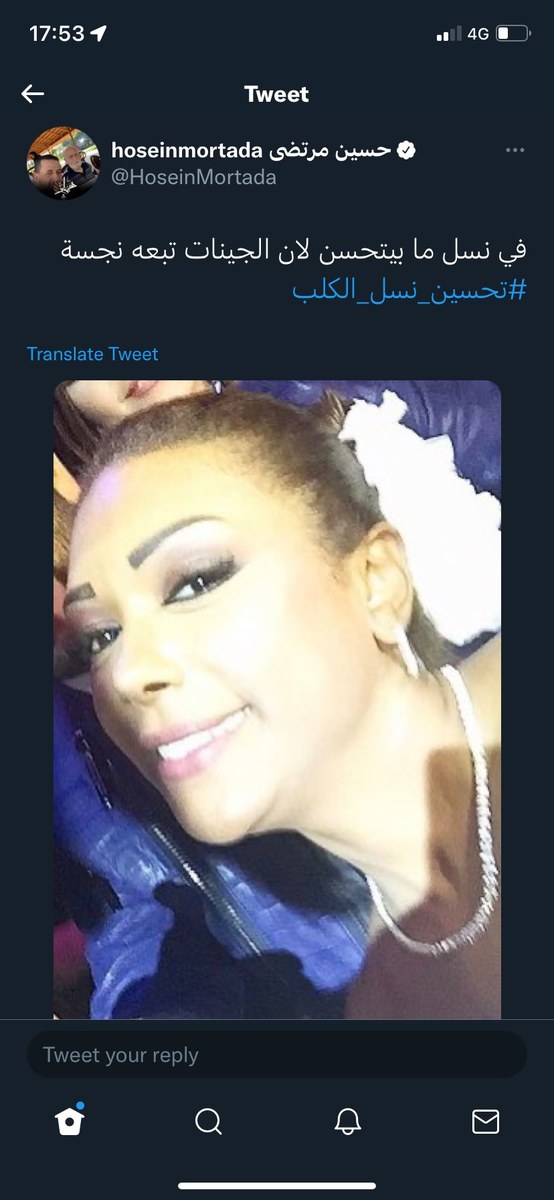
His tweet is no longer visible because, according to the platform, it “violated the Twitter Rules.”
“Abuse and harassment have no place on our service. Our Abusive Behavior Policy prohibits behavior which intimidates, harasses or tries to silence another user’s voice, while we also robustly enforce hateful conduct and violent threats policies,” a Twitter spokesperson told Arab News.
“We have taken action against Tweets found to be in violation of Twitter Rules. We use a combination of machine learning-based automation and human review to enforce our policies across the different languages on the service.”
There were some who came to the defense of Ahmad, including Emmy-nominated director and writer Lucien Bourjeily who tweeted: “My dears: ‘crocodiles’ is a very nice description. Your leaders are corrupt, scammers, and criminals, and an entire society is being destroyed at their hands! How many are you after defending those who impoverished you, plundered you, and destroyed your lives?”
في مين عم يدافع بشراسة وعنصرية عن زعيمه لأن الاعلامية #داليا_أحمد وصفت ما يسمى ب "زعماء" ب تماسيح.
اعزائي: "تماسيح" وصف كتير لطيف.
زعمائكم فاسدين،نصابين،ومجرمين وفي مجتمع باكمله عم يتدمر على ايديهم!
والكم عين بعد تدافعوا عن يلي فقروكم، نهبوكم، ودمروا حياتكم؟ #كلن_يعني_كلن مورطين pic.twitter.com/I43tFI8c1D— lucien bourjeily (@lucienbourjeily) January 15, 2022
And while the Twitter spokesperson said that the company “proactively surface more than 65 percent of abusive content we remove, reducing the burden on individuals on Twitter,” Hezbollah and its loyalists maintain a record of harassing and attacking female journalists.
In January of last year, Alhurra news anchor Layal Alekhtiar received death threats and was subjected to harassment online after tweeting a video of the unveiling of a Soleimani statue and a line from the Qur’an that said: “What are these statues to which you are so devoted?”
In October 2020, independent journalist Luna Safwan was targeted by Hezbollah in an online abuse campaign after her tweet criticizing the party was carried by an Israeli news channel and she was accused of cooperating with Israel. 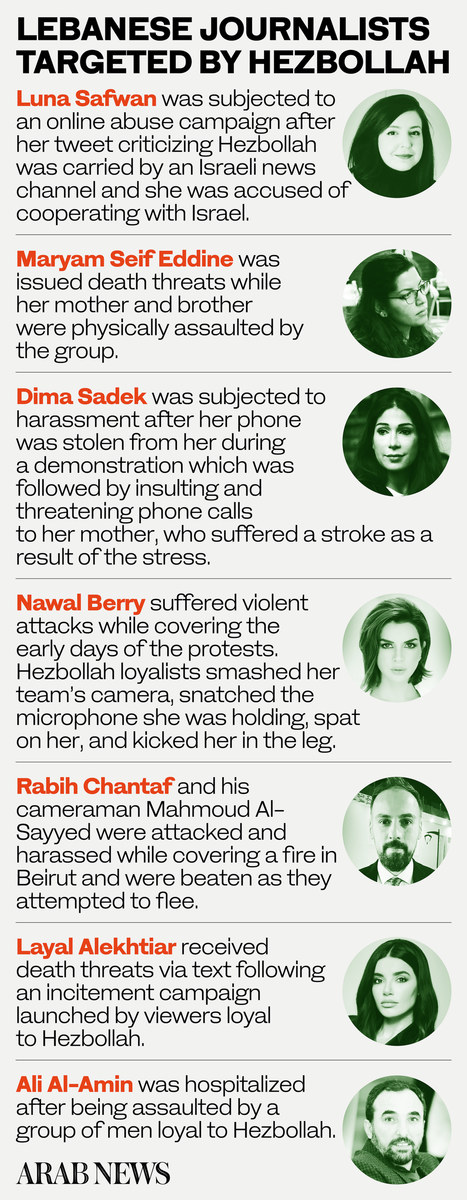
Lebanese journalist Maryam Seif Eddine, known for her staunch criticism of Hezbollah despite being Shiite, received death threats from the group while her mother and brother were physically assaulted, with her sibling being left with a broken nose. Party loyalists had targeted her family home in Burj El-Barajneh, in the Hezbollah-dominated southern suburbs of Beirut.
Before that, as the country witnessed mass protests in 2019, former LBC news anchor and Shiite journalist Dima Sadek was subjected to harassment by the group after her phone was stolen from her during a demonstration. The harassment, she said, was followed by insulting and threatening phone calls to her mother, who suffered a stroke as a result of the stress.
MTV reporter Nawal Berry, also a Shiite, suffered violent attacks by supporters of Hezbollah and its allies while covering the early days of the protests. Loyalists smashed her team’s camera, snatched the microphone she was holding, spat on her, and kicked her in the leg.
• Tarek Ali Ahmad is the head of the Research & Studies Unit at Arab News and the Media Editor - Twitter: @Tarek_AliAhmad