Lawyer seeks medical treatment as Zahir Jaffer appears before Islamabad court in chair

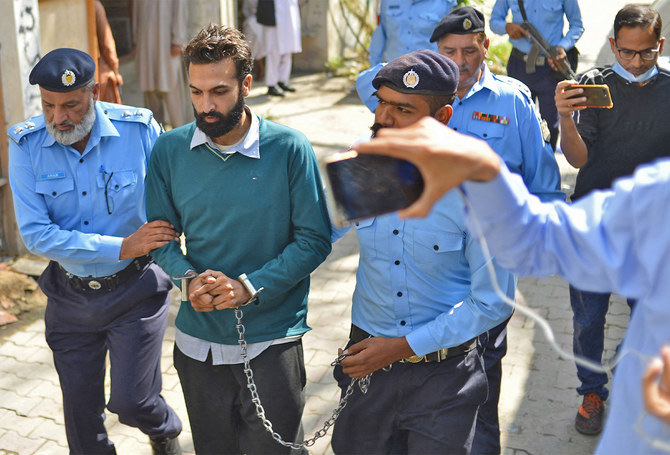
Policemen escort Zahir Jaffer (2L), a Pakistani-American man who went on trial accused of raping and beheading his girlfriend, the daughter of a former ambassador, after his court hearing in Islamabad, Pakistan, on October 20, 2021. (AFP/File)
Short Url
Updated 17 January 2022
Follow

Lawyer seeks medical treatment as Zahir Jaffer appears before Islamabad court in chair

  • Jaffer is accused of murdering 27-year-old Noor Mukadam in Islamabad in July 2021
  • The judge says he has already issued written order for the suspect’s medical check-up

ISLAMABAD: The lawyer of Zahir Jaffer, the prime suspect in the grisly murder of 27-year-old Noor Mukadam in July last year, on Monday pleaded with an Islamabad trial court to order medical treatment of his client, who was brought into the courtroom in a chair. 
Mukadam, the daughter of a former Pakistani diplomat, was found beheaded at a residence in Islamabad’s upscale F-7/4 neighborhood, in a case that has sparked public outrage and grabbed media attention unlike any other recent crime against women. The key suspect was arrested from the crime scene on the day of the murder and has since been in Rawalpindi’s Adiala Jail. 
Others charged in the case include Jaffer’s parents, Zakir Jaffer and Asmat Adamjee, their three household staff, Iftikhar, Jan Muhammad and Jameel, and six workers from Therapy Works, a counselling center from where Jaffer had received certification to become a therapist and where he had been receiving treatment in the weeks leading up to the murder. 
The case is now in the concluding stage in the Islamabad district court, where additional sessions judge Atta Rabbani has been conducting the hearings. Eyewitnesses have been recording their statements in the case and defense attorneys cross-examining them. Inspector Abdul Sattar, who has investigated the case, also recorded his testimony before the court on Monday. 
As the hearing began, Jaffer’s counsel objected to the proceeding and called it “illegal.” “The prime suspect Zahir Jaffer is not being presented [before the court] despite our repeated requests,” advocate Usman Riaz Gill objected. 
The judge said he had already written a letter to prison authorities for the suspect’s medical examination. “You are trying to obstruct the proceeding by giving such statements,” Justice Rabbani told Jaffer’s lawyer, expressing his displeasure. 
Later, police officials brought Jaffer in the courtroom while carrying him in a chair. The accused was handcuffed, wearing a trouser and jacket, and appeared to be listless and fragile. After his brief attendance, he was shifted back to a lock-up on the court premises. 
“His mental health has deteriorated seriously,” Jaffer’s lawyer said, pleading the court for a written order for his client’s medical treatment. 
The judge said he had already issued a written order for the purpose. To which, Jaffer’s lawyer said the order was not acted upon and therefore, they had submitted a new petition. The court was informed that Jaffer was facing “some medical issues” in the prison and was unable to walk, stand and move for the last ten days. 
“That the accused Zahir is on wheelchair but prison authorities are not providing him proper medical treatment and playing with the life of a prisoner whose custody is under the control of this court,” read the application submitted on the behalf of Jaffer’s father Zakir Jaffer on Saturday. 
Earlier in January, the court rejected an application seeking the constitution of a medical board to determine Jaffer’s mental health after he had twice been expelled from the courtroom for disrupting trial proceedings. 
On one occasion, police officers had to carry Jaffer out of the courtroom building after he used indecent language and misbehaved with the judge. The Islamabad police later registered a criminal case against Jaffer for using “abusive language” and attempting suicide on the court premises. 
In Monday’s hearing, the investigation officer in the case recounted the whole investigation process and the collection of evidence from the crime scene. 
Defense lawyers also cross-examined Noor Mukadam’s father, Shaukat Mukadam, who recorded his statement in the case on Saturday. 
The court will resume hearing the case on January 20. 


Pakistan says it backs Gaza peace plan, hopes next phase leads to Palestinian state

Updated 9 sec ago
Follow

Pakistan says it backs Gaza peace plan, hopes next phase leads to Palestinian state

  • Foreign Office says it is not concerned about who joins or stays out of the Abraham Accords
  • Pakistan reaffirms rejection of Israel’s recognition of Somaliland, warns of regional instability

ISLAMABAD: Pakistan’s Foreign Office said on Thursday it supported the Gaza peace plan endorsed by the United Nations Security Council, expressing hope its next phase would stabilize the situation in the war-ravaged territory, scale up humanitarian assistance and lead to an independent Palestinian state.

The United States said on Wednesday it was moving into the next phase of a Gaza ceasefire plan. President Donald Trump’s Middle East envoy Steve Witkoff said in a post on X that the second phase will establish “a transitional technocratic Palestinian administration in Gaza” and mark the beginning of “the full demilitarization and reconstruction of Gaza, primarily the disarmament of all unauthorized personnel.”

Commenting on the development, Foreign Office Spokesperson Tahir Andrabi said Pakistan had taken note of the announcement.

“We have seen this social media post about the next phase of the ceasefire agreement in Gaza, and we express the hope that these steps will lead to further stabilization of the situation, and upscaling the humanitarian assistance and end of the sacrifices of the people,” he said while addressing his weekly news conference.

Andrabi said Pakistan had been engaged in the Gaza peace effort as part of a group of Arab and Islamic countries since the initiative was presented by the US president and supported both the plan and the UN Security Council resolution endorsing it.

“We also hope that these efforts will lead to a credible time bound, political process consistent with international legitimacy and relevant UN resolutions to establish an independent, sovereign, contiguous state of Palestine, based on pre-1967 borders with East Jerusalem as its capital,” he added.

Asked about Pakistan’s position on the Abraham Accords, a series of US-brokered agreements normalizing relations between Israel and several Arab states, Andrabi said Islamabad’s stance remained unchanged.

“Our position with respect to it is that there are certain benchmarks that have to be achieved ... And [these relate do] a viable, contiguous state of Palestine, with East Jerusalem as its capital.”

He said Pakistan did not judge other countries’ choices on the accords.

“We are not concerned about who does or who does not join the Abraham Accords,” he said.

SOMALILAND ISSUE

Earlier in his opening remarks, Andrabi reiterated Pakistan’s rejection of Israel’s recognition of Somaliland, a self-declared breakaway region of Somalia, calling the move illegal and warning it could destabilize the Horn of Africa and Red Sea region.

Somaliland declared independence from Somalia in 1991 but is not recognized by the United Nations or the African Union.

Israel’s recent steps to recognize the territory have drawn criticism from Somalia and several Muslim-majority countries.

Pakistan’s Deputy Prime Minister and Foreign Minister Ishaq Dar raised the issue during the 22nd Extraordinary Session of the Organization of Islamic Cooperation Council of Foreign Ministers held in Jeddah on Jan. 10.

“In his address, the DPM-FM strongly condemned the illegal and unlawful recognition by Israel of the Somaliland region, as well as subsequent unwarranted and highly provocative visits of Israeli officials to the territory,” the Foreign Office spokesman said.

“He termed such acts as political aggression and a direct assault on Somalia’s internationally recognized borders, setting a perilous precedent and threatening peace and security in the Horn of Africa, the Red Sea region, and beyond.”

Andrabi said Dar also addressed the Palestinian issue during the session, rejecting proposals for the displacement of Palestinians and reaffirming Pakistan’s long-standing support for a two-state solution.