

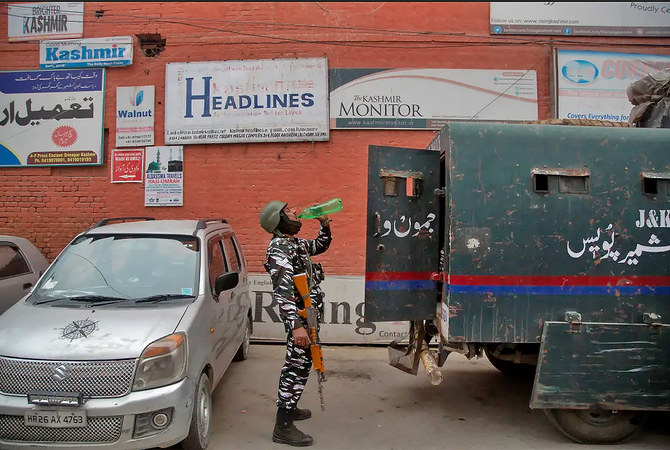

ISLAMABAD: Pakistan on Sunday called on the international community, particularly the United Nations and international human rights groups, to hold India accountable for its “unabated harassment and illegal arrests” of journalists, human rights defenders and civil society activists in India-administered Kashmir.
Journalists have increasingly voiced concerns about harassment and threats by the police that have effectively restricted reporting after India revoked Kashmir’s semi-autonomy and divided the region under its control into two federally governed territories in 2019. Many journalists have been arrested, beaten, harassed and sometimes investigated under antiterrorism laws.
On Saturday, a group of journalists, with the alleged help of local administration, forced their way into the Kashmir Press Club’s (KPC) administration office in Srinagar and announced themselves “interim” KPC office-bearers, prompting condemnations from independent journalist bodies in India.
Pakistan condemned the “increasing harassment, illegal arrests and registration of fake criminal cases” against journalists and civil society activists in India-administered Kashmir, the Pakistani foreign office said.
“The reported attack on Kashmir Press Club yesterday manifestly reflects India’s entrenched use of brute force and coercion to forcibly silence those raising voices against its horrendous crimes and egregious human rights violations,” it said in a statement.
“Equally condemnable is the increasing use of draconian and inhumane laws including Unlawful Activities Prevention Act (UAPA), Public Safety Act (PSA) and Armed Forces Special Powers Act (AFSPA) with impunity in IIOJK (Indian Illegally Occupied Jammu and Kashmir), which reflects India’s colonial mindset.”
On Sunday, the Editors Guild of India, a non-partisan association of editorial leaders committed to free, fair and independent journalism, said it was “aghast at the manner in which the office and the management of Kashmir Press Club, the largest journalists’ association in the Valley, was forcibly taken over by a group of journalists with the help of armed policemen on January 15, 2022.”
Earlier this month, Indian soldiers picked up a Kashmiri journalist, Sajjad Gul, from his home in northeastern Shahgund village and later handed him over to the police, his family said. He had posted a video of family members and relatives protesting the killing of a rebel commander on Monday.
The New York-based Committee to Protect Journalists said it was “deeply disturbed” by the arrest of Gul and asked Indian authorities to immediately release him.
India’s decision to strip the region of its special powers in August 2019 brought journalism to a near halt in Kashmir for months. India began implementing a policy in 2020 that gives the government more power to censure independent reporting.
Fearing reprisals from government agencies, most of the local press has wilted under pressure. Journalists have also come under scrutiny through anonymous online threats the government says are linked to rebels fighting against Indian rule.
Kashmir is divided between India and Pakistan and both claim it in full.
Since 1989, a full-blown armed rebellion has raged in Indian-controlled Kashmir seeking a united Kashmir — either under Pakistani rule or independent of both countries.
The region is one of the most heavily militarized in the world. Tens of thousands of civilians, rebels and government forces have been killed in the conflict.


