

Indian police raid homes, question journalists in Kashmir

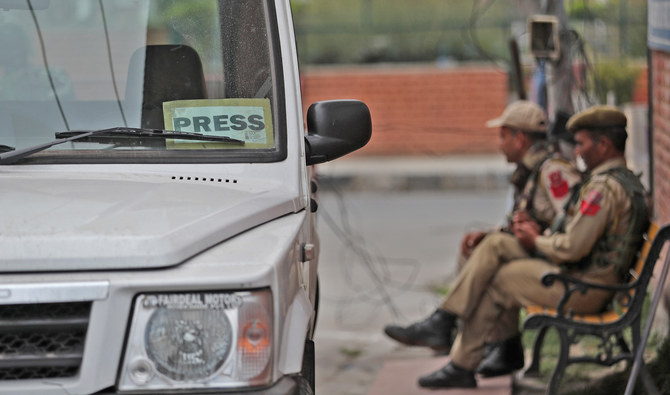
Indian policemen rest on a bench at the entrance of Press Enclave in Srinagar on September 8, 2021. (AP)
Short Url
Updated 08 September 2021
Follow

Indian police raid homes, question journalists in Kashmir

  • Three of the journalists have written for foreign media, one is an editor of a magazine
  • Police seize documents and electronic devices belonging to the scribes and their spouses

SRINAGAR: Police in Indian-controlled Kashmir raided the homes of four journalists on Wednesday, triggering concerns of a further crackdown on press freedom in the disputed region. 

After the raids in Srinagar, the region’s main city, the four journalists were summoned to local police stations where they were questioned. Police did not specify the reason for the raids. 

Police seized documents and electronic devices, including cellphones and laptops, belonging to the journalists and their spouses. 

Three of the journalists have written for foreign media while one is an editor of a monthly news magazine. 

Journalists in Kashmir have long worked under tremendous stress and have been targeted in the past, some fatally, by both the Indian government and militant groups. 

Journalists have said harassment and threats by police increased after India revoked Kashmir’s semi-autonomous status and divided the region into two federally governed territories amid an unprecedented lockdown in 2019. 

Many journalists have been arrested, beaten, harassed and sometimes investigated under anti-terror laws. 

The Kashmir Press Club, an elected body of journalists in the region, has repeatedly urged the Indian government to allow them to report freely, saying security agencies were using physical attacks, threats and summons to intimidate journalists and muzzle the press. 

India’s decision to strip the region of its special status in August 2019 brought journalism to a near halt in Kashmir for months. India introduced a controversial media policy in June last year that gives the government more power to censure independent reporting. 

Fearing reprisals from government agencies, most of the local press wilted under the pressure. Journalists have also come under scrutiny through anonymous online threats the government says are linked to rebels fighting against Indian rule. 

Kashmir is divided between India and Pakistan and has been claimed by both since they won independence from the British empire and began fighting over their rival claims. 

Since 1989, a full-blown armed rebellion has raged in Indian-controlled Kashmir seeking a united Kashmir — either under Pakistani rule or independent of both countries. 

The region is one of the most heavily militarized in the world. Tens of thousands of civilians, rebels and government forces have been killed in the conflict. 


Trump suspends green card lottery program that let Brown University, MIT shootings suspect into US

Updated 2 sec ago
Follow

Trump suspends green card lottery program that let Brown University, MIT shootings suspect into US

President Donald Trump suspended the green card lottery program on Thursday that allowed the suspect in the Brown University and MIT shootings to come to the United States.
Homeland Security Secretary Kristi Noem said in a post on the social platform X that, at Trump’s direction, she is ordering the United States Citizenship and Immigration Services to pause the program.
“This heinous individual should never have been allowed in our country,” she said of the suspect, Portuguese national Claudio Neves Valente.
Neves Valente, 48, is suspected in the shootings at Brown University that killed two students and wounded nine others, and the killing of an MIT professor. He was found dead Thursday evening from a self-inflicted gunshot wound, officials said.
Neves Valente had studied at Brown on a student visa beginning in 2000, according to an affidavit from a Providence police detective. In 2017, he was issued a diversity immigrant visa and months later obtained legal permanent residence status, according to the affidavit. It was not immediately clear where he was between taking a leave of absence from the school in 2001 and getting the visa in 2017.
The diversity visa program makes up to 50,000 green cards available each year by lottery to people from countries that are little represented in the US, many of them in Africa. The lottery was created by Congress, and the move is almost certain to invite legal challenges.
Nearly 20 million people applied for the 2025 visa lottery, with more than 131,000 selected when including spouses with the winners. After winning, they must undergo vetting to win admission to the United States. Portuguese citizens won only 38 slots.
Lottery winners are invited to apply for a green card. They are interviewed at consulates and subject to the same requirements and vetting as other green-card applicants.
Trump has long opposed the diversity visa lottery. Noem’s announcement is the latest example of using tragedy to advance immigration policy goals. After an Afghan man was identified as the gunman in a fatal attack on National Guard members in November, Trump’s administration imposed sweeping rules against immigration from Afghanistan and other counties.
While pursuing mass deportation, Trump has sought to limit or eliminate avenues to legal immigration. He has not been deterred if they are enshrined in law, like the diversity visa lottery, or the Constitution, as with a right to citizenship for anyone born on US soil. The Supreme Court recently agreed to hear his challenge to birthright citizenship.