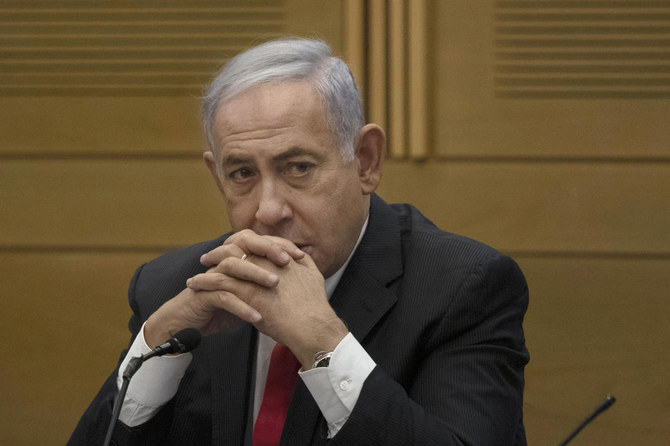
TEL AVIV, Israel: Former Israeli Prime Minister Benjamin Netanyahu is negotiating a plea deal in his corruption case, a person involved in the talks said Sunday.
The deal, which could be signed as early as this week, could usher Netanyahu off the Israeli political stage for years, paving the way for a leadership race in his Likud party and shaking up Israel’s political map.
Any deal would also absolve Netanyahu of an embarrassing and protracted trial that has gripped the nation and risks tarnishing his legacy.
A spokesman for Netanyahu declined to comment.
Netanyahu is on trial for fraud, breach of trust and accepting bribes in three separate cases. The former premier, now opposition leader, denies wrongdoing.
The person involved in the negotiations said the plea deal would drop the bribery and fraud charges and scrap one case entirely.
The person asked for anonymity because he wasn’t authorized to discuss the details of the talks. He said a plea deal would likely be announced in the coming days.
The person said a number of elements remained unresolved, including the inclusion of the charge of “moral turpitude,” which under Israeli law would ban Netanyahu from politics for seven years. They were also deliberating whether Netanyahu would be forced to do community service under the deal.
Including “moral turpitude” would challenge Netanyahu’s vows to return to lead the country after his 12-year reign was ended last year by a coalition of ideologically disparate parties with little in common other than its opposition to his leadership. But Netanyahu, dubbed a political wizard for his ability to survive repeated attempts at ending his rule, could make a comeback when the ban expires. He would be nearly 80.
His departure from the political scene would set off a leadership race in the Likud party, with several lawmakers already promising to run. Likud isn’t expected to remain as dominant without Netanyahu, but would still be a major force under a new leader.
With Netanyahu gone, the more nationalist elements of the coalition could decide to break off from the fragile union and opt to join forces with their ideological brethren.
Netanyahu is charged in three separate cases. The first alleges that Netanyahu received gifts worth hundreds of thousands of dollars from wealthy associates.
In the second case, Netanyahu is accused of orchestrating positive coverage in a major Israeli paper in exchange for promoting legislation that would have harmed the news outlet’s chief rival, a free pro-Netanyahu daily.
The third, nicknamed Case 4000, alleges that Netanyahu promoted legislation worth hundreds of millions of dollars to the owner of Israeli telecom giant Bezeq in exchange for positive coverage on its Walla news site.


Netanyahu negotiating plea deal in corruption trial
https://arab.news/czy99
Netanyahu negotiating plea deal in corruption trial

- Netanyahu is on trial for fraud, breach of trust and accepting bribes in three separate cases


Pro-Palestinian flotilla announces new mission to Gaza
- Israel controls Gaza's borders and scrutinises all aid coming into the territory
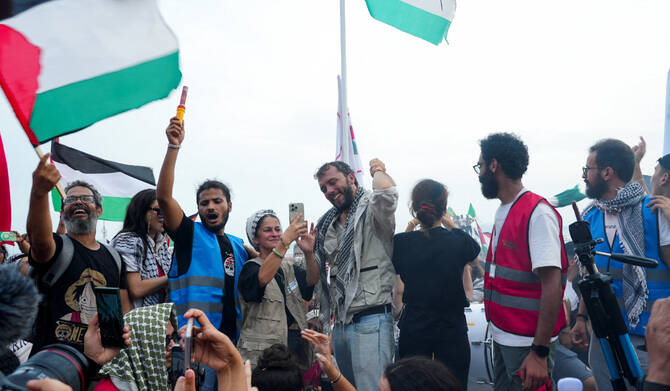
TUNIS: A flotilla of pro-Palestinian activists who attempted to reach Gaza last year will set sail for the besieged territory again next month, one member told AFP on Friday.
The Global Sumud Flotilla said the new mission set for March 29 would be "the largest coordinated humanitarian intervention for Palestine in history" and will mobilise "thousands from over 100 countries".
"We will be sailing from Barcelona, Tunis, Italy and many other ports not yet made public," Brazilian activist Thiago Avila told AFP.
The group said an overland convoy would also leave for Gaza on the same day, without specifying from where.
The campaigners sought to break an Israeli blockade by delivering aid to Gaza by sea last October, before they were intercepted by Israel, detained and deported.
Israel controls Gaza's borders and scrutinises all aid coming into the territory.
The activists describe their actions as a "non-violent response to genocide, siege, mass starvation, and the destruction of civilian life in Gaza".


