

The girl who would be general: Pakistan army’s first three-star woman officer

Lt. Gen. Nagar Johar during a ceremony at National Defence University in Islamabad, Pakistan, on October 9, 2020. (Photo courtesy: NDU)
Short Url
Updated 15 January 2022
Follow

The girl who would be general: Pakistan army’s first three-star woman officer

  • Lt. Gen. Nigar Johar has been a trailblazer in ensuring women in Pakistan get the right to join and lead within the military
  • She landed her first real leadership role when she was asked to command an entire hospital as a brigadier

RAWALPINDI: For Pakistan’s first woman general, the journey to her three-star rank started off as an impossible dream in small town Swabi, a settlement in the conservative Khyber Pakhtunkhwa province in the country’s northwest. With her army officer father, the girl who would be general traveled all over 1970’s Pakistan, living in big and small cities, and keeping her dream alive despite the odds.

But it is a dream, she says, that will not end with her as more and more women join the armed forces in recent years.

Back in the day, Lt. General Nigar Johar could only join the army as a doctor specializing in gynaecology. Today, she said, things were different with more women joining the army in different specializations and in different corps.

“Now we have women in so many areas in the army,” General Johar told Arab News.
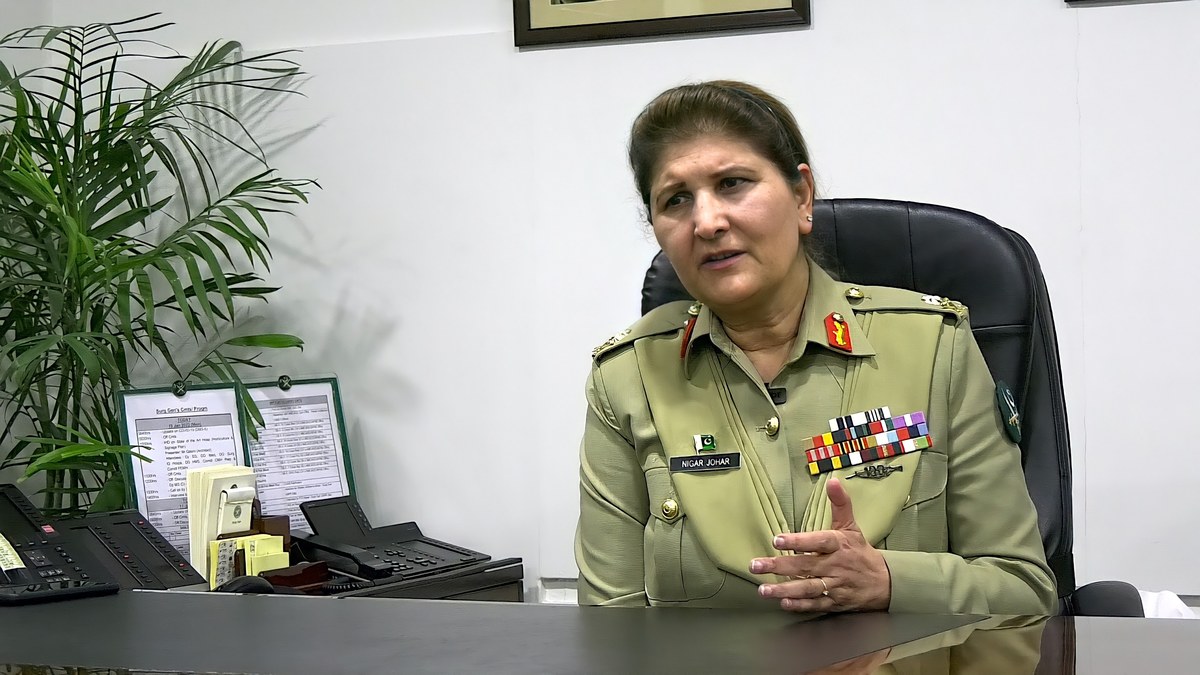


Pakistan’s first female general, Lieutenant General Nigar Johar Nigar Johar (right), speaks to Arab News Pakistan in Islamabad, Pakistan on January 10, 2022. (AN Photo)

“In education, in information technology, engineering, architecture. They are spreading and working everywhere.”

For her part, she has been a trailblazer in ensuring women in Pakistan get the right to join and lead within the military.

As a young officer, Johar’s dedication and professional excellence routinely captured the attention of her superiors who gave her positions of command and authority.

She landed her first real leadership role when she was asked to command an entire hospital as a brigadier, something she describes as the greatest challenge of her life.

“Since the formation of Pakistan, no woman was ever given command of any setup in the Pakistan army,” she said. “So I knew that I was there to make it or break it for the women who’d come after me.”

Not surprisingly, she made it. She believes her success with the hospital is the reason so many women got opportunities around her.
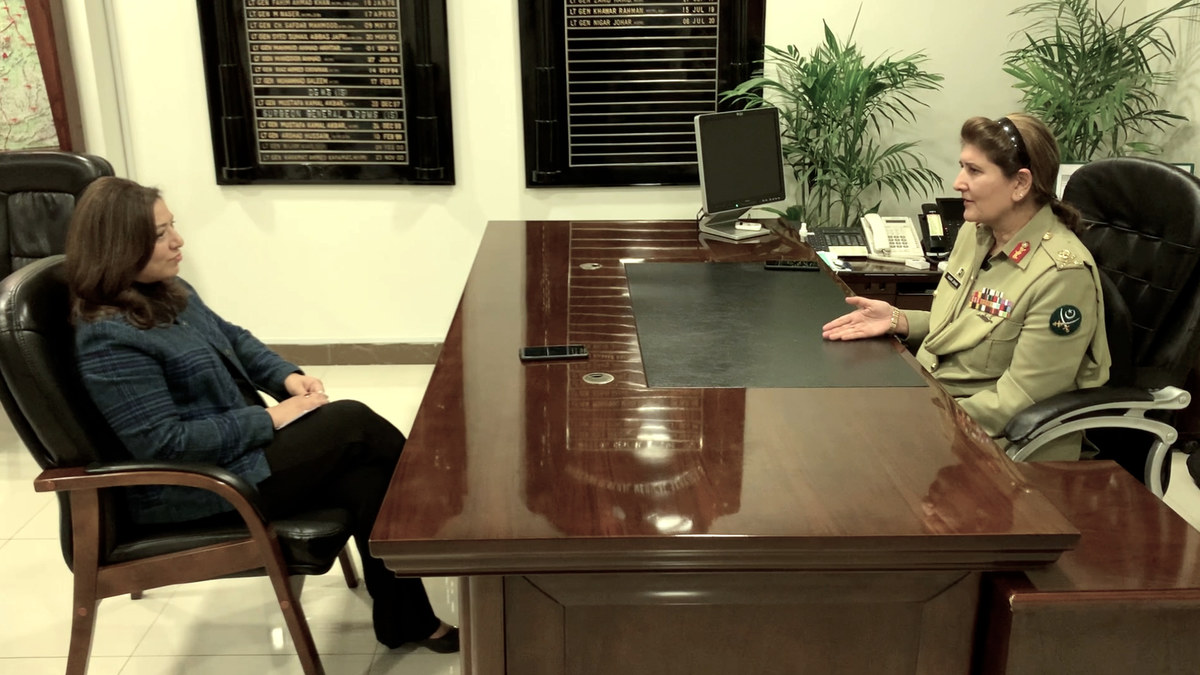


Pakistan’s first female general, Lieutenant General Nigar Johar Nigar Johar (right), speaks to Arab News Pakistan in Islamabad, Pakistan on January 10, 2022. (AN Photo)

The road to her success began many years ago, when Johar would watch her father in his army uniform and idolize his every move as the family moved during military postings from place to place.

“I feel like I belong to the whole of Pakistan,” she said of her childhood. “All the provinces, the big cities and the small cities within.”

“My father was my ideal,” she said. “I had seen him in uniform from the beginning which influenced my decision to become a doctor and join the army.”

General Johar lost both her parents in a car accident in 1989, a few years after she graduated from army medical college. Subsequently, she became the only woman in the history of the powerful Pakistan Army to reach the rank of a three-star general and lead a corps.

Now, at the pinnacle of professional success, she says that even though she is often the only woman in the room, she doesn’t think others see her through a gendered lens.

“At this stage, you don’t look at things as male and female,” she said. “At this stage, you look at things as policies and improvements of the system.”

“When you have proved yourself to be in leadership at this highest level ... then people respect you for your work and what you have attained. They know you are here because you achieved... and because you earned this place.”


Pakistan, ADB reaffirm partnership to push IMF-backed reforms

Updated 5 sec ago
Follow

Pakistan, ADB reaffirm partnership to push IMF-backed reforms

  • ADB signals further budget support aligned with Pakistan’s $7 billion IMF program
  • Finance minister outlines focus on privatization, energy reforms, project execution

KARACHI: Pakistan and the Asian Development Bank (ADB) on Monday reaffirmed their strategic partnership to accelerate IMF-backed economic reforms, as Islamabad seeks to sustain macroeconomic stabilization and deepen private-sector-led growth.

The commitment came during a meeting between Finance Minister Muhammad Aurangzeb and a senior ADB delegation in Islamabad, where both sides reviewed Pakistan’s reform trajectory under the International Monetary Fund’s Extended Fund Facility (EFF) and discussed ways to improve development impact and project execution.

Pakistan has been pursuing wide-ranging fiscal, energy and structural reforms under the $7 billion IMF loan program after years of balance-of-payments stress and repeated stabilization cycles. While recent reviews have pointed to improved macroeconomic indicators, the government has stressed that sustained growth will depend on translating policy commitments into implementation, particularly in taxation, state-owned enterprises and the energy sector.

“ADB representatives expressed appreciation for Pakistan’s reform progress under the IMF program and confirmed ADB’s readiness to provide further budget support aligned with the EFF,” the finance ministry said in a statement. 

“They outlined future areas of engagement, including insurance sector reforms, public-private partnerships, pension reforms, and continued support for climate resilience and social sector development.”

Aurangzeb told the delegation that the government was focused on improving project readiness and execution, noting that delays had historically weakened the impact of development spending, especially in social sectors and climate-related initiatives. He said visible progress on privatization and energy sector restructuring was essential to building investor confidence and sustaining reform momentum.

The finance minister highlighted recent steps, including the privatization of a small bank, renewed interest in strategic transactions and ongoing work to restructure electricity distribution companies. He also pointed to encouraging trends in exports, remittances and services, particularly information technology, while cautioning that growth needed to remain balanced and sustainable.

According to the statement, ADB officials reiterated the bank’s emphasis on results-based engagement and faster project implementation, saying streamlined processes were critical for timely disbursements and measurable outcomes. The delegation also flagged expanded support for private-sector development through guarantees, public-private partnerships and potential infrastructure transactions.
