PM Khan unveils public version of first ever national security policy

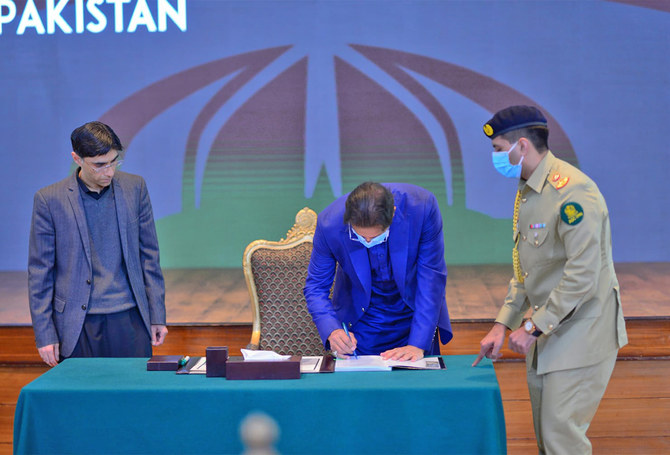
Pakistan Prime Minister Imran Khan, second left, signs country’s first ever national security policy in Islamabad, Pakistan, on January 14, 2021. (Prime Minister Office)
Short Url
Updated 15 January 2022
Follow

PM Khan unveils public version of first ever national security policy

  • Impossible for a country to remain secure for long if its economy is not stable, says PM Imran Khan
  • New policy articulates citizen-centric framework, seeks a secure and economically resilient Pakistan

ISLAMABAD: Pakistani Prime Minister Imran Khan on Friday launched a public version of the country’s first ever national security policy, referring to it as an “all-encompassing, multidimensional” document. 
In December 2021, Pakistan’s National Security Committee (NSC) approved the National Security Policy (NSP) 2022-2026, which articulates a citizen-centric framework, places economic security at its core and seeks a secure and economically resilient Pakistan. 
The main themes of the NSP are national cohesion, securing an economic future, defense and territorial integrity, internal security, foreign policy in a changing world and human security. 
“Based on the all-encompassing, multidimensional national security policy that you [National Security Division] have helmed, we will now focus our efforts to ensure the government and people proceed in one direction,” PM Khan said at the launch of the NSP’s public version. 
He said it was not possible for a country to remain secure for long if its economy was not stable. “If you have to go to the International Monetary Fund at regular intervals, it means you security will be [adversely] affected,” he said. 
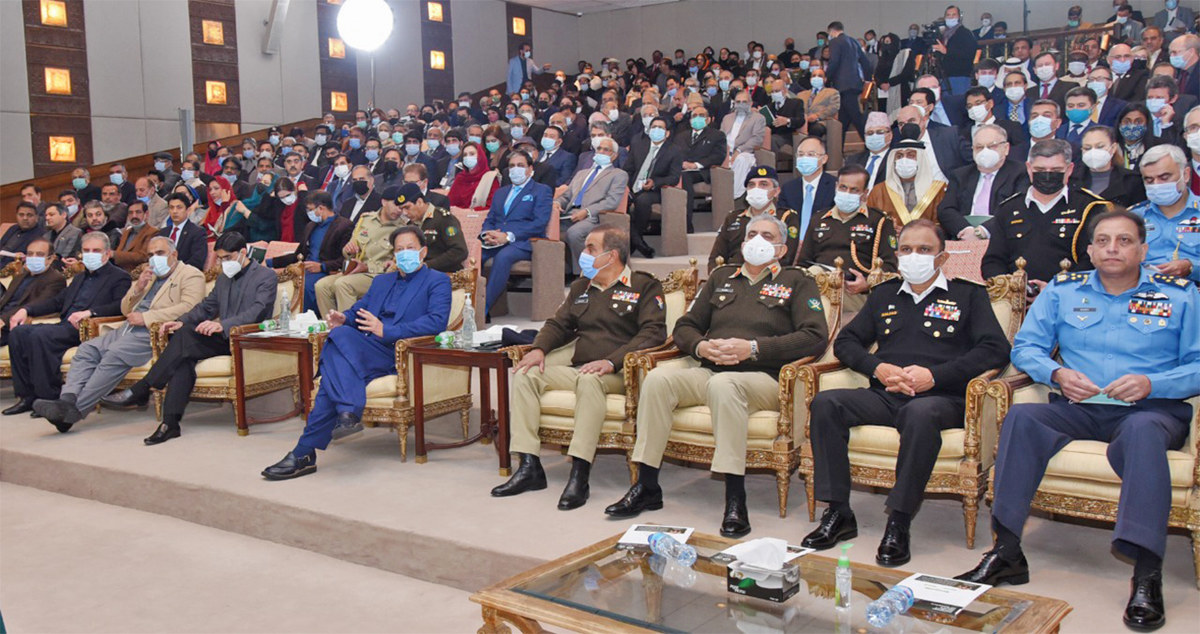


Pakistan's Prime Minister Imran Khan, fifth from left, and top military brass attend the launching ceremony of country’s first ever National Security Policy in Islamabad, Pakistan, on January 14, 2021. (Prime Minister Office)

The prime minister said Pakistan had never adopted a coordinated approach regarding its national security or even its economy. Citing examples of previous governments, he said Pakistan’s current account deficit increased whenever the country registered growth. 
“When the current account deficit increased, it put pressure on the currency. Due to pressure on the currency, Pakistan had to go to the IMF [to secure loans],” PM Khan said. 
Hence, he said, Pakistan always had to go to the IMF “as a last resort” and was forced to agree to its terms. “And when you agree to their terms, somewhere, our security gets compromised,” he contended. 
The prime minister praised the new policy for highlighting the need for inclusive growth, adding that the State of Madinah established by Holy Prophet (Peace Be Upon Him) was the first to introduce it. “We should secure the most vulnerable segment of our society,” he added. 
PM Khan stressed the need for enforcement of law and compliance with contracts. 
“One of the main reasons there is minimal foreign investment in Pakistan is that they [investors] do not trust Pakistan’s judicial system,” he said, adding that these companies and investors instead sought arbitration in international courts. 

The prime minister said that this was a “great impediment” to Pakistan’s growth and with such a huge population, it was the need of the hour to attract well-known global companies. 
He lauded National Security Adviser Moeed Yusuf and the National Security Division for carving out such a policy and that too with consensus. 


Pakistan says it seized 32 square kilometers inside Afghanistan as border clashes escalate

Updated 28 February 2026
Follow

Pakistan says it seized 32 square kilometers inside Afghanistan as border clashes escalate

  • Security official describes ‘limited tactical action’ in Gudwana after Afghan assaults
  • Islamabad accuses Kabul of sheltering militants as UN, China and Russia urge restraint

ISLAMABAD: Pakistan has seized a 32-square-kilometer area inside Afghanistan following overnight fighting, a security official said on Saturday, as cross-border clashes between the two countries escalated sharply.

A Pakistani security official, speaking on condition of anonymity, said troops carried out a “limited tactical action” in the Gudwana area opposite the Zhob sector along the frontier, capturing Afghan territory after responding to attacks on Pakistani positions.

“On the night of Feb. 26/27, posts opposite the Zhob sector launched anticipated physical attacks on multiple Pakistani positions,” the official said, referring to fighters linked to Afghanistan’s Taliban authorities, whom Islamabad identifies as Tehreek-e-Taliban Afghanistan (TTA).

“In response to aggressive unprovoked fire and physical attacks, Pakistan security forces launched a limited tactical action on the night of Feb. 27/28 in the general area of Gudwana with a view to capture TTA Tahir Post,” he continued, adding that 32 square kilometers of Afghan territory were seized.

The official said special combat teams crossed the border after preparatory bombardment, supported by intelligence, surveillance and reconnaissance assets providing “real-time battlefield awareness.”

He said 24 Afghan Taliban fighters were killed and 37 wounded, with no Pakistani casualties reported.

The claims could not be independently verified, and there was no immediate confirmation from Taliban authorities in Kabul of any territorial loss in the Gudwana area.

The latest clashes erupted after Pakistani airstrikes targeted what Islamabad described as militant hideouts inside Afghanistan over the weekend, triggering retaliatory fire along the frontier and sharply escalating long-running tensions. Islamabad accuses Kabul of sheltering Pakistani Taliban militants responsible for attacks inside Pakistan, an allegation that Afghanistan denies.

Pakistan’s Information Minister Attaullah Tarar said on Saturday evening that 352 Afghan Taliban fighters had been killed and more than 535 wounded since the latest phase of hostilities began.

Tarar said Pakistani strikes had destroyed 130 check posts, 171 tanks and armored vehicles and targeted 41 locations across Afghanistan by air. Those figures could not be independently verified.

The United Nations, as well as China and Russia, have called for restraint.

The United States said Pakistan has the right to defend itself against cross-border militancy.