

India, UK start talks on free-trade deal

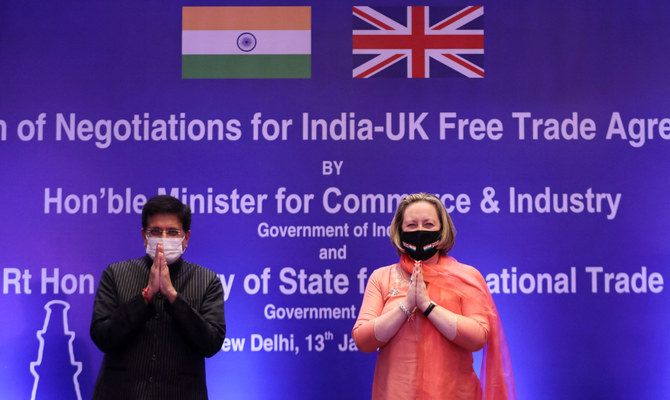
India's Minister of Commerce and Industry, Piyush Goyal, and British Secretary of State for International Trade Anne-Marie Trevelyan pose for a picture during the launch of free trade agreement negotiations in New Delhi on Thursday. (Reuters)
Short Url
Updated 13 January 2022
Follow

India, UK start talks on free-trade deal

  • Britain’s International Trade Secretary Anne-Marie Trevelyan is in New Delhi for the discussions
  • Deal expected to boost two-way trade by $38.4bn a year by 2035

NEW DELHI: India and the United Kingdom on Thursday formally launched talks for a free-trade deal expected to double their bilateral trade by 2030.

The UK has made the agreement with India one of its post-Brexit priorities, with London aiming to anchor its trade policy toward the fast-growing economies in the Indo-Pacific region.

India’s Trade and Commerce Minister Piyush Goyal started the talks with Britain’s International Trade Secretary Anne-Marie Trevelyan, who arrived in New Delhi on Wednesday.

Actual negotiations are scheduled to begin next week.

“The FTA with the UK is expected to provide certainty, predictability and transparency and will create a more liberal, facilitative and competitive services regime,” Goyal said in a joint press conference with Trevelyan.

“The negotiations with the UK are expected to increase our exports in leather, textile, jewelry and processed agriproducts, and register a quantum jump in the export of marine products.”

Trevelyan said the deal, under which the countries would double bilateral trade by 2030, would help strengthen their post-pandemic recovery.

“With the commencement of the first full round of talks this month, the trade deal between the United Kingdom and India will put us in pole position to recover from the pandemic and to strengthen our mutually beneficial ties and to grasp the enormous opportunities that lie ahead,” she said.

“We aim to double trade between our countries by the end of this decade supporting jobs, businesses and communities in both countries.”

The British Embassy in New Delhi said in a statement the agreement would boost two-way trade by $38.4 billion a year by 2035.

Foreign policy expert Harsh V. Pant of the New Delhi-based Observer Research Foundation told Arab News the deal would give “new momentum” to India’s trade relations with the UK, with both countries seeking to reposition themselves for a post-pandemic world order.

“This is important for both sides, as Britain looks to diversify and it looks to engage with the post-Brexit economic order, and India looks at a post-COVID global economic environment,” he said.

“There is a recognition that at the time of global economic fragmentation and the supply chain restructuring, India has to get its economic act in order.”

He added that for India, signing free-trade agreements would be important in its goal to be a part of the “global economic map,” while for the UK, the Indo-Pacific push was part of its post-Brexit economic.

“India, with such a big market, is one of the largest economies of the world. It is in Britain’s interests to see that this this deal is signed,” Pant said.

“Even with limited tariff reduction, it will lead to a significant increase in trade volumes.”


EU leaders begin India visit ahead of ‘mother of all deals’ trade pact

Updated 25 January 2026
Follow

EU leaders begin India visit ahead of ‘mother of all deals’ trade pact

  • Antonio Luis Santos da Costa, Ursula von der Leyen are chief guests at Republic Day function
  • Access to EU market will help mitigate India’s loss of access to US following Trump’s tariffs

New Delhi: Europe’s top leaders have arrived in New Delhi to participate in Republic Day celebrations on Monday, ahead of a key EU-India Summit and the conclusion of a long-sought free trade agreement.

European Council President Antonio Luis Santos da Costa and European Commission President Ursula von der Leyen arrived in India over the weekend, invited as chief guests of the 77th Republic Day parade.

They will hold talks on Tuesday with Prime Minister Narendra Modi at the EU-India Summit, where they are expected to announce a comprehensive trade agreement after years of stalled negotiations.

Von der Leyen called it the “mother of all deals” at the World Economic Forum in Davos last week — a reference made earlier by India’s Commerce Minister Piyush Goyal — as it will create a market of 2 billion people.

“The India-EU FTA has been a long time coming as negotiations have been going on between the two for more than a decade. Some of the red lines that prevented the signing of the FTA continue to this date, but it seems that the trade negotiations have found a way around it,” said Anupam Manur, professor of economics at the Takshashila Institution.

“The main contentious issue remains the Indian government’s desire to protect the farmers and dairy producers from competition and the European Union’s strict climate-based rules and taxation. Despite this, both see enormous value in the trade deal.”

India already has free trade agreements with more than a dozen countries, including Australia, the UAE, and Japan.

The pact with the EU would be its third in less than a year, after it signed a multibillion CEPA (comprehensive economic partnership agreement) with the UK in July and another with Oman in December. A week after the Oman deal, New Delhi also concluded negotiations on a free trade agreement with New Zealand, as it races to secure strategic and trade ties with the rest of the world, after US President Donald Trump slapped it with 50 percent tariffs.

The EU is also facing tariff uncertainty. Earlier this month Trump threatened to impose new tariffs on several EU countries unless they supported his efforts to take over Greenland, which is an autonomous region of Denmark.

“The expediting factor in the trade deal is the unilateral and economically irrational trade decisions taken by their biggest trading partner, the United States,” Manur told Arab News.

Being subject to the highest tariff rates, India has been required to sign FTAs with other major economies. Access to the EU market would help mitigate the loss of access to the US.

The EU is India’s largest trading partner in goods, accounting for about $136 billion in the financial year 2024-25.

Before the tariffs, India enjoyed a $45 billion trade surplus with the US, exporting nearly $80 billion. To the EU’s 27 member states, it exports about $75 billion.

“This can be sizably increased after the FTA,” Manur said. “Purely in value terms, this would be the biggest FTA for India, surpassing the successful FTAs with the UK, Australia, Oman and the UAE.”