Deadly bus blast hits southern Philippines

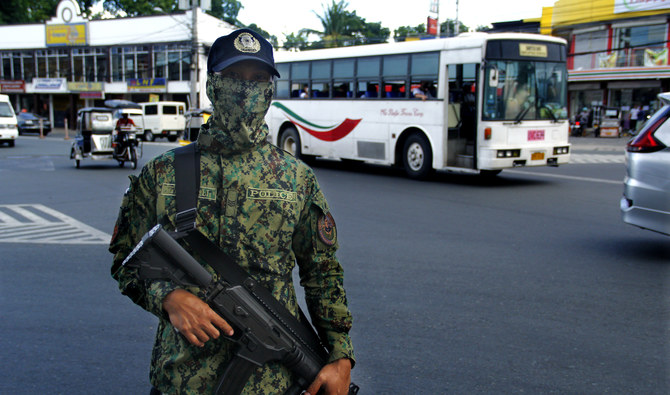
Military spokesman Lt. Col. John Paul Baldomar said seven individuals were initially hurt in the blast. (Shutterstock/File)
Short Url
Updated 12 January 2022
Follow

Deadly bus blast hits southern Philippines

MANILA: An explosion on a bus killed at least one child and injured six other people in the southern Philippines on Tuesday, a military official has confirmed, as authorities launched an investigation into what has been described as a “terroristic act.” 

Seven individuals were initially hurt in the blast on Tuesday morning on the national highway in Cotabato province, military spokesman Lt. Col. John Paul Baldomar said. 

“So far no group has claimed responsibility for the attack. (The) post-blast investigation is ongoing to determine what type of explosive was planted at the rear end of the bus,” he told reporters. 

Among the victims is a five-year-old boy, who was rushed to a nearby hospital in critical condition and later succumbed to his injuries. Baldomar said an infant and a three-year-old are also among the wounded. 

Police Chief MSG Randy Hampac, a spokesman for the local police in Aleosan town, where the incident took place, described it as “plainly a terroristic act” in a radio interview. 

Authorities have yet to identify any suspects as of Tuesday afternoon. Local media outlets initially reported that the explosion was triggered by an improvised explosive device. 

The attack came just two days after the government imposed stricter security measures ahead of the 2022 election period in the Philippines. 

Philippine National Police Chief Gen. Dionisio Carlos said on Sunday that some 14,000 military and police personnel had been deployed across the country to implement a nationwide ban on carrying firearms, and to prevent election-related violence. In addition, at least 2,000 checkpoints have been established at strategic locations all over the country.


Philippines eyes closer cooperation on advanced defense tech with UAE

Updated 58 min 40 sec ago
Follow

Philippines eyes closer cooperation on advanced defense tech with UAE

  • Philippine-UAE defense agreement is Manila’s first with a Gulf country
  • Philippines says new deal will also help modernize the Philippine military

MANILA: The Philippines is seeking stronger cooperation with the UAE on advanced defense technologies under their new defense pact — its first such deal with a Gulf country — the Department of National Defense said on Friday.

The Memorandum of Understanding on Defense Cooperation was signed during President Ferdinand Marcos Jr.’s visit to Abu Dhabi earlier this week, which also saw the Philippines and the UAE signing a comprehensive economic partnership agreement, marking Manila’s first free trade pact with a Middle Eastern nation.

The Philippines-UAE defense agreement “seeks to deepen cooperation on advanced defense technologies and strengthen the security relations” between the two countries, DND spokesperson Assistant Secretary Arsenio Andolong said in a statement.

The MoU “will serve as a platform for collaboration on unmanned aerial systems, electronic warfare, and naval systems, in line with the ongoing capability development and modernization of the Armed Forces of the Philippines,” he added.

It is also expected to further military relations through education and training, intelligence and security sharing, and cooperation in the fields of anti-terrorism, maritime security, and peacekeeping operations.

The UAE’s Ministry of Foreign Affairs has described security and defense as “very promising fields” in Philippine-UAE ties, pointing to Abu Dhabi being the location of Manila’s first defense attache office in the Middle East.

The UAE is the latest in a growing list of countries with defense and security deals with the Philippines, which also signed a new defense pact with Japan this week.

“I would argue that this is more significant than it looks on first read, precisely because it’s the Philippines’ first formal defense cooperation agreement with a Gulf state. It signals diversification,” Rikard Jalkebro, associate professor at the Anwar Gargash Diplomatic Academy in Abu Dhabi, told Arab News.

“Manila is widening its security partnerships beyond its traditional circles at a time when strategic pressure is rising in the South China Sea, and the global security environment is (volatile) across regions.”

Though the MoU is not an alliance and does not create mutual defense obligations, it provides a “framework for the practical stuff that matters,” including access, training pathways, procurement discussions and structured channels” for security cooperation, he added.

“For the UAE, the timing also makes sense, seeing that Abu Dhabi is no longer only a defense buyer; it’s increasingly a producer and exporter, particularly in areas like UAS (unmanned aerial systems) and enabling technologies. That opens a new lane for Manila to explore capability-building, technology transfer, and industry-to-industry links,” Jalkebro said.

The defense deal also matters geopolitically, as events in the Middle East and the Indo-Pacific region have ripple effects on global stability and commerce.

“So, a Philippines–UAE defense framework can be read as a pragmatic hedge, strengthening resilience and options without formally taking sides,” Jalkebro said.