KARACHI: A top official in Pakistan’s southern Sindh province on Tuesday expressed dissatisfaction over the coverage of the coronavirus vaccination campaign, describing the country’s most densely populated Karachi city as “super spreader” where a large number of people had yet to receive their first vaccine against COVID-19.
Sindh reported 1,347 new coronavirus cases during the day, its highest since August last year. According to official statistics, 1,200 of them were identified in Karachi where the positivity ratio surged to 20 percent.
Speaking to Arab News, Sindh’s parliamentary secretary for health, Qasim Soomro, said the provincial authorities observed in a recent meeting that vaccination coverage in Karachi, Sukkur and Larkana was “unacceptable.”
“It is unacceptable, particularly in Karachi, which has become a super spreader,” he said. “A significant number of people in its suburbs have not even received their first dose yet.”
Sharing the details of the meeting, Soomro said the provincial health minister Dr. Azra Fazal Pechuho asked to launch two phases of vaccination drive to cover Karachi, Sukkur, Larkana, Hyderabad and Shaheed Benazirabad regions.
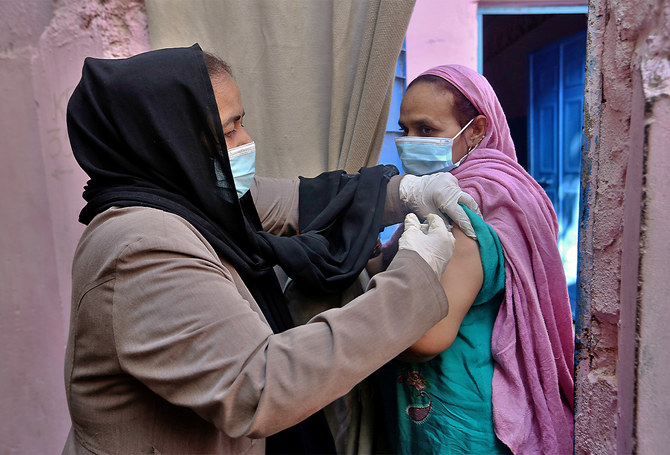
A handout issued by Sindh health department said vaccinators had been hired and lady health workers trained to reach maximum number of people at their doorstep to improve the pace of the official inoculation campaign.
It added the provincial authorities would not allow any indoor activities or events where the prescribed health care precautions were not adequately followed.
“Public transport should be monitored as there is a high level of infection transmission within those mediums of transport,” the statement continued. “Unvaccinated staff working in different trade and industrial sectors should be barred from working and upon denial of so, those businesses should be closed/sealed till vaccination of the same be done.”
In a separate statement, the province’s chief minister Syed Murad Ali Shah also raised concern over the increasing rate of infection among people of the province.
“Since August 11, 2021, today we have the highest number of 1,347 cases detected through 12,114 PCR tests while Karachi has shown a 20 percent detection rate,” he said. “The current detection rate of the omicron variant is 95 percent.”
Shah added that nine more coronavirus patients had died overnight, taking Sindh’s death toll to 7,691 which constituted 1.6 percent of the total COVID-19 fatality rate in the country.


![]()

Sindh to increase vaccination coverage as COVID-19 positivity reaches 20 percent in Karachi
Short Url
https://arab.news/zf2ph
Sindh to increase vaccination coverage as COVID-19 positivity reaches 20 percent in Karachi
- The provincial health authorities have agreed to seal industrial units, shopping centers with unvaccinated staff
- Sindh reported 1,347 new COVID-19 cases on Tuesday, its highest since August last year
Latest updates


© 2026 SAUDI RESEARCH & PUBLISHING COMPANY, All Rights Reserved And subject to Terms of Use Agreement.