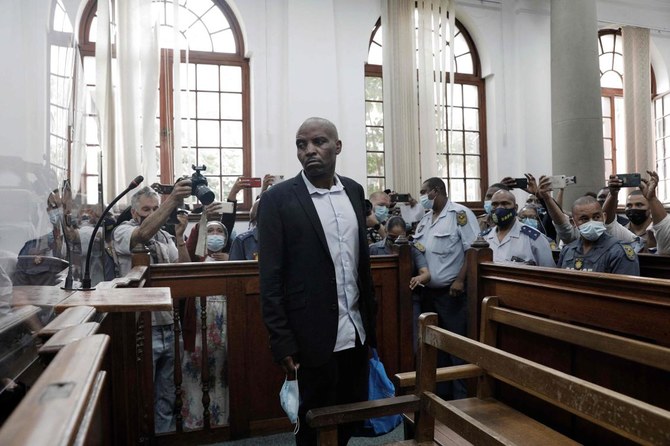
CAPE TOWN: A man suspected of starting a devastating fire that gutted South Africa’s parliament made his second appearance in court on Tuesday.
The blaze broke out in the Cape Town complex before dawn on January 2, spreading to the National Assembly, the roof of which collapsed.
Zandile Christmas Mafe, 49, was arrested around the complex the same day and made his first brief court appearance three days later.
He initially faced charges of breaking into parliament, arson and intention to steal property, including laptops, crockery and documents.
Since his arrest, debate has raged in South Africa over whether Mafe, described in the local media as homeless, was responsible for setting the building on fire.
Ahead of the hearing on Tuesday, a group of around 30 people, picketed outside the Cape Town magistrate court demanding Mafe be freed, brandishing handwritten signs such as “Free Mafe,” “He is innocent” and “He is not guilty.”
One homeless person recounted the events of the night the fire started. He was sleeping on a street near the parliament complex and heard a sound like a car collision. He later suspected that was the break-in before the fire started.
A preliminary report by the city of Cape Town last week said the fire detection system appeared “faulty,” and that “sprinklers did not activate” and that they were last serviced in 2017, missing a February 2020 scheduled service.
It took scores of fire fighters more than two days to extinguish the blaze which tore through the wood-panelled assembly chamber where parliamentary debates are held.
No casualties were reported in the fire, but the extensive damage has shaken the country and forced the authorities to move the annual state-of-the-nation address to be delivered next month by President Cyril Ramaphosa to an alternative venue in Cape Town.

Suspect in South African parliament fire back in court
https://arab.news/4bwy6
Suspect in South African parliament fire back in court
- Zandile Christmas Mafe arrested around the complex the same day of the blaze
- No casualties were reported in the fire, but the extensive damage has shaken the country
What is Trump’s ‘Board of Peace’?
- The Board of Peace’s charter does not appear to limit its role to the occupied Palestinian territory of Gaza
- Trump will be chairman but also “separately serve as inaugural representative of the United States of America”
BRUSSELS: US President Donald Trump’s government has asked countries to pay $1 billion for a permanent spot on his “Board of Peace” aimed at resolving conflicts, according to its charter seen by AFP.
The board was originally conceived to oversee the rebuilding of war-torn Gaza, but the charter does not appear to limit its role to the occupied Palestinian territory.
What exactly will it do? And who has been invited?
- To what end? -
The Board of Peace will be chaired by Trump, according to its founding charter.
It is “an international organization that seeks to promote stability, restore dependable and lawful governance, and secure enduring peace in areas affected or threatened by conflict,” reads the preamble of the charter sent to countries invited to participate.
It will “undertake such peace-building functions in accordance with international law,” it adds.
- Who’s boss? -
Trump will be chairman but also “separately serve as inaugural representative of the United States of America.”
“The Chairman shall have exclusive authority to create, modify, or dissolve subsidiary entities as necessary or appropriate to fulfill the Board of Peace’s mission,” the document states.
He will pick members of an Executive Board to be “leaders of global stature” to “serve two-year terms, subject to removal by the Chairman.”
He may also, “acting on behalf of the Board of Peace,” “adopt resolutions or other directives.”
The chairman can be replaced only in case of “voluntary resignation or as a result of incapacity.”
- Who can be a member? -
Member states have to be invited by the US president, and will be represented by their head of state or government.
Each member “shall serve a term of no more than three years,” the charter says.
But “the three-year membership term shall not apply to Member States that contribute more than USD $1,000,000,000 in cash funds to the Board of Peace within the first year of the Charter’s entry into force,” it adds.
The board will “convene voting meetings at least annually,” and “each member State shall have one vote.”
But while all decisions require “a majority of Member States present and voting,” they will also be “subject to the approval of the Chairman, who may also cast a vote in his capacity as Chairman in the event of a tie.”
- Who’s already in? -
The White House has said its members will include:
US President Donald Trump, chair
US Secretary of State Marco Rubio
Steve Witkoff, Trump’s special negotiator
Jared Kushner, Trump’s son-in-law
Tony Blair, former UK prime minister
Marc Rowan, billionaire US financier
Ajay Banga, World Bank president
Robert Gabriel, loyal Trump aide on the National Security Council
- Who’s been invited? -
The list of countries and leaders who say they have been invited include, but are not limited to:
Russia’s President Vladimir Putin
Canada’s Prime Minister Mark Carney
Egypt’s President Abdel Fattah El-Sisi
Argentina’s President Javier Milei
Jordan
Brazil
Paraguay
India
Pakistan
Germany
France
Italy
Hungary
Romania
Uzbekistan
Belarus
Greece
Morocco
Slovenia
Poland
- When does it start? -
The charter says it enters into force “upon expression of consent to be bound by three States.”


