

Qiddiya — a global tourism destination is in the making: Year in Review

Short Url
Updated 07 January 2022
Follow

Qiddiya — a global tourism destination is in the making: Year in Review

  • The project is in line with Vision 2030 plan to reduce the Kingdom’s reliance on oil

RIYADH: Qiddiya ended the year on a high after it signed a SR3.75 billion ($1 billion) contract to build a theme park housing the world’s tallest and fastest rollercoaster in what will be the Kingdom’s entertainment city.

The Qiddiya Investment Co. penned an agreement in December with Saudi Arabia’s Almabani General Contractors and France’s Bouygues Batiment International to build the Six Flags Qiddiya theme park.

The 32 hectare-site will include 28 rides and attractions across six different themed areas.

The 4km Falcon’s Flight rollercoaster ride will be the centerpiece of the park, and will touch speeds of 250km an hour and includes a dive of 160 meters.

But the rollercoaster is just a small part of the Qiddiya giga-project that will include arts centers, festival grounds, a sports stadium, shops and restaurants, housing developments, a motor racing circuit and a golf course designed by 18-time major winner Jack Nicklaus.
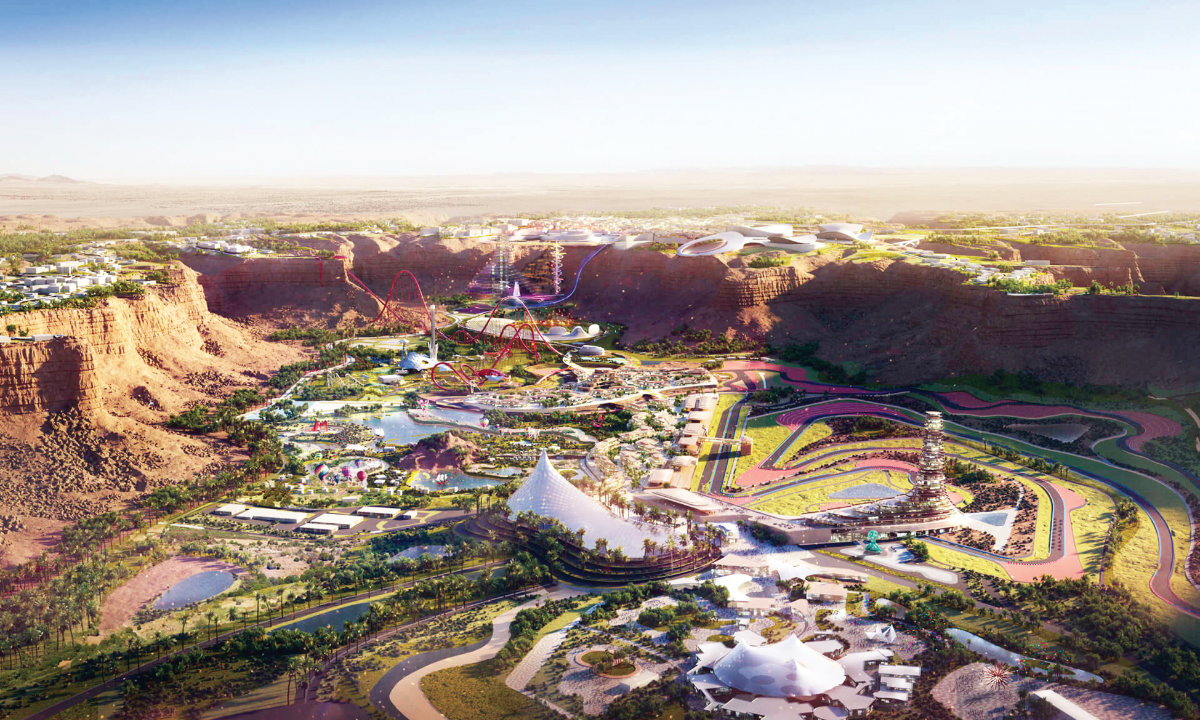


The area hopes to attract 17 million visitors a year by 2030 and is expected to contribute up to SR17 billion to the country’s gross domestic product by 2030. (Supplied)

The development was announced by Crown Prince Mohammed bin Salman in 2017 in a bid to make Qiddiya one of the top tourist destinations in the world.

The move is in line with the Crown Prince’s Vision 2030 plan to reduce the Kingdom’s reliance on oil and boost investment.

The site is also in step with the government’s moves to boost revenue from tourism from its current 3 percent to 10 percent of gross domestic product by the end of the decade.

The Qiddiya project is located south-west of Riyadh on a site that covers 367 sq. km and is 45km from the capital city Riyadh. The new city will be an hour's drive from King Khaled International Airport.

The area hopes to attract 17 million visitors a year by 2030 and is expected to contribute up to SR17 billion to the country’s gross domestic product by 2030, providing 25,000 jobs. 

The project, in its early development stage, currently employs around 500 workers, 60 percent of whom are Saudis.

The Qiddiya Investment Co., which is wholly owned by sovereign wealth body the Public Investment Fund of the Kingdom, has said the site plans to host international and local holidaymakers.

It said that Qiddiya will help “redirect tourism spending into the Kingdom, by providing distinct entertainment options for residents, which are currently unavailable to explore and experience without the need to travel to other countries and incur extra expenses abroad.”

QIC also plans to appeal to locals or expats looking for second homes. It expects to build 4,000 houses by 2025, and 11,000 by 2030. 

With art centers, golf courses and racing circuits to build — it looks like Qiddiya’s rollercoaster riding is only just beginning.

Decoder

What is Qiddiya?

Qiddiya is one of Saudi Arabia's six giga-projects being established as part of the Kingdom's Vision 2030, which aims to diversify the income resources of the country. Located 45 km south-west of the capital city of Riyadh, the project aspires to be an entertainment, sports and arts hub, and hopes to attract 17 million visitors a year by 2030 and is expected to provide 25,000 jobs and contribute up to SR17 billion to the country’s gross domestic product by 2030.


Saudi POS stays above $4bn as Ramadan spending lifts home goods

Updated 16 sec ago
Follow

Saudi POS stays above $4bn as Ramadan spending lifts home goods

RIYADH: Saudi point-of-sale transactions remained above $4 billion in the week ending Feb. 14, with spending on furniture and home supplies rising ahead of Ramadan, central bank data showed. 

Overall POS activity totaled SR15.34 billion ($4.09 billion), representing a 4.8 percent week-on-week decrease, while the number of transactions dipped 1.6 percent to 252 million, according to the Saudi Central Bank. 

Spending on furniture and home supplies rose 5.9 percent to SR697.35 million, marking the strongest weekly increase among major retail categories. 

Expenditure on electronics increased 2.9 percent, while spending on construction and building materials rose 1.1 percent.

Sectors that saw declines includes freight transport and courier services, which posted a drop of 5 percent to SR64.86 million.

Pharmacy and medical supplies spending fell 8.2 percent to SR223.81 million, but outlays on medical services rose 5.7 percent to SR539.68 million. 

Food and beverage expenditure decreased 4.3 percent, but the total spend of SR2.57 billion meant it retained the largest share of POS activity.

Restaurants and cafes followed with SR1.73 billion, despite a 4.7 percent decline. Apparel and clothing outlays represented the third-largest share of POS spending during the monitored week, up 0.5 percent to SR1.38 billion.

The Kingdom’s major urban centers mirrored the mixed national changes. Riyadh, which accounted for the largest share of total POS spending, saw a 3.4 percent drop to SR5.32 billion. The number of transactions in the capital reached 80.7 million, down 0.8 percent week on week. 

In Jeddah, transaction values decreased 4.4 percent to SR2.12 billion, while Dammam reported a 3.3 percent decrease to SR746.29 million. 

POS data, tracked weekly by SAMA, provides an indicator of consumer spending trends and the ongoing growth of digital payments in Saudi Arabia.  

The data also highlights the expanding reach of POS infrastructure, extending beyond major retail hubs to smaller cities and service sectors, supporting broader digital inclusion initiatives.  

The growth of digital payment technologies aligns with Saudi Arabia’s Vision 2030 objectives, promoting electronic transactions and contributing to the Kingdom’s broader digital economy.