

More than 200 detained in Kazakhstan unrest, president removes ex-leader from post

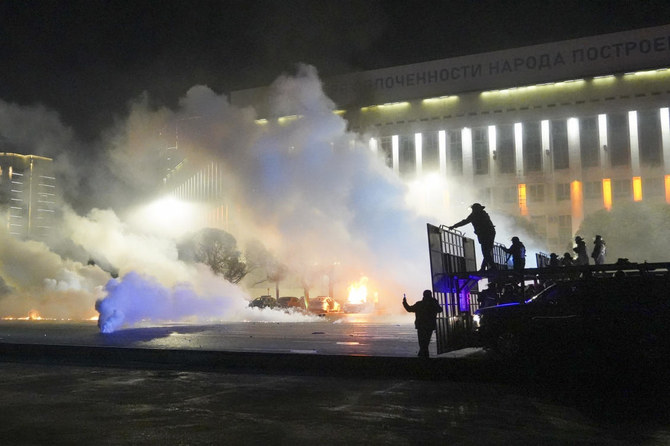
Riot police prepare to block protesters in the center of Almaty, Kazakhstan, Wednesday, Jan. 5, 2022. (AP)
Short Url
Updated 05 January 2022
Follow

More than 200 detained in Kazakhstan unrest, president removes ex-leader from post

  • Buildings on fire in biggest city Almaty
  • President says government botched fuel price increase

ALMATY: Kazakhstan’s president stripped his powerful predecessor of a role as head of the country’s security council on Wednesday after demonstrators stormed and torched public buildings in the republic’s worst unrest for more than a decade.
The cabinet resigned, but that failed to quell the demonstrators’ anger after days of unrest triggered by a fuel price rise in the oil-producing Central Asian country.
Some protesters chanted slogans against Nursultan Nazarbayev, 81, who has retained wide authority since stepping down in 2019 as the longest-serving ruler of an ex-Soviet state.
Nazarbayev’s hand-chosen successor, President Kassym-Jomart Tokayev, said he had taken over as head of the powerful Security Council, a post that had been retained by Nazarbayev.
The former president has still been widely seen as the main political force in Nur-Sultan, the puropose-built capital which bears his name. His family is believed to control much of the economy.
In a televised address, Tokayev did not mention Nazarbayev by name. The former president has not been seen or heard from in public since the start of the protests.
With the Internet shut down across Kazakhstan after the unrest, it was not possible to determine whether removing Nazarbayev from the Security Council post would satisfy the protesters. Tokayev also removed Nazarbayev’s nephew from a post as number two at the State Security Committee, the successor to the Soviet-era KGB.
An Instagram live stream by a Kazakh blogger showed a fire blazing in the office of the mayor of the main city, Almaty, with apparent gunshots audible nearby. Videos posted online also showed the nearby prosecutor’s office burning.
Earlier on Wednesday, Reuters journalists saw thousands of protesters pressing toward Almaty city center, some of them on a large truck. Security forces, ranked in helmets and riot shields, fired tear gas and flash-bang grenades.
The city’s police chief said Almaty was under attack by “extremists and radicals,” who had beaten up 500 civilians and ransacked hundreds of businesses.
States of emergency were declared in Nur-Sultan, Almaty, and westerly Mangistau province where protests first broke out.

Meanwhile, Kuwait's budget carrier Jazeera Airways suspended flights to Almaty in Kazakhstan due to the situation in the city on Wednesday.
“We will provide an update on our operations when we have further information,” an airline spokesperson said in a statement.
Almaty is the airline's only destination in Kazakhstan, according to the company's website.
Reuters journalists reported the Internet had been shut down as the unrest spread. Netblocks, a site that monitors global Internet connectivity, said Kazakhstan was “in the midst of a nation-scale Internet blackout.”
Though the unrest was triggered by a fuel price rise, there were signs of broader political demands.
Footage showed police and security officials in civilian clothes breaking up a small group of protesters in the city of Shymkent, hauling away men and pushing them into a police car and a white van as some chanted “Nazarbayev, go away!“
In the city of Aqtobe, what appeared to be several hundred protesters gathered on a square shouting: “Old Man, go away!.” A video posted online showed police using water cannon and stun grenades against protesters near the mayor’s office there.
After accepting the Cabinet’s resignation, Tokayev ordered acting ministers to reverse the fuel price rise, which doubled the cost of liquefied petroleum gas from the start of the year. The gas is widely used to power vehicles in Kazakhstan because official prices made it much cheaper than gasoline.
Kazakhstan’s reputation for political stability under Nazarbayev has helped it attract hundreds of billions of dollars of foreign investment in its oil and metals industries.
The unrest saw the price of Kazakhstan’s dollar bonds plunge by nearly 6 cents, the worst showing since the height of the market collapse of 2020 after the start of the COVID-19 pandemic.
Political analysts said the veneer of stability has masked anger among a younger generation denied the liberalization seen in other former Soviet states.
“I think there is an underlying undercurrent of frustrations in Kazakhstan over the lack of democracy,” said Tim Ash, emerging market strategist at BlueBay Asset Management.
“Young, Internet savvy Kazakhs, especially in Almaty, likely want similar freedoms as Ukrainians, Georgians, Moldovans, Kyrgyz and Armenians, who have also vented their frustrations over the years with authoritarian regimes.”
Kazakhstan is a close ally of Russia. The Kremlin said it expected the country to quickly resolve its internal problems, warning other countries against interfering.
Kazakhstan has been grappling with rising price pressures. Inflation was closing in on 9 percent year-on-year late last year — its highest level in more than five years — forcing the central bank to raise interest rates to 9.75 percent.


UK veterans are ‘ticking time bomb’ after Iraq war chemical exposure

Updated 10 sec ago
Follow

UK veterans are ‘ticking time bomb’ after Iraq war chemical exposure

  • Fifteen former RAF personnel were deployed to the Qarmat Ali water plant in 2003, which was contaminated with sodium dichromate
  • Veterans say they were not screened or protected, and are now living with serious health conditions

LONDON: Fifteen British servicemen who worked on a carcinogen-contaminated water treatment site during the Iraq war say they were not offered biological screening despite official guidance saying they should have been.

The former Royal Air Force members, who have suffered from ailments including cancer, tumors and nosebleeds, told Sky News they were offered no medical assistance or subsequent treatment after having been exposed to toxic sodium dichromate at the Qarmat Ali water treatment plant in 2003.

The channel said it had seen a letter from the RAF’s medical authority stating that senior officers knew of the dangers posed by the substance.

Peter Lewis, 53, was one of 88 personnel deployed to guard the site, which was deemed vital for getting Iraq’s oil industry up and running. He told Sky: “I’ve had eight or nine operations to remove cancer.

“I’ve had so many lumps taken out of my neck, one on my face. This is something I’m literally fighting every year now. It’s constant.”

Qarmat Ali, the former troops say, was covered in ripped bags of bright orange sodium dichromate.

“We were never warned what the bags of chemicals were,” Jon Caunt, another former serviceman, said. “We were breathing this stuff in.”

His former comrade Tony Watters added: “I never thought about what it was. We were told the site is safe.”

Several months after deployment to the site, however, the servicemen were joined by two workers wearing protective gear who placed signs around it reading: “Warning. Chemical hazard. Full protective equipment and chemical respirator required. Sodium dichromate exposure.”

Watters said: “When you left the site, your uniform was contaminated, your webbing was contaminated.

“You went in your sleeping bag, and that was contaminated. And you were contaminating other people with it back at camp.”

Andy Tosh, who has led the group of veterans as they sought answers from the Ministry of Defence, said: “Even with the warning signs going up … they kept us there. They knowingly kept us exposed.”

The RAF gave some of the men a leaflet on their return to the UK, warning of the dangers of the substance, but not all were told.

The letter seen by Sky acknowledging the dangers posed to the veterans made a “strong” link to “increased risk of lung and nose cancer” as well as numerous other issues. It suggested personnel sent to Qarmat Ali should have their medical records altered to mention their exposure to sodium dichromate.

“Offer biological screening. This cannot be detailed until the numbers exposed are confirmed,” the letter also said.

An inquiry into US personnel deployed to Qarmat Ali found that 830 people were “unintentionally exposed” to sodium dichromate, giving them access to support from the US Department of Veterans Affairs. This came after the death of Lt. Col. James Gentry from cancer in 2009, which the US Army determined came “in line of duty for exposure to sodium dichromate.”

There has been no such inquiry by UK authorities despite British personnel being deployed at the site for longer than their American counterparts.

Thirteen of them have suffered from cancer and similar symptoms, including one who developed a brain tumor.

Jim Garth told Sky: “My skin cancer will never go away … It’s treatable, but when the treatment is finished, it comes back, so I’ve got that for life really.”

Lewis added: “I’m actually getting to the point now where I don’t care anymore … sooner or later, it’s going to do me.”

Caunt described his former colleagues’ conditions as a “ticking time bomb.”

He added: “We do not know what’s going to happen in the future."

The MoD insists medical screening was offered to personnel at the time, despite the men stating that it was not. In 2024, several met with Labour MPs about the issue. One, John Healey, who is now the UK defence secretary, said at the time the veterans should have “answers to their important questions.”

In a statement, the MoD said: “We take very seriously the concerns raised by veterans who were deployed to guard the Qarmat Ali Water Treatment Plant in 2003.

“As soon as we were alerted to the possible exposure of Sodium Dichromate, an environmental survey was conducted to evaluate typical exposure at Qarmat Ali. Results showed that the levels at the time were significantly below UK government guidance levels.”

A 2004 letter seen by Sky News suggested, however, that the MoD knew the levels of sodium dichromate were higher.

“Anyone who requires medical treatment can receive it through the Defence Medical Services and other appropriate services,” the MoD said.

“Veterans who believe they have suffered ill health due to service can apply for no-fault compensation under the War Pensions Scheme.”

Watters called on the government to hold an investigation into what happened at Qarmat Ali.

“We are the working class, we are ex-soldiers who have put our lives on the line and you’re turning a blind eye to us,” he said.

Garth added: “We felt let down at Qarmat Ali all those years ago, and we still feel let down now.”