

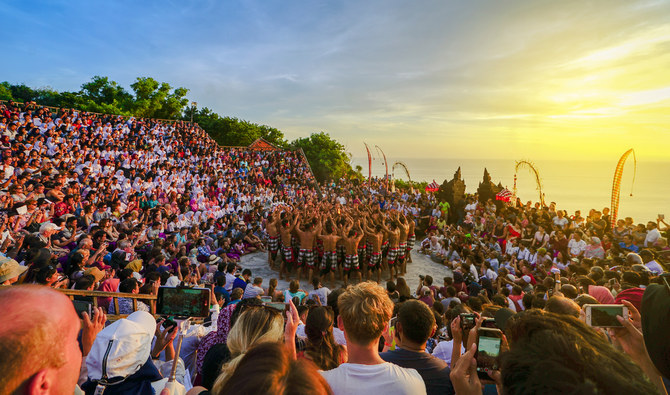

DENPASAR: Hypnotic chants accompanying the famous Kecak dance have become a symbol of the gradual recovery of the beleaguered tourism industry on Indonesia’s holiday island of Bali.
Dancers have resumed regular performances of their routines, although only for domestic tourists.
The Kecak dance was developed in the 1930s by Balinese artist Wayan Limbak and German painter Walter Spies as an art form that does not use any musical instruments instead relying on human voices for its background rhythm.
It is an adaptation of the story of the Hindu epic Ramayana, involving up to 100 bare-chested male Kecak dancers wearing black and white checkered sarongs, who harmoniously chant the cak throughout the show while sitting in a circle as the character dancers perform Ramayana roles such as Hanuman, Rama, Shinta, Ravana, and the golden deer in the middle.
Since the start of the coronavirus pandemic, many tourist attractions across the island had to close, including the Uluwatu Temple amphitheater in southern Bali, which for years has hosted Kecak performances. However, as the global health crisis has eased, Indonesians are increasingly making their way to the island and during the year-end holidays hundreds of spectators watched the captivating show.
Bali Tourism Board chairman, Ida Bagus Agung Partha Adnyana, told Arab News: “We are very grateful for the domestic tourist arrivals. In December, an average of 15,000 domestic tourists entered the island every day. With limited international destinations and foreign travel restrictions still in place, Bali remains the main destination for domestic tourists.”
Recent visitor numbers have represented a significant surge on figures for July and August, the peak of the outbreak of the delta variant of COVID-19, when the average number of daily trippers was between 700 and 800.
But Bali is still experiencing a dearth of foreign tourists, despite officially reopening for direct international flights on Oct. 14.
Adnyana said industry stakeholders and the government would be reviewing the situation based on the global development of the omicron variant.
“If the situation looks good, we hope the number of days for mandatory quarantine upon arrival will be shortened, and regulations about international flights to Bali will be revised,” he added.
Restrictions throughout the pandemic have brought tourism — a lifeline for Bali’s economy — to a standstill, severely impacting life across the island, including those of the Kecak dancers.
“There are only two things that can stop the show — the COVID-19 pandemic and Nyepi Day,” dancer I Komang Adi Kusyanto told Arab News, referring to the Balinese new year, or Day of Silence, when the predominantly Hindu island refrains from all activities.
Following multiple readjustments, the group finally restarted daily performances at the end of October for limited audiences. Troupe spokesperson I Nyoman Adi Ardika said that the dance was slightly changed to comply with social distancing measures, including reducing the number of male chanters to 40, modifying formations that required close physical contacts, and the use of face masks and face shields.
“The adjustment doesn’t change the core composition although the dancers acknowledged it makes them less expressive,” Ardika added.
Regardless of the changes and the limited audience, Kusyanto, 33, who has been a Kecak dancer since he was 15, said: “We are just really happy to perform again.”
The pandemic has hit him and fellow troupe members hard as they lost their dancing and main jobs in the hospitality sector.
“I wasn’t so shocked back in March 2020 when the border was closed. I thought it was only temporary for a few months. I never thought it would be this long,” Kusyanto added.
He worked odd jobs in between to make ends meet, including producing and selling big kites during the kite season in Bali, and as a garbage truck driver for his village administration.
But now, as domestic tourists return to the island, Kusyanto has resumed his main hospitality job working as a bartender and barista in his brother’s restaurant.


