

Pakistan makes negative PCR tests mandatory for incoming travelers above age six

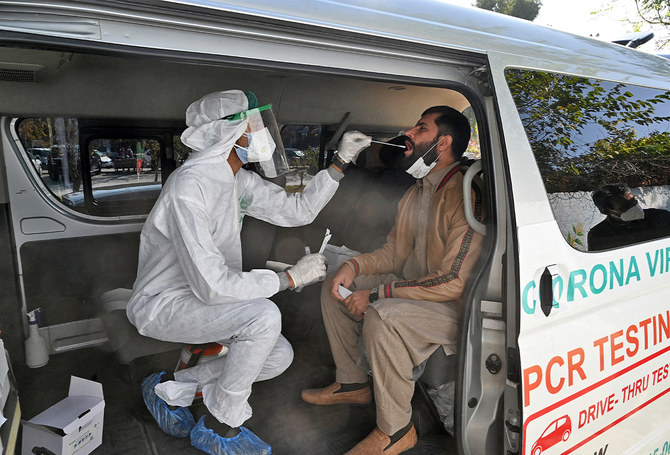
A health official collects a swab sample from a man to test for the Covid-19 coronavirus inside a van along the roadside in Islamabad, Pakistan, on November 26, 2020. (AFP/File)
Short Url
Updated 04 January 2022
Follow

Pakistan makes negative PCR tests mandatory for incoming travelers above age six

  • Government says omicron-driven fifth COVID-19 wave spreading at ‘great pace’ in Pakistan
  • New blanket guidelines will be effective from Jan 5, civil aviation authority says

ISLAMABAD: Pakistan has made a negative polymerase chain reaction (PCR) test mandatory for all passengers above 6 years flying into the country, its Civil Aviation Authority (CAA) said on Tuesday, as an omicron-fueled fifth wave of coronavirus infections gains momentum in the South Asian nation. 
Pakistan reported 630 new coronavirus cases and two fatalities in the last 24 hours, according to official figures. The country reported 708 new infections on Monday, the first time daily infections crossed the 700 mark since October 30, 2021. 
In a statement released on Monday, the National Command and Operation Center (NCOC), which oversees the country’s pandemic response, said the omicron-driven fifth wave was spreading at a “great pace.” 
“Valid negative PCR test result conducted within 48 hours prior to commencement of travel to Pakistan. This is applicable for all passengers above 6 years of age,” the CAA said in its new pre-departure guidelines. 
“Mandatory COVID-19 vaccination and proof of COVID-19 vaccination. This is applicable for all passengers above 15 years of age.” 
The South Asian nation has abolished its Category B and C of countries. Previously, arrivals from countries in Category B required a negative COVID-19 PCR test taken 72 hours before departure, while Category C list meant a “complete ban on inbound travel.” Passengers coming from countries in Category A did not require a negative PCR test until now. 
The new blanket guidelines will be effective from January 5. 

The country also issued the following on-arrival guidelines for passengers above 6 years: 
Rapid Antigen Testing upon arrival for all direct flights from Europe 
Rapid Antigen Testing upon arrival of a minimum of 50 percent inbound flights from the United Arab Emirates (UAE), Saudi Arabia and Qatar 
Selective Rapid Antigen Testing for all inbound flights other than flights mentioned above 

The development comes hours after Pakistan’s Director General Health Dr. Rana Muhammad Safdar said the country would adopt a “bi-pronged strategy” to deal with the fifth wave of coronavirus and a surge in cases of the omicron variant. 
“Government of Pakistan going for bi-pronged strategy of fast-tracking vaccination alongside standard operating procedures,” Safdar told Arab News. “We would keep on monitoring and mapping new clusters of cases for targeted containment measures.” 
The DG health said the threat of the omicron variant was “definitely serious given very high transmissibility and continued challenges of global vaccine equity.” 
However, he said it was a good omen that Pakistan had achieved its goal of vaccinating over 70 million of its 220 million population by the end of 2021. 
On Monday, Dr. Mumtaz Ali Khan, a focal person at the National Institute of Health in Islamabad, told Arab News the omicron variant was now transmitting locally in Pakistan. 
“Vaccination of maximum people, including children above 12 is the only solution to curb its surge,” he said. “We are planning a massive countrywide vaccination campaign in March to boost the immunity of our people against new variants, including the omicron strain.” 
In Sindh, the results of 351 COVID-19 tests conducted under a government initiative to determine the prevalence of the omicron variant showed that 175 samples, nearly 50 percent, were infected with the strain, the Dawn newspaper reported, citing a statement issued from the Sindh chief minister’s office. 
“Among the cases found infected with omicron, few had a travel history, predominantly from the United Kingdom, US, Dubai, Germany, Saudi Arabia, Nairobi and Angola,” the report read. 
Karachi Administrator Murtaza Wahab said coronavirus positivity rate in the southern Pakistani port city had crossed six percent and a majority of the cases were of the omicron variant. 


Pakistan opposition to meet today as Imran Khan’s party rejects prison medical exam

Updated 5 sec ago
Follow

Pakistan opposition to meet today as Imran Khan’s party rejects prison medical exam

  • Pakistan government conducted ex-PM Imran Khan’s medical examination in jail on Sunday over reports of his deteriorating eye condition
  • Khan’s family, PTI party have rejected the examination, saying that neither his family nor former premier’s doctors were invited to check-up

Islamabad: An alliance of opposition parties will meet today, Monday, to determine its future course of action after former prime minister Imran Khan’s family and his Pakistan Tehreek-e-Insaf (PTI) party rejected a medical examination of the former premier conducted by the government, a spokesperson of the alliance confirmed. 

The superintendent of Adiala Jail, where Khan is incarcerated, said a team of expert doctors from various hospitals conducted a detailed examination of his eye on Sunday. The examination was held days after a lawyer, who was asked by the top court to visit Khan at the jail earlier this month to assess his living conditions, submitted a report in the Supreme Court. The report said the 73-year-old had suffered severe vision loss in his right eye due to central retinal vein occlusion, and that he was left with only 15 percent sight in the affected eye.

Khan’s PTI party and family have dismissed the medical examination, protesting that the government had carried it out without inviting the former premier’s family members or his personal doctors. 

“Opposition will meet during the next few hours to discuss the future line of action,” Sheikh Waqas Akram, the PTI’s central information secretary, told Arab News.

“We reject the examination that has been conducted in the absence of family or their nominated doctor.”

He said that while Khan’s family members and doctors were informed of the medical examination, “disallowing our doctor and family is aimed at hiding the truth.”

Akram said the government had rejected the family’s request for Khan’s sister Dr. Uzma Khan or Dr. Nausherwan Burki, a prominent physician based in Khyber Pakhtunkhwa, to be present during the check-up. 

He said Khan’s sisters and Dr. Burki will hold a press conference on Tuesday to apprise the media about the latest situation. 

Separately in a video statement, Khan’s physician Dr. Aasim Yousaf said he spoke to the two doctors who were treating the former premier at Adiala Jail on Sunday via a conference call. He said that as per their latest assessment, Khan had shown “significant improvement” due to the treatment and that his vision “had improved significantly as well.”

“I would be extremely happy if I was able to confirm that this was the case,” Dr. Yousaf said. “Unfortunately, because I have not seen him myself and have not been able to participate in his care or to talk to him, I’m unable to either confirm or deny the veracity of what we have been told.”

Dr. Yousaf appealed to the authorities to either allow him or Dr. Faisal Sultan, CEO of the Shaukat Khanum Memorial Cancer Hospital and Research Center, to care for Khan at the central prison in Rawalpindi. He also appealed to authorities to carry out Khan’s further treatment at Shifa International Hospital in Islamabad. 

Hussain Ahmad Yousafzai, a spokesperson of the Tehreek-e-Tahafuz-e-Ayin-e-Pakistan alliance, also confirmed that members of parliament from the opposition alliance are meeting to discuss the future course of action today. 

“The opposition meeting is going to discuss future line of action as our demand for moving Imran Khan to Al-Shifa International Hospital in Islamabad and treating him in front of the family has not been fulfilled,” Yousafzai said. 

’NOTHING TO WORRY ABOUT’

Speaking to lawyers in the eastern city of Ferozewala, Law Minister Azam Nazeer Tarar said one of Khan’s eyes has around 70 percent vision with corrective glasses, while the other has “normal” 6/6 vision.

“The latest report being discussed today has been re-examined as per the Supreme Court’s order,” he said. “There is nothing to worry about.”

Separately, the Supreme Court disposed off a petition by PTI lawyers on Monday, saying that the court’s concerns about Khan’s living conditions in jail had been addressed.

“As evident from the above, the petitioner has generally expressed satisfaction with the prevailing conditions of his confinement and has not raised any concerns necessitating accommodations beyond the existing level of care,” a copy of the order seen by Arab News reads.

It added that both the reports by the Supreme Court’s appointed lawyer and the government’s team corroborated this fact, which was reinforced by assurances provided by the attorney general of Pakistan.

Opposition members have gathered outside the parliament building in Islamabad and staged a sit-in protest since Friday over health concerns regarding Khan. Reports of Khan’s eye ailment have also triggered road closures in several parts of KP.

PTI Peshawar President Saleem Irfan said major roads remained blocked on Monday, including the Peshawar–Islamabad Motorway at Swabi’s Anbar Interchange, Khairabad Bridge linking Punjab with the northwestern province, the Dera Ismail Khan–Bhakkar Road, Lakki Marwat–Mianwali Road, the Hazara Motorway at the Abbottabad–Havelian Interchange, Kohat–Pindi Road near Khushal Garh, and sections of the Karakoram Highway in Upper Kohistan.  

“We will continue to block these points until our demand is accepted,” he said.