

Pakistan says will fast track vaccine campaign, push SOPs amid omicron surge

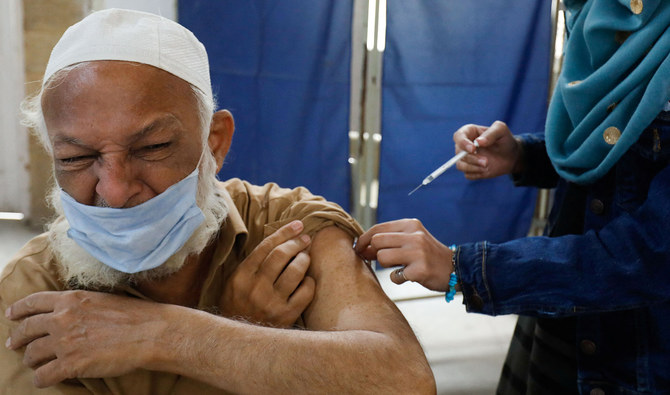
A man receives a dose of the coronavirus disease (COVID-19) booster vaccine at a vaccination centre in Karachi, Pakistan on January 3, 2022. (REUTERS)
Short Url
Updated 05 January 2022
Follow

Pakistan says will fast track vaccine campaign, push SOPs amid omicron surge

  • Government says omicron variant-driven fifth wave of the pandemic spreading at ‘great pace’ in Pakistan
  • 351 COVID-19 tests conducted in Sindh showed 175 samples, nearly 50 percent, infected with omicron strain

ISLAMABAD: Director General Health Dr. Rana Muhammad Safdar said on Tuesday Pakistan would adopt a “bi-pronged strategy” to deal with a fifth wave of the coronavirus in the country and a surge in cases of the omicron variant. 
Pakistan reported 708 new coronavirus cases on Monday, according to official figures, the first time daily infections crossed the 700 mark since October 30, 2021. In a statement released that day, the National Command and Operation Center, which oversees the country’s pandemic response, said an omicron-driven fifth wave of the virus was spreading at a “great pace.”
“Government of Pakistan going for bi-pronged strategy of fast tracking vaccination along side standard operating procedures,” Safdar told Arab News. “We would keep on monitoring and mapping new clusters of cases for targeted containment measures.”
The DG health said the threat of the omicron variant was “definitely serious given very high transmissibility and continued challenges of global vaccine equity.”
However, he said it was a good omen that Pakistan had achieved its goal of vaccinating over 70 million of its 220 million population by the end of 2021.
On Monday, Dr. Mumtaz Ali Khan, a focal person at the National Institute of Health in Islamabad, told Arab News the omicron variant was now transmitting locally in Pakistan.

“Vaccination of maximum people, including children above 12 is the only solution to curb its surge,” he said. “We are planning a massive countrywide vaccination campaign in March to boost the immunity of our people against new variants, including the omicron strain.”
In Sindh, the results of 351 COVID-19 tests conducted under a government initiative to determine the prevalence of the omicron variant showed that 175 samples, nearly 50 percent, were infected with the strain, the Dawn newspaper reported, citing a statement issued from the Sindh chief minister’s office. 
“Among the cases found infected with omicron, few had a travel history, predominantly from the United Kingdom, US, Dubai, Germany, Saudi Arabia, Nairobi and Angola,” the report read. 
Karachi Administrator Murtaza Wahab said coronavirus positivity rate in the southern Pakistani port city had crossed six percent and a majority of the cases were of the omicron variant. 


Pakistan air chief highlights modernization as PAF marks seven years since India aerial clash

Updated 4 sec ago
Follow

Pakistan air chief highlights modernization as PAF marks seven years since India aerial clash

  • Swift Retort was launched in 2019 after India attempted airstrikes following a Kashmir suicide bombing
  • Air chief’s remarks come amid fierce clashes between Pakistan and Afghanistan over cross-border militancy

ISLAMABAD: Pakistan’s air chief said on Friday the country’s air force had undertaken “comprehensive modernization and indigenization” in recent years, as he addressed a ceremony at Air Headquarters to mark seven years since an aerial confrontation with India.

Operation Swift Retort was launched on Feb. 27, 2019, a day after India attempted airstrikes inside Pakistan following a suicide bombing in Indian-administered Kashmir that killed at least 40 Indian paramilitary troops.

Pakistan responded with aerial strikes across the Line of Control and shot down an Indian fighter jet in a subsequent dogfight, capturing one pilot who was later returned in what Islamabad called a gesture of de-escalation.

“PAF has pursued comprehensive modernization and indigenization to transition into a Next Generation Air Force,” Air Chief Marshal Zaheer Ahmed Baber Sidhu said, according to a statement circulated by the military’s media wing, the Inter-Services Public Relations.

He added that the force had recalibrated its operational doctrine and rapidly inducted advanced combat and support capabilities, including indigenously developed unmanned systems, electronic warfare, space and cyber assets, establishing what he described as a “home-grown multi-domain kill chain.”

Sidhu said Pakistan remained committed to peace but would respond decisively to violations of its sovereignty.

“Pakistan is a responsible country which desires peace with honor,” he continued.

The remarks come amid renewed security tensions on Pakistan’s western frontier.

Islamabad earlier this week launched airstrikes inside Afghanistan targeting what it described as hideouts of Tehreek-e-Taliban Pakistan (TTP) and Daesh militants. Afghan authorities condemned the strikes and subsequently launched their own military response that led to fierce clashes between the two sides overnight.

Pakistan has frequently accused Kabul of allowing militant groups to use Afghan territory to carry out cross-border attacks on Pakistani civilians and security forces, an allegation denied by Afghan officials.

Pakistani authorities said earlier in the day small drones launched from the Afghan side were intercepted and brought down by the country’s air defense systems.

Sidhu said the PAF would continue to maintain a vigilant yet responsible defense posture to safeguard national sovereignty.