

Pakistan air chief highlights modernization as PAF marks seven years since India aerial clash

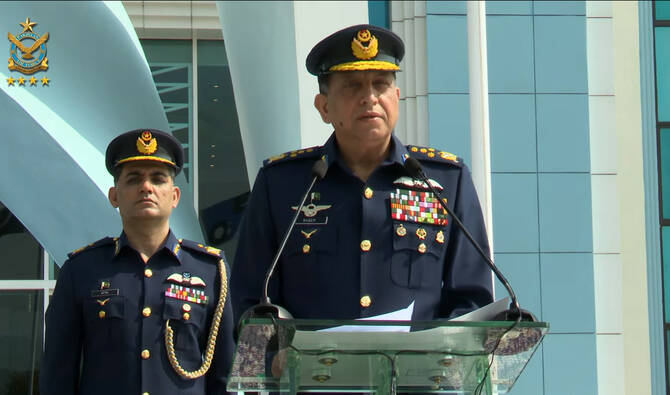
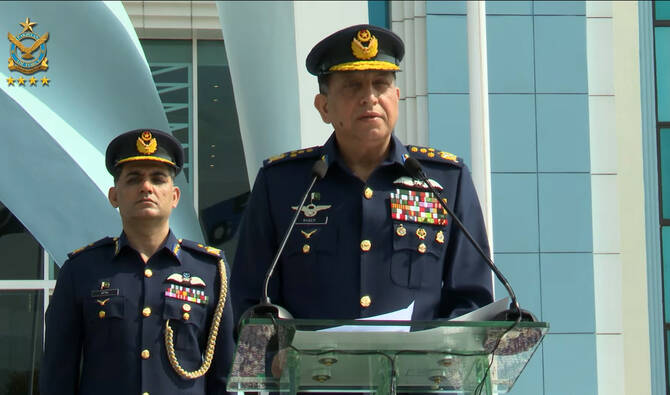
Pakistan’s Air Chief Marshal Zaheer Ahmed Baber Sidhu speaks at a ceremony at the Air Headquarters to commemorate the 7th anniversary of Operation Swift Retort in Islamabad, Pakistan, on February 27, 2026. (Screengrab/Facebook/@DGPR.PAF)
Short Url
Updated 27 February 2026
Follow

Pakistan air chief highlights modernization as PAF marks seven years since India aerial clash

  • Swift Retort was launched in 2019 after India attempted airstrikes following a Kashmir suicide bombing
  • Air chief’s remarks come amid fierce clashes between Pakistan and Afghanistan over cross-border militancy

ISLAMABAD: Pakistan’s air chief said on Friday the country’s air force had undertaken “comprehensive modernization and indigenization” in recent years, as he addressed a ceremony at Air Headquarters to mark seven years since an aerial confrontation with India.

Operation Swift Retort was launched on Feb. 27, 2019, a day after India attempted airstrikes inside Pakistan following a suicide bombing in Indian-administered Kashmir that killed at least 40 Indian paramilitary troops.

Pakistan responded with aerial strikes across the Line of Control and shot down an Indian fighter jet in a subsequent dogfight, capturing one pilot who was later returned in what Islamabad called a gesture of de-escalation.

“PAF has pursued comprehensive modernization and indigenization to transition into a Next Generation Air Force,” Air Chief Marshal Zaheer Ahmed Baber Sidhu said, according to a statement circulated by the military’s media wing, the Inter-Services Public Relations.

He added that the force had recalibrated its operational doctrine and rapidly inducted advanced combat and support capabilities, including indigenously developed unmanned systems, electronic warfare, space and cyber assets, establishing what he described as a “home-grown multi-domain kill chain.”

Sidhu said Pakistan remained committed to peace but would respond decisively to violations of its sovereignty.

“Pakistan is a responsible country which desires peace with honor,” he continued.

The remarks come amid renewed security tensions on Pakistan’s western frontier.

Islamabad earlier this week launched airstrikes inside Afghanistan targeting what it described as hideouts of Tehreek-e-Taliban Pakistan (TTP) and Daesh militants. Afghan authorities condemned the strikes and subsequently launched their own military response that led to fierce clashes between the two sides overnight.

Pakistan has frequently accused Kabul of allowing militant groups to use Afghan territory to carry out cross-border attacks on Pakistani civilians and security forces, an allegation denied by Afghan officials.

Pakistani authorities said earlier in the day small drones launched from the Afghan side were intercepted and brought down by the country’s air defense systems.

Sidhu said the PAF would continue to maintain a vigilant yet responsible defense posture to safeguard national sovereignty.



Pakistan PM calls for faster CPEC implementation, pledges security for Chinese workers

Updated 27 February 2026
Follow

Pakistan PM calls for faster CPEC implementation, pledges security for Chinese workers

  • Shehbaz Sharif pushes expanded cooperation in agriculture, IT and mining under CPEC phase two
  • Chinese envoy reaffirms Beijing’s support for Pakistan’s sovereignty and economic development

ISLAMABAD: Prime Minister Shehbaz Sharif on Friday called for speeding up projects under the China-Pakistan Economic Corridor (CPEC) and pledged stronger security guarantees for Chinese workers and investments, during a meeting with China’s ambassador in Islamabad.

Sharif made the remarks as the two countries strive to launch the second phase of CPEC, a multibillion-dollar infrastructure and energy initiative launched in 2015 as part of China’s Belt and Road Initiative (BRI).

CPEC’s first phase focused largely on power generation and transport infrastructure aimed at easing Pakistan’s chronic energy shortages and improving connectivity. The second phase seeks to expand cooperation into industrial development, with an emphasis on special economic zones and export-oriented growth.

“While highlighting the importance of accelerating ongoing CPEC projects, the Prime Minister stressed on the need to enhance cooperation in agriculture and IT and mining & minerals,” said a statement circulated by the PM Office after the meeting.

“He also underscored Pakistan’s resolve to provide a secure and conducive environment for Chinese personnel, investments, and institutions in Pakistan,” it added.

Chinese nationals and projects in Pakistan have faced security threats in the past, including attacks by militant groups targeting infrastructure sites and convoys. Islamabad has repeatedly vowed to tighten security and has deployed special protection units for Chinese workers.

China is Pakistan’s closest ally in the region and a key economic partner, with CPEC widely regarded by Islamabad as central to long-term economic growth.

During the meeting, the prime minister conveyed greetings to Chinese President Xi Jinping and Premier Li Qiang, particularly on the occasion of the Chinese New Year.

China’s Ambassador to Pakistan, Jiang Zaidong, reiterated Beijing’s support for Pakistan’s sovereignty and socioeconomic development, according to the statement. Both sides also exchanged views on regional and international issues and agreed to maintain close coordination.