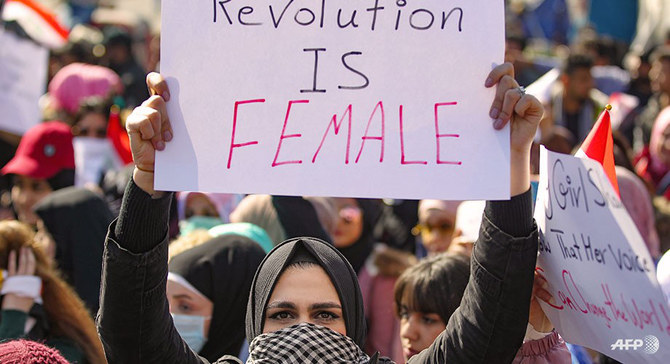

BAGHDAD: After a day’s work in an Iraq public sector job, Azhar offers legal support to women who are victims of domestic abuse, something she knows well given her experience with a brutal husband.
After she was forced into marriage by family pressure, Azhar, 56, battled in court for almost a decade to divorce the man who would beat her up.
“I believed I was going to die,” she said, recalling one attack and showing pictures of purple bruises on her arms and legs.
“That was the moment when I decided to break my chains.”
She eventually won her freedom, and the ordeal prompted her to study law.
“I felt I was weak in the face of the justice system,” recalled Azhar, who heads a non-government organization that offers legal support to victims of violence and is part of the Iraqi Women’s Network coalition.
“I help any woman who is a victim of violence or in need of legal aid, so that these women become aware of their rights and can defend themselves,” she said.
From marriage of minors to economic coercion, feminists and lawyers struggle to defend the rights of women in the overwhelmingly patriarchal country.
They cite regressive laws and the indifference of authorities as key obstacles.
In a country of 40 million, about 17,000 complaints of domestic violence were registered in 2021 by the interior ministry’s family protection unit, said media official General Saad Maan.
The marriage of minors is on the rise in Iraq, according to a government survey.
For females under 18 it jumped to 25.5 percent last year, up from 21.7 percent in 2011.
Azhar, who did not wish her surname to be published for security reasons, was around 20 when she first got married.
But she was soon widowed and forced again into marriage seven years later.
She eventually left her abusive second husband with her eight children and filed for divorce.
The first judge knew the man and rejected the request, despite three medical certificates proving her injuries, she said.
“’I will not break up families on the basis of certificates’,” she recalled the judge telling her.
“’So what if a man beats his wife?’,” she quoted him as saying.
In cases of domestic abuse, judges often push for “reconciliation,” said the head of the family protection unit, Brig. Ali Mohamed.
But “it is the victim who pays the price,” said Hanaa Edwar who heads the Al-Amal organization and has worked for 50 years as a rights defender.
“The justice system’s considerations for affairs involving women is much weaker than the machismo that dominates the minds of judges.”
Iraq has no specific law dealing with violence against women, and the 1969 penal code contains an article that allows rapists to escape punishment if they agree to marry their victims.
Rights groups are seeking parliament’s endorsement of a draft law on domestic abuse, but it has been blocked by Islamist parties since 2010.
A key provision of the bill is the creation of shelters for victims of domestic violence, said lawyer Marwa Eleoui.
\Mobilizing public opinion is often the only way to make headway and score the smallest of victories in Iraq, as in the case of Mariam, 16.
The teenager was disfigured by a man who broke into her home and sprayed her with acid, after her family spurned his offer of marriage, media quoted her parents as saying.
Mariam’s story drew sympathy nationwide when it was reported by Iraqi media in December, seven months after the acid attack.
Authorities say two suspects have been arrested over the assault.
“If it weren’t for media pressure, Mariam’s case would have taken two years before it went to court,” said Eleoui.
In the northern province of Kirkuk, Lina was among the young women for whom the Al-Amal organization became a critical lifeline.
At just 13 years of age, she was married off against her will to a man she said was violent.
“I was 25 when I told myself I’d had enough,” she said. “He would beat me up in a way I cannot describe.”
When she complained, her husband — and her father — tried to obtain a certificate from a doctor saying she was mentally unstable, eager to avoid a social scandal.
“The doctor saw the bruises and put me in contact with the association,” said Lina, who uses a pseudonym, fearing for her safety.
Now she works with Al-Amal and makes house calls to tell women about their rights.
“Leaving the courtroom after I got my divorce was like leaving a prison,” she said.