ISLAMABAD: The Pakistani government has directed its principal legal officer to request the Lahore High Court (LHC) to either order the return of former prime minister Nawaz Sharif or take action against his brother for submitting a “fake” affidavit ensuring his return, Information Minister Chaudhry Fawad Hussain said on Sunday.
Nawaz, 72, a key Pakistani opposition leader, has dominated the country’s politics for three decades and thrice served as its prime minister. He was removed from office by a Supreme Court order in 2017 amid revelations regarding his personal wealth.
In December 2018, he was convicted of corruption and sentenced to seven years in jail. He has consistently denied the accusations, saying they were politically motivated. Granted medical bail for treatment in London in 2019, Nawaz has not returned to the country where he is facing non-bailable arrest warrants.
Prior to Nawaz’s travel abroad, his brother, Shehbaz Sharif, had signed a court-approved affidavit, stating that he would ensure his return within four weeks or on confirmation by doctors that he had regained his health and was fit to return to Pakistan.
In August 2021, the UK Home Department refused to extend Nawaz’s stay in the country on medical grounds — a decision the former Pakistani prime minister has appealed with the British Immigration Tribunal.
The Pakistani government has now decided to take up the case and seek action against Nawaz’s brother, who is also the National Assembly opposition leader.
“After submitting an affidavit there (in court), Shehbaz Sharif sahib is lecturing us on one thing or the other,” Hussain lamented at a press conference in Karachi.
“In principle, the high court should have taken suo moto notice and summoned Shehbaz Sharif and asked him that ‘you submitted this affidavit and your brother is not returning, so should we send you to jail over a fake affidavit?’“
He said if the court didn’t take a suo moto notice, then the government would have to become a party in the case “out of compulsion.”
“Yes, the attorney general has been asked to take up this case and request the high court that either Shehbaz Sharif sahib should bring Nawaz Sharif sahib back,” he said.
“And if he doesn’t, then action should be taken against him (Shehbaz) for submitting a fake affidavit.”
Hussain’s comments came a week after local media reports suggested the Pakistani government had reached a “secret deal” with Sharif to bring him back home.
But government officials and opposition members denied on Sunday they were negotiating any deal for the return of the ex-prime minister.
State Minister for Information Broadcasting Farrukh Habib told Arab News there were no such negotiations.
“Not at all. Law will take its course,” Habib said. “He is an absconder, declared by courts. Lifetime disqualified by Supreme Court.”
Ahsan Iqbal, secretary general of Nawaz’s Pakistan Muslim League-Nawaz (PML-N), also denied the reports.
“There is no deal being negotiated with government on the return of Nawaz Sharif. All the debate is speculative and sponsored by government to divert attention from real issues faced by the public,” he told Arab News.
On the possibility of Sharif’s return to Pakistan, he said there were no such plans for now.


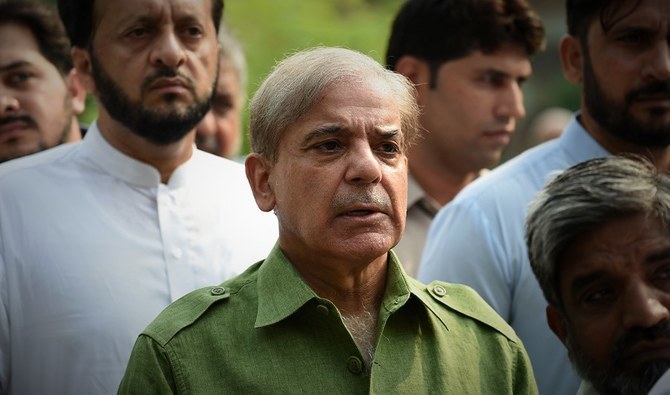
Pakistan seeks action against ex-PM Nawaz’s brother over ‘fake’ affidavit ensuring his return
https://arab.news/m8d2t
Pakistan seeks action against ex-PM Nawaz’s brother over ‘fake’ affidavit ensuring his return

- Nawaz was granted medical bail for treatment in London in October 2019 and has not returned since
- Prior to his departure, his brother Shehbaz Sharif signed an affidavit ensuring his brother’s return

Pakistan raises fuel prices by Rs55 per liter as Middle East conflict drives oil surge
- Government says adequate fuel stocks in place despite global energy shock
- Oil prices jump from about $78 to over $106 per barrel amid regional conflict
ISLAMABAD: Pakistan on Friday increased petrol and diesel prices by Rs55 ($0.20) per liter each as escalating conflict in the Middle East sent global oil prices sharply higher and disrupted energy supply routes, officials said.
Global oil markets have been rattled since coordinated strikes by the United States and Israel against Iran began last week, triggering retaliatory attacks across the region, raising fears of disruption to key energy shipping routes and pushing petroleum prices sharply upward.
The price adjustment in Pakistan was announced after a joint press conference by Finance Minister Muhammad Aurangzeb, Deputy Prime Minister and Foreign Minister Ishaq Dar and Petroleum Minister Ali Pervaiz Malik, who said the government was monitoring international energy markets and domestic supply conditions amid the crisis.
“So, the decision we have made by changing the levy a little bit is that we are going ahead with increasing the price of both fuels, petrol and diesel, by Rs55 ($0.20),” Malik told reporters.
“And as soon as this matter settles, we will revise the prices downward with the same speed and take steps on how to increase people’s income and purchasing power.”
He said Pakistan entered the crisis with “comfortable energy reserves” due to earlier planning but rising global prices had forced the government to adjust domestic fuel rates to maintain supply continuity.
He said international petrol prices had climbed from roughly $78 per barrel on March 1 to around $106.8 per barrel, while diesel prices had risen to about $150 per barrel.
Malik added that the government had taken steps to minimize the burden on consumers, noting diesel plays a critical role in agriculture, transportation and public mobility.
Malik also warned that authorities would take strict action against anyone attempting to hoard fuel or manipulate supply for profiteering.
The minister said Pakistan was working with international partners to secure additional energy supplies, including arrangements with Saudi Aramco and the use of Pakistan National Shipping Corporation vessels to transport crude oil imports.
Finance Minister Aurangzeb said a high-level government committee formed by Prime Minister Shehbaz Sharif had been meeting daily to review developments in global petroleum markets and their potential impact on Pakistan’s economy.
“Pakistan currently maintains adequate energy stocks and macroeconomic stability,” Aurangzeb said, adding that the government’s response was based on preparedness rather than panic.
He said the committee, which includes senior ministers, the governor of the State Bank of Pakistan and other officials, was assessing short-, medium- and long-term implications of the crisis for inflation, foreign exchange reserves and broader economic indicators.
Deputy PM Dar said the regional conflict had significantly disrupted global energy markets, with international petroleum prices rising by as much as 50–70 percent in recent days.
The deputy prime minister added that Pakistan was also engaged in diplomatic efforts aimed at de-escalating tensions and restoring stability in the region.
Petroleum prices will now be reviewed more frequently, potentially on a weekly basis, and any reduction in global oil prices would be passed on to consumers.
Pakistan, which relies heavily on imported fuel to meet its energy needs, is particularly vulnerable to global oil price shocks that can quickly feed into inflation and pressure the country’s external accounts.


