Pakistan’s cash incentive to exchange companies to help boost remittances — currency dealers

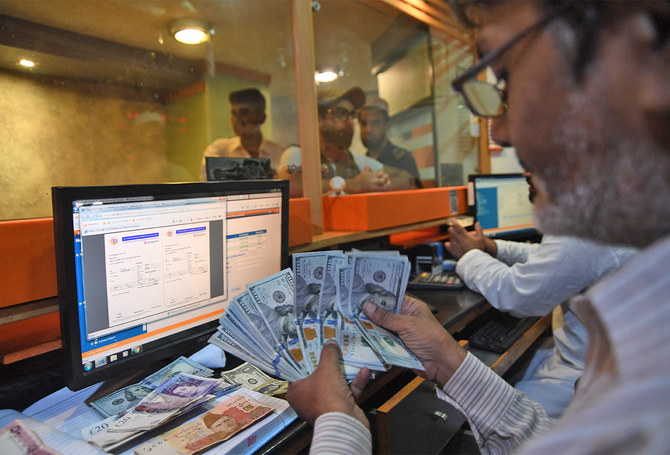
A Pakistani currency dealer counts USD banknotes at a currency exchange shop in Karachi, Pakistan, on August 1, 2018. (AFP/File)
Short Url
Updated 02 January 2022
Follow

Pakistan’s cash incentive to exchange companies to help boost remittances — currency dealers

  • Under the scheme, exchange companies will get Re1 against each surrendered US dollar in inward remittances
  • Currency dealers say initiative will help discourage illegal money transfers, stabilize rupee against greenback

ISLAMABAD: The Pakistani government’s proposed cash incentive to foreign exchange companies on surrendering US dollars in the interbank market will help boost remittances, discourage illegal money transfers and currency smuggling, Pakistani currency dealers said on Saturday. 
The Economic Coordination Committee of the federal cabinet on Friday approved a proposal to provide exchange companies with cash incentives of Re1 for surrendering each dollar mobilized from inward remittances. 
Exchange companies are now required to surrender 100 percent of their inward remittances in the interbank market to take full advantage of the scheme. 
The government has approved the proposal and directed authorities to review the model for further improvement as the country struggles to boost its foreign reserves and stabilize rupee against dollar. 
“We welcome the government’s initiative as this will help us compete with hawala/hundi (illegal money transfer channels) by offering different schemes to remitters,” Zafar Paracha, general secretary of the Exchange Companies Association of Pakistan (ECAP), told Arab News. 
He said exchange companies would now be offering better exchange rates to remitters besides offering gifts, schemes and other incentives. “This will ultimately help Pakistan boost its much-needed foreign remittances from different countries and stabilize our currency.” 
Paracha said exchange companies were playing a major part in facilitating inward remittances as they deposited around $5 billion in banks last year. 
He said this was their core business and their network operated across the globe to facilitate people in sending remittances back home. 
Earlier, the government was only offering incentives to banks for receiving and delivering inward remittances, which experts said was helping hawala/hundi do majority of business by offering better exchange rates to remitters. 
Paracha said banks were getting around Rs6-8 against each dollar, while the government was offering only Rs1 to exchange companies. “We hope the government will further increase our margin to completely document this whole business,” he said. 
Exchange companies would be buying dollars from everywhere to deposit in banks to earn more and this would ultimately result in preventing smuggling of foreign currencies, the ECAP general secretary said. 
Besides inward remittances, these companies also receive funds by exporting currencies other than the US dollar and receiving an equivalent in greenbacks in return from their customers. But this part of their business is not part of the recently announced incentive scheme. 
“Once the whole business of foreign currency is regularized and documented through different incentives, it would help the government meet its FATF (Financial Action Task Force requirements as well,” Paracha said. 
Exchange companies were earlier required to surrender 10 percent of their export proceeds and 15 percent of inward remittances in the interbank market, as per the State Bank of Pakistan’s (SBP) regulations. 
They were free to use the rest of the funds to either sell in the open market or make outward remittances on behalf of their customers. 
“This government incentive to exchange companies will break the backbone of hawala/hundi and the whole business will become legal,” Saleh Mohammad Khan, chairman of AA Exchange Company in Islamabad, told Arab News. 
“We will now be offering competitive and even better rates to remitters as more remittances will increase our incentive.” 
Overseas Pakistanis who used to carry cash while traveling to Pakistan would now prefer to remit their money through legal channels for better exchange rates, Khan added. 


US approves sale of $686 million tech upgrade, equipment for Pakistan’s F-16 fighter jets

Updated 4 sec ago
Follow

US approves sale of $686 million tech upgrade, equipment for Pakistan’s F-16 fighter jets

  • US Defense Security Coope­ration Age­ncy informs Congress sale will allow Pakistan to partner with US in counterterror efforts, won’t alter regional military balance
  • Non-Major Defense Equipment includes aircraft hardware and software modifications, precision navigation, cryptographic devices, and spare and repair parts

ISLAMABAD: The United States has approved the sale of advanced technology support and equipment for Pakistan’s F-16 fighter jets valued at $686 million, according to a letter sent by the US Defense Security Coope­ration Age­ncy (DSCA) to the American Congress, saying the move would allow Islamabad to partner with Washington in ongoing counterterrorism efforts. 

As per a copy of the document dated Dec. 8 seen by Arab News, the letter stated that Islamabad has requested to buy 92 Link-16 systems communication/data-sharing networks and six Mk–82 inert 500-lb general purpose bomb bodies. The letter also said that the sale includes non-Major Defense Equipment items such as aircraft hardware and software modifications, precision navigation, cryptographic devices, other weapons integration, test and support equipment such as spare and repair parts. 

“The estimated total cost is $686 million,” the DSCA’s letter to Congress reads. “This proposed sale will support the foreign policy and national security objectives of the United States by allowing Pakistan to retain interoperability with US and partner forces in ongoing counterterrorism efforts and in preparation for future contingency operations.”

Pakistan and the US have been key allies in battling militants in the region, with Islamabad counted among Washington’s closes non-NATO allies during the “War on Terror” campaign. The proposed sale takes place as Washington, under US President Donald Trump, warms up to Pakistan after his recent meetings with Prime Minister Shehbaz Sharif and Chief of Defense Forces Field Marshal Syed Asim Munir. 

The DSCA letter said the sale will maintain Pakistan’s capability to meet current and future threats by updating and refurbishing its Block–52 and Mid Life Upgrade F–16 fleet. 

“These updates will provide more seamless integration and interoperability between the Pakistan Air Force and the US Air Force in combat operations, exercises, and training, and refurbishment will extend the aircraft life through 2040 while addressing critical flight safety concerns,” the letter added. 

It further said Pakistan has shown a commitment to maintaining its military forces and “will have no difficulty” absorbing these articles into its armed forces. 

“The proposed sale of this equipment and support will not alter the basic military balance in the region,” the letter said. 

The principal contractor for the deal will be Lockheed Martin Company, the DSCA said, adding that the implementation of the sale will not require the assignment of any additional US government or contractor representatives to Pakistan. 

“All defense articles and services listed in this transmittal have been authorized for release and export to the Government of Pakistan,” the letter concluded. 

The development takes place as Pakistan undertakes efforts to expand its fleet of fighter jets, defense exports and deepen military-industrial partnerships with other countries. Islamabad claimed last month that a “friendly country” signed a memorandum of understanding to procure Pakistan’s JF-17 fighter aircraft during the Dubai Airshow 2025. 

The JF-17 Thunder, a multi-role fighter that Pakistan jointly developed with China, has become the backbone of the Pakistan Air Force (PAF) over the past decade. It is designed to replace aging legacy aircraft. 

The South Asian country has been eager to assert its regional dominance, especially when it comes to air warfare, after its four-day military confrontation with India in May. 

Pakistan claimed it shot down seven Indian fighter jets during the May altercation between the two forces. Indian officials have acknowledged their planes were shot down but have refused to share the exact number, rejecting Pakistan’s claim it had shot down seven.