

Chinese J-10 fighter jets to fly-past in Pakistan Day parade to counter Indian Rafale

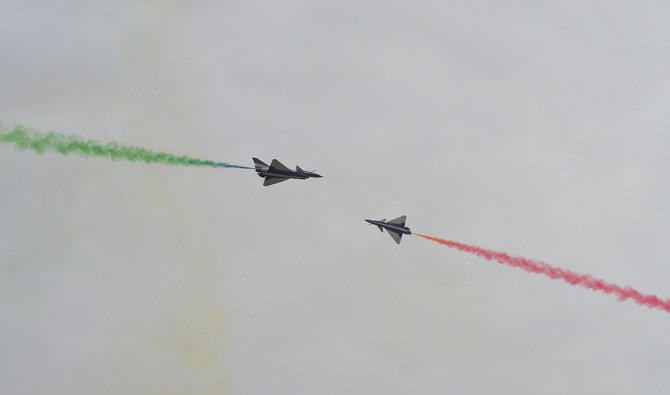
Chinese J-10 fighter jet perform during the Pakistan Day parade in Islamabad on March 23, 2019. (AFP/File)
Short Url
Updated 30 December 2021
Follow

Chinese J-10 fighter jets to fly-past in Pakistan Day parade to counter Indian Rafale

  • Interior minister says complete squadron of J-10C fighter planes will fly-past on March 23 in response to India’s Rafale jets
  • In 2016, India signed deal to buy 36 Rafale jets from France for around $8.7 billion, it has so far received 26 planes

ISLAMABAD: Pakistani Interior Minister Sheikh Rashid Ahmed has said the Pakistan Day parade on March 23 next year would include a fly-past of Chinese multirole J-10C fighter jets, putting to rest longtime rumours of Islamabad having purchased the planes from its longtime ally.

The Pakistan Day parade is held on March 23 every year to commemorate the Lahore Resolution, which was adopted on the same day in 1940 and laid the foundation for a Muslim-majority state in South Asia.  

“VIP guests are coming [to attend the 23rd March ceremony],” Ahmed told reporters on Wednesday. “For the first time in Pakistan, the fly-past ceremony of JS-10 (J-10C) is being held. In response to Rafale, Pakistan Air Force is going to perform a fly-past with Chinese JS-10 planes. This is in response to Rafale, a complete squadron of JS-10 (J-10C) aircraft will fly-past.”

He was referring to arch-rival India’s purchase of French-made Rafale combat jets, which employ dual-capable systems that can be modified as nuclear weapon delivery platforms.  

In 2016, India signed a deal to buy 36 Rafale fighter jets from France for around $8.7 billion, the country’s first major acquisition of combat planes in two decades and a boost for Prime Minister Narendra Modi’s plan to rebuild an aging fleet.

At the time, the Indian air force was down to 33 squadrons, against its requirement of 45 to face both China, with which it has a festering border dispute, and nuclear-armed rival Pakistan. India has so far received 26 of the 36 planes.

China is one of the biggest weapons suppliers for the Pakistani armed forces. Besides advanced naval ships, China has also partnered with the Pakistan Air Force to build JF-17 Thunder fighter Jets.


ADB, Pakistan sign over $300 million agreements to undertake climate resilience initiatives

Updated 30 December 2025
Follow

ADB, Pakistan sign over $300 million agreements to undertake climate resilience initiatives

  • Pakistan ranks among nations most vulnerable to climate change and has seen erratic changes in weather patterns
  • The projects in Sindh and Punjab will restore nature-based coastal defenses and enhance agricultural productivity

ISLAMABAD: The Pakistani government and the Asian Development Bank (ADB) have signed more than $300 million agreements to undertake two major climate resilience initiatives, Pakistan’s Press Information Department (PID) said on Tuesday.

The projects include the Sindh Coastal Resilience Sector Project (SCRP), valued at Rs50.5 billion ($180.5 million), and the Punjab Climate-Resilient and Low-Carbon Agriculture Mechanization Project (PCRLCAMP), totaling Rs34.7 billion ($124 million).

Pakistan ranks among nations most vulnerable to climate change and has seen erratic changes in its weather patterns. In 2022, monsoon floods killed over 1,700 people, displaced another 33 million and caused over $30 billion losses, while another 1,037 people were killed in floods this year.

The South Asian country is ramping up climate resilience efforts, with support from the ADB and World Bank, and investing in climate-resilient infrastructure, particularly in vulnerable areas.

“Both sides expressed their commitment to effectively utilize the financing for successful and timely completion of the two initiatives,” the PID said in a statement.

The Sindh Coastal Resilience Project (SCRP) will promote integrated water resources and flood risk management, restore nature-based coastal defenses, and strengthen institutional and community capacity for strategic action planning, directly benefiting over 3.8 million people in Thatta, Sujawal, and Badin districts, according to ADB.

The Punjab project will enhance agricultural productivity and climate resilience across 30 districts, improving small farmers’ access to climate-smart machinery, introducing circular agriculture practices to reduce residue burning, establishing testing and training facilities, and empowering 15,000 women through skills development and livelihood diversification.

Earlier this month, the ADB also approved $381 million in financing for Pakistan’s Punjab province to modernize agriculture and strengthen education and health services, including concessional loans and grants for farm mechanization, Science, Technology, Engineering and Mathematics (STEM) education, and nursing sector reforms.