
Update: 16.37 Riyadh time
Prices update
Bitcoin, the leading cryptocurrency in trading internationally, traded lower on Wednesday, falling by 4.91 percent to $46,736 at 4:31 p.m Riyadh time.
Ether, the second most traded cryptocurrency, traded at $3,706, down by 5.39 percent, according to data from Coindesk.
New year predictions
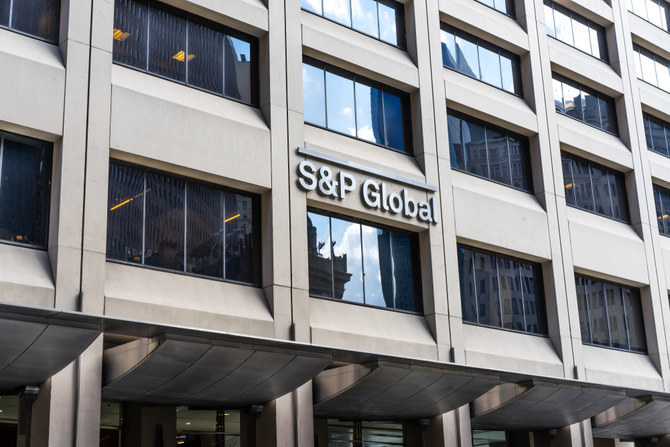
A new report from S&P Global, an intelligence gathering and data company, predicts that the cryptocurrency and decentralized finance — DeFi — sectors will continue to grow in 2022.
The report titled Global Credit Outlook 2022, shows that while institutional investments in cryptocurrency remain concentrated in a small number of companies, this could lead to other institutions following suit, Bitcoin.com reported.
Three companies, Block.one, MicroStrategy and Tesla hold almost 84 percent of corporate investments in Bitcoin.
However, the increased interest from institutional investors demonstrates the accelerated expansion of cryptocurrencies as investment vehicles, according to the report.
The report also showed that tokenization could provide the possibility of democratizing opportunities.
Regulation will also be an important part of the coming year, as the industry still needs a regulatory framework that recognizes the rights of token holders and smart contract protocols.
“Defi will continue to complement, not supplant, traditional finance in 2022. We believe it will continue evolving in 2022 toward complementing the current financial system rather than substituting financial services companies. To remain relevant, we think incumbent players will have to further step up investments in new technologies,” the report declared.
India & crypto
Indian legal experts reportedly say that it is too late to ban cryptocurrency despite calls for a complete crypto ban by the central bank.
The Swadeshi Jagran Manch (SJM), affiliated with the nationalist Rashtriya Swayamsevak Sangh, has also issued a resolution calling for a total ban on cryptocurrencies, according to Bitcoin.com.
Meanwhile, the Indian government is reworking the crypto bill before submitting it to parliament.
13:25 Riyadh time: Iran orders ban on crypto mining for second time to save energy: Crypto Moves
RIYADH: Bitcoin, the leading cryptocurrency in trading internationally, traded lower on Wednesday, falling by 2.49 percent to $47,842 at 1:21 p.m. Riyadh time.
Ether, the second most traded cryptocurrency, traded at $3,809, down by 2.47 percent, according to data from Coindesk.
Mining
For the second time this year, Iran has ordered the closure of licensed crypto-mining centers.
This is part of efforts to relieve pressure on the country's energy plants and avoid power outages, according to Mostafa Mashhadi, a spokesman for Iran’s power industry.
The ban, which will be in place until March 6, will free up 209 megawatts of power for consumption in the household sector, he said in an interview with state TV, Bloomberg reported.
Mashhadi added that the authorities are cracking down on illegal mining by individuals at home and industrial units on a large scale.
These unlicensed operators account for the largest share of crypto mining in the country, consuming more than 600 megawatts of electricity.
Other measures to save fuel include turning off street lights in some areas and regulating electricity consumption in offices.
The government expected to increase electricity production by 60% in the summer, Mashhadi said.
Iran's daily household gas demand rose to an unprecedented level of 570 million cubic meters per day for the first time ever, while the country exceeded its maximum production of natural gas to 800 million cubic meters per day, according to the National Iranian Gas Company.
Excessive demand has also reduced the electricity supply to industrial units.
NFTs
The Kraken cryptocurrency exchange is working on a Non-Fungible Token market that can attract clients who want to do more than just collect digital art, Jesse Powell, Kraken founder and CEO said.
The market will offer custody services and the exchange is considering a system whereby clients can use NFTs as collateral to borrow money against, according to Bloomberg.
“If you deposit a CryptoPunk on Kraken, we want to be able to reflect the value of that in your account, and if you want to borrow funds against that, Kraken is working on a system to determine the liquidation value of the NFT deposited,” Powell said in an interview with Bloomberg News.
“Phase one was speculation, phase two is buying art and supporting artists, phase three is going to be functional uses of NFTs,” he added. Using deposited NFTs as collateral on Kraken could be one of those uses.