

Mother Teresa charity to continue services after India bans foreign funding

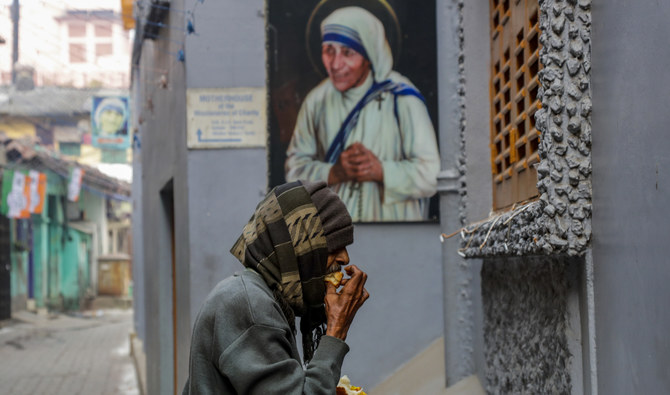
A man eats breakfast distributed by the nuns of Missionaries of Charity, the order founded by Saint Teresa, outside its headquarter beside a portrait of her in Kolkata, India, Tuesday, Dec. 28, 2021. (AP)
Short Url
Updated 29 December 2021
Follow

Mother Teresa charity to continue services after India bans foreign funding

  • The Home Ministry decided on Christmas Day to “refuse” the Missionaries of Charity’s application to renew a license that allows it to receive funds from abroad

NEW DELHI: A Catholic charity founded by Mother Teresa said that it will carry on with its “service to humanity” after the Indian government blocked it from receiving foreign funds.

The Home Ministry decided on Christmas Day to “refuse” the Missionaries of Charity’s application to renew a license that allows it to receive funds from abroad. In a statement issued on Monday, the ministry said that the organization did not meet eligibility conditions under the Foreign Contribution Regulation Act, following the discovery of “adverse inputs.”

Sunita Kumar, MoC spokesperson and longtime associate of Mother Teresa, told Arab News: “I have not known something like this ever since I have taken over as spokesperson. I have not heard of this.”

Based in the Indian city of Kolkata, MoC is considered one of the most prominent groups running shelters for the poor. The charity was founded in 1950 by Mother Teresa, a Roman Catholic nun who died in 1997 and was posthumously declared a saint by the Vatican in 2016. MoC has more than 3,000 nuns worldwide who run hospices, clinics and schools, while also taking care of abandoned children and leprosy patients.

In a statement on Monday, MoC confirmed that its renewal application had been denied, adding that it would suspend its foreign funding accounts “until the matter is resolved.”

However, Kumar said that the organization is “not worried about money.”

She added: “Our service to humanity will continue.” 

The rejection of the application came amid reports of rising intolerance towards Christians in India, including right-wing Hindu groups disrupting Christmas mass in parts of the country. The wave of anti-Christian violence reportedly took place mostly in states run by the ruling Bharatiya Janata Party, such as Madhya Pradesh, Uttar Pradesh, Haryana and Karnataka.

The latest development drew sharp criticism on social media, with senior opposition leader P. Chidambaram referring to the rejection as “shocking.”

“This is the greatest insult to the memory of Mother Teresa, who devoted her life to care for the ‘poor and wretched’ of India,” the former finance minister tweeted on Tuesday.

The BJP has yet to provide a comment on the matter. The party’s spokesperson, Sudesh Verma, did not immediately respond to queries sent by Arab News.


South Korea will boost medical school admissions to tackle physician shortage

Updated 9 sec ago
Follow

South Korea will boost medical school admissions to tackle physician shortage

  • Jeong said all of the additional students will be trained through regional physician programs

SEOUL: South Korea plans to increase medical school admissions by more than 3,340 students from 2027 to 2031 to address concerns about physician shortages in one of the fastest-aging countries in the world, the government said Tuesday.

The decision was announced months after officials defused a prolonged doctors’ strike by backing away from a more ambitious increase pursued by Seoul’s former conservative government. Even the scaled-down plan drew criticism from the country’s doctors’ lobby, which said the move was “devoid of rational judgment.”

Kwak Soon-hun, a senior Health Ministry official, said that the president of the Korean Medical Association attended the healthcare policy meeting but left early to boycott the vote confirming the size of the admission increases.

The KMA president, Kim Taek-woo, later said the increases would overwhelm medical schools when combined with students returning from strikes or mandatory military service, and warned that the government would be “fully responsible for all confusion that emerges in the medical sector going forward.” The group didn’t immediately signal plans for further walkouts.

Health Minister Jeong Eun Kyeong said the annual medical school admissions cap will increase from the current 3,058 to 3,548 in 2027, with further hikes planned in subsequent years to reach 3,871 by 2031. This represents an average increase of 668 students per year over the five-year period, far smaller than the 2,000-per-year hike initially proposed by the government of former President Yoon Suk Yeol, which sparked the months long strike by thousands of doctors.

Jeong said all of the additional students will be trained through regional physician programs, which aim to increase the number of doctors in small towns and rural areas that have been hit hardest by demographic pressures. The specific admissions quota for each medical school will be finalized in April.