

Saudi Arabia’s Ithra promotes Arabic calligraphy through special initiative

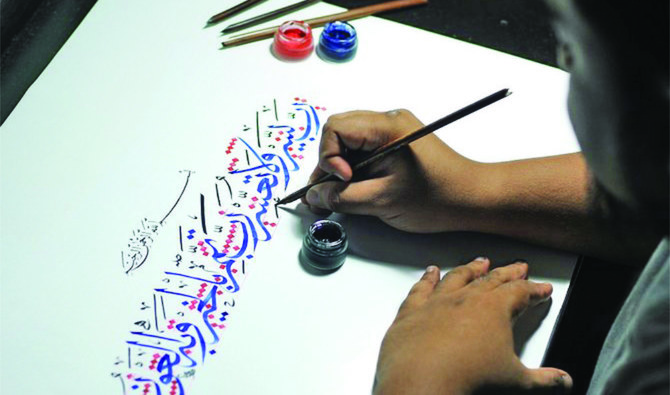
The audience was provided with a space to enjoy the beauty of the Arabic language, revive the arts of language, and exchange its rich types. (Shutterstock)
Short Url
Updated 28 December 2021
Follow

Saudi Arabia’s Ithra promotes Arabic calligraphy through special initiative

  • During 2021, Arabic had the lion’s share of programs at the center

DHAHRAN: The King Abdulaziz Center for World Culture (Ithra) has been promoting the art of Arabic calligraphy through a special initiative, the Saudi Press Agency reported.

Its “Year of Calligraphy” initiative, launched by the Ministry of Culture, has celebrated this cultural tradition through programs, activities, and workshops, taking participants into a world of Mu’allaqat (distinguished poems), Arabic maqams (melodic material), poetry, prose and more.

The Arabic language had the lion’s share of programs at Ithra during 2021, with audiences and visitors having the space to enjoy its beauty, diversity, and richness.

Ithra’s programs have offered people the opportunity to explore the history and design of calligraphy, while also encouraging them to focus on the history of the Arabic language.

HIGHLIGHT

Ithra’s programs have offered people the opportunity to explore the history and design of calligraphy.

One of the programs discussed the identity of Arabic calligraphy and learning to see it as an art form. Another was called “The Calligraphy Tree,” which was an installation of all the Arabic letters in different colors, sizes and shapes.

A workshop on Arabic calligraphy through sculpture was held to explore the stages of the art, and other activities were also organized to advance calligraphy on intellectual, cultural, and cognitive levels.

Seminars on teaching Arabic calligraphy were held at the Children’s Museum, and there were workshops that focused on printing Arabic calligraphy through risograph technology. Rare products and manuscripts were exhibited in the Ithra library.

Ithra ended its calligraphy journey through the execution of an artistic work, carving out verses for 51 Arab poets of all ages and from different times.

These were set on 50 pillars inside the center’s library and were accompanied by a set of posts published on electronic platforms and in Ithraiyat magazine.

The center aims to enrich Saudi society by providing quality initiatives and programs for all sections of the community and by providing broad experiences for visitors through scientific and cultural programs and activities.


Alwaleed Philanthropies allocates $15 million for global polio eradication efforts

Updated 11 sec ago
Follow

Alwaleed Philanthropies allocates $15 million for global polio eradication efforts

  • The new contribution will support frontline vaccination campaigns, disease surveillance and rapid outbreak response over three years

DAVOS: Alwaleed Philanthropies, chaired by Prince Alwaleed bin Talal Al-Saud, renewed its commitment to the Global Polio Eradication Initiative on Thursday with a $15 million contribution during the World Economic Forum Annual Meeting 2026 in Davos, Switzerland.

The announcement was made by Princess Lamia Bint Majed Al-Saud, secretary general of Alwaleed Philanthropies, and Bill Gates, chair of the Gates Foundation.

The new contribution will support frontline vaccination campaigns, disease surveillance and rapid outbreak response over three years, helping the program reach children in vulnerable and conflict-ravaged areas through the Gates Philanthropy partners.

The donation comes at a pivotal moment for the global effort to end polio, as the program intensifies operations in the last remaining endemic countries and responds to outbreaks worldwide.

With cases of wild poliovirus now confined to just two countries — Afghanistan and Pakistan — sustained political leadership and financing remain essential to protect hard-won gains and ensure that no child is left behind.

The princess said the contribution “builds on Alwaleed Philanthropies’ long-standing support for global health and its partnership with the Global Polio Eradication Initiative, reinforcing the critical role of philanthropy in addressing some of the world’s most complex public health challenges.”

Gates said that polio eradication “is within sight, but the last mile is the hardest.” He added: “Alwaleed Philanthropies’ latest commitment is exactly the kind of leadership the world needs to build a future where no family has to live in fear of polio paralyzing their child.”

Mike McGovern, chair of the Polio Oversight Board, said sustained support enables organizations to reach children in vulnerable and remote communities and to preserve the progress made over the past four decades.

Launched in 1988, the GPEI, led by national governments and supported by its core partners, has reduced polio cases by more than 99 percent and protected over 20 million people from paralysis.

The World Health Organization and UNICEF play a leading role, working alongside governments and communities to sustain access, build trust and ensure that polio eradication efforts reach the most vulnerable children.