

PM-led committee approves Pakistan’s ‘first ever’ national security policy 

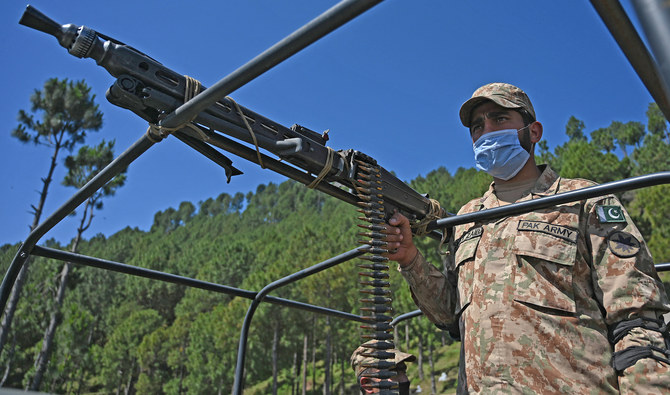
A Pakistani soldier patrols near the Line of Control, de facto border between India and Pakistan at Salohi village in Poonch district of Pakistan-administered Kashmir on April 26, 2021. (AFP)
Short Url
Updated 28 December 2021
Follow

PM-led committee approves Pakistan’s ‘first ever’ national security policy 

  • Document will now be presented to federal cabinet before being officially adopted
  • Formulated over last seven years in consultation with relevant stakeholders 

ISLAMABAD: Pakistan’s National Security Committee, on Monday, approved the country’s first-ever national security policy 2022-2026 in a high-level huddle to ensure safety, security and dignity of the citizens.
The meeting was chaired by Prime Minister Imran Khan with federal ministers for foreign affairs, defense, information, interior, finance, human rights, chairman Joint Chiefs of Staff Committee, all services chiefs, National Security Adviser and senior civil and military officers in attendance. 
“The security of Pakistan rests in the security of its citizens,” the prime minister emphasized during the meeting while reposing confidence that Pakistan is well prepared to meet any internal and external threats. 
Terming the policy’s formulation and approval a “historic moment,” the prime minister noted that the policy must guide all organs of the government to ensure that their efforts are synchronized with the overall direction of the strategy. 
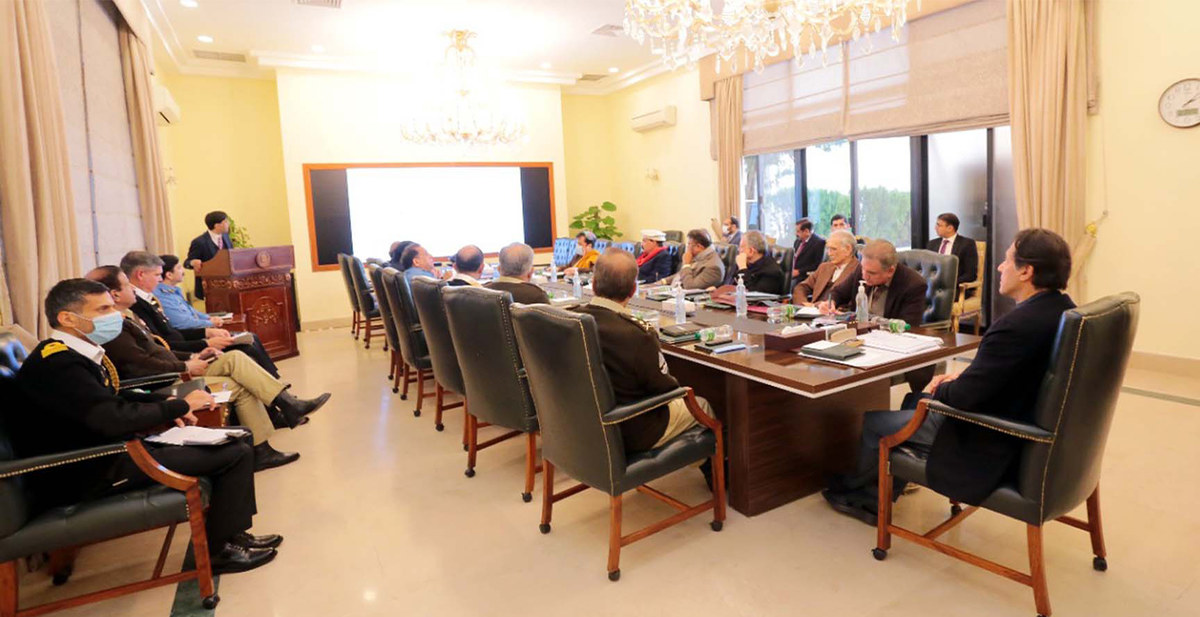


Pakistan Prime Minister Imran Khan chairs National Security Committee meeting in Islamabad, Pakistan, on December 27, 2021. (PID)

He instructed the National Security Adviser (NSA) Moeed Yusuf to present an implementation progress report to the national security committee every month. 
The NSA briefed the participants on the salient features of the policy while highlighting that Pakistan was shifting to a Comprehensive National Security Framework whereby the “ultimate purpose of national security was to ensure the safety, security and dignity of the citizen of Pakistan.” 
To ensure citizen-centric approach to security, the policy put economic security at the core, according to a press statement issued after the meeting. 
“A stronger economy would create additional resources that would in turn be judiciously distributed to further bolster military and human security,” the NSA was quoted as saying in the meeting. 
The statement said that participants of the meeting were informed that the policy had been created through a whole-of-government effort over the last seven years, and included extensive consultations among federal government institutions, with all provinces, and with the academia and private sector. 
It was highlighted that a detailed implementation framework had been created through which the National Security Division would review progress in collaboration with relevant ministries and departments. 
The national security policy will now be presented to the federal cabinet before being officially adopted, it said. 
A public version of the document will be released in due course, the statement added. 


Pakistan court directs authorities to form medical board to assess Imran Khan’s eye condition

Updated 12 March 2026
Follow

Pakistan court directs authorities to form medical board to assess Imran Khan’s eye condition

  • Islamabad High Court rejects jailed ex-PM’s request for immediate transfer to private hospital
  • Medical board comprising doctors from PIMS and Shifa to submit report on possible transfer

ISLAMABAD: A Pakistani high court on Thursday directed authorities to form a medical board of government doctors to assess whether jailed former prime minister Imran Khan needs to be transferred to a hospital, his party said, following a rejection of his request to be moved to a private facility for treatment.

The development comes after the Pakistan Institute of Medical Sciences (PIMS) said last week that Khan’s vision had “improved remarkably” since he was given an Anti-VEGF injection amid concerns related to his eyesight.

Anti-VEGF injections are commonly used to treat retinal vein occlusion and other retinal vascular disorders by reducing swelling and abnormal blood vessel growth inside the eye. Prior to the development, the ex-premier had complained of rapid deterioration in vision in one of his eyes.

“The Islamabad High Court has rejected Imran Khan’s request for immediate transfer to Shifa International Hospital,” the Pakistan Tehreek-e-Insaf (PTI) party said in a post on X.

“The court directed that the Chief Commissioner immediately constitute a medical board comprising doctors from PIMS and Shifa Hospital,” it continued. “The medical board will submit a report, on the basis of which the Chief Commissioner will decide whether a hospital transfer is to take place or not.”

The PTI said the court’s decision had raised questions over the judiciary’s independence.

“Delaying a medical emergency and handing it over to administrative discretion is a violation of human rights,” it said. “The issue of Imran Khan’s health is not just about one individual but reflects the entire judicial and state system.”

The 74-year-old cricketer-turned politician has been in prison since August 2023 in cases that he and his party say are politically motivated.

Khan was taken to PIMS for a medical procedure earlier this year, as his party questioned the transparency of the medical update and demanded independent access to his care.

Khan was removed from office in April 2022 through a parliamentary vote of no confidence that he says was orchestrated at the behest of the former administration in Washington by his political rivals with backing from the military. His allegation has been denied by all parties involved.

Since his imprisonment, Khan has faced multiple convictions and ongoing legal proceedings that authorities say follow due process, while his party describes them as efforts to sideline him from politics.