

PM-led committee approves Pakistan’s ‘first ever’ national security policy 

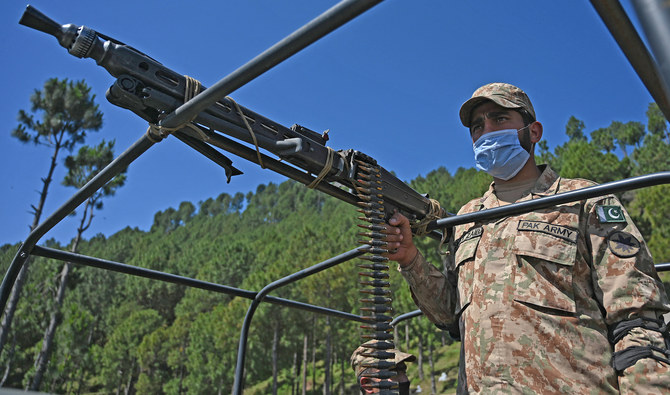
A Pakistani soldier patrols near the Line of Control, de facto border between India and Pakistan at Salohi village in Poonch district of Pakistan-administered Kashmir on April 26, 2021. (AFP)
Short Url
Updated 28 December 2021
Follow

PM-led committee approves Pakistan’s ‘first ever’ national security policy 

  • Document will now be presented to federal cabinet before being officially adopted
  • Formulated over last seven years in consultation with relevant stakeholders 

ISLAMABAD: Pakistan’s National Security Committee, on Monday, approved the country’s first-ever national security policy 2022-2026 in a high-level huddle to ensure safety, security and dignity of the citizens.
The meeting was chaired by Prime Minister Imran Khan with federal ministers for foreign affairs, defense, information, interior, finance, human rights, chairman Joint Chiefs of Staff Committee, all services chiefs, National Security Adviser and senior civil and military officers in attendance. 
“The security of Pakistan rests in the security of its citizens,” the prime minister emphasized during the meeting while reposing confidence that Pakistan is well prepared to meet any internal and external threats. 
Terming the policy’s formulation and approval a “historic moment,” the prime minister noted that the policy must guide all organs of the government to ensure that their efforts are synchronized with the overall direction of the strategy. 
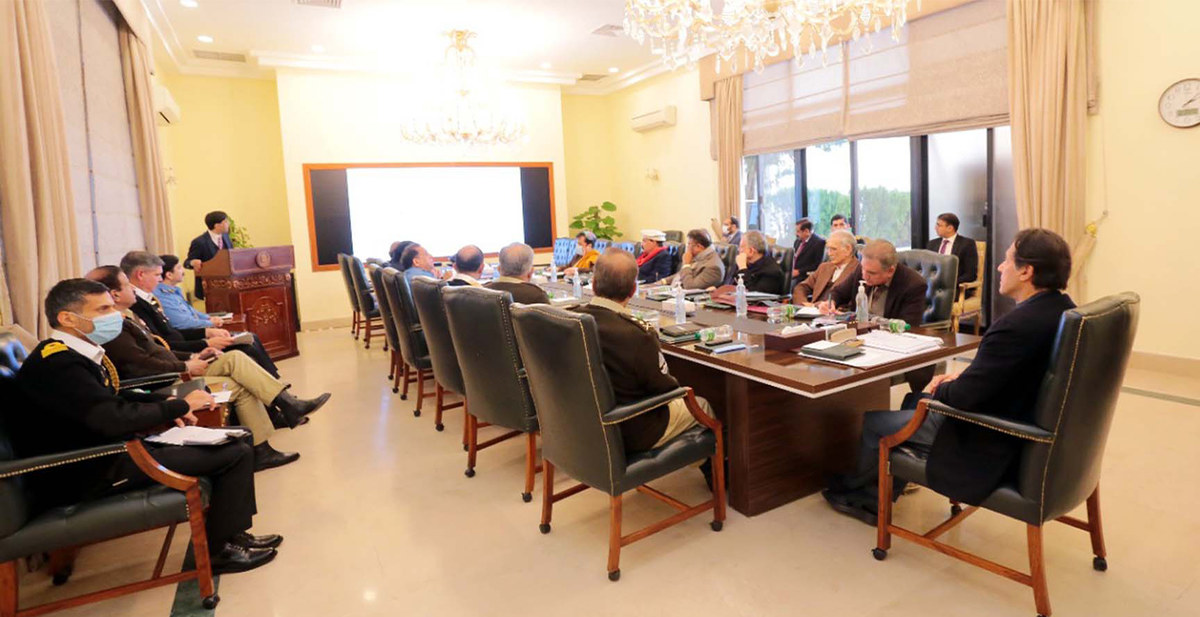


Pakistan Prime Minister Imran Khan chairs National Security Committee meeting in Islamabad, Pakistan, on December 27, 2021. (PID)

He instructed the National Security Adviser (NSA) Moeed Yusuf to present an implementation progress report to the national security committee every month. 
The NSA briefed the participants on the salient features of the policy while highlighting that Pakistan was shifting to a Comprehensive National Security Framework whereby the “ultimate purpose of national security was to ensure the safety, security and dignity of the citizen of Pakistan.” 
To ensure citizen-centric approach to security, the policy put economic security at the core, according to a press statement issued after the meeting. 
“A stronger economy would create additional resources that would in turn be judiciously distributed to further bolster military and human security,” the NSA was quoted as saying in the meeting. 
The statement said that participants of the meeting were informed that the policy had been created through a whole-of-government effort over the last seven years, and included extensive consultations among federal government institutions, with all provinces, and with the academia and private sector. 
It was highlighted that a detailed implementation framework had been created through which the National Security Division would review progress in collaboration with relevant ministries and departments. 
The national security policy will now be presented to the federal cabinet before being officially adopted, it said. 
A public version of the document will be released in due course, the statement added. 


Pakistan Air Force conducts ‘Exercise Golden Eagle’ to test combat readiness, agility

Updated 10 February 2026
Follow

Pakistan Air Force conducts ‘Exercise Golden Eagle’ to test combat readiness, agility

  • The exercise follows an intense, four-day Pakistan-India military conflict in May 2025
  • It focused on AI-enabled operations integrating disruptive technologies, military says

ISLAMABAD: The Pakistan Air Force (PAF) has conducted “Exercise Golden Eagle” that successfully validated its combat readiness and operational agility through synchronized employment of the PAF’s complete combat potential, the Pakistani military said on Tuesday.

It comes months after Pakistan’s four-day military conflict with India in May, with Islamabad claiming victory in the standoff after the PAF claimed to have shot down at least six Indian fighter aircraft, including the French-made Rafale. New Delhi acknowledged some losses but did not specify a number.

The exercise was conducted on a Two-Force construct, focusing on AI-enabled, net-centric operations while integrating indigenous niche, disruptive and smart technologies in line with evolving regional security dynamics, according to the Inter-Services Public Relations (ISPR), the Pakistani military’s media wing.

Operating within a robust Integrated Air Defense System, friendly forces shaped the battlespace through seamless fusion of kinetic operations with cyber, space and electro-magnetic spectrum operations.

“The kinetic phase featured First-Shoot, First-Kill swing-role combat aircraft equipped with long-range BVR air-to-air missiles, extended-range stand-off weapons and precision strike capabilities, supported by Airborne Early Warning & Control platforms and Air-to-Air Refuelers,” the ISPR said in a statement.

“A key highlight of the exercise was Manned–Unmanned Teaming, with deep-reach killer drones and loitering munitions operating in a highly contested, congested and degraded environment, validating PAF’s capability to conduct high-tempo operations in modern warfare.”

In recent months, many countries have stepped up defense engagement with Pakistan, while delegations from multiple nations have proposed learning from the PAF’s multi-domain air warfare capabilities that officials say were successfully employed during the May conflict.

“The successful conduct of Exercise Golden Eagle reaffirms Pakistan Air Force’s unwavering commitment to maintaining a high state of operational preparedness, leveraging indigenous innovation and effectively countering emerging and future security challenges,” the ISPR added.