

Arab coalition conducts air raids on Houthi targets across Yemen

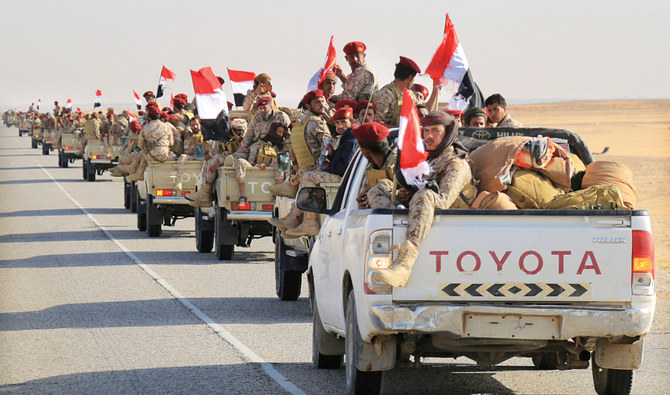
Yemeni army reinforcements arrive on the southern front of Marib to join fighters loyal to the government. (AFP/File)
Short Url
Updated 27 December 2021
Follow

Arab coalition conducts air raids on Houthi targets across Yemen

  • Militia fails to reinforce dwindling forces in Marib, paving way for govt victory

AL-MUKALLA: The Arab coalition supporting the Yemeni government carried out new airstrikes on Sunday, targeting a military camp in Houthi-held Sanaa and rebel reinforcements in Marib Governorate.

The coalition said in a statement on Sunday that it destroyed weapon depots at a military camp controlled by the Houthis, urging residents not to pass through or congregate near targeted military sites in Sanaa.

Residents in Sanaa reported hearing large explosions as images on social media showed smoke billowing from the targeted sites.

On Saturday, the coalition launched a large-scale military operation against the Houthis in Yemen, shortly after a missile fired by the militia killed two civilians in Saudi Arabia’s Jazan.

The coalition vowed to punish the Houthis for targeting civilians in Yemen and across the border in the Kingdom.

At the same time, local media reported on Sunday that the latest airstrikes by the coalition in have prompted the Houthis into replacing officials and arresting members on suspicion of being coalition spies.

Quoting a source close to the Houthi movement’s Supreme Council, Al-Sahil Al-Gharbi, a news site affiliated with Yemen’s former president Ali Abdullah Saleh, reported that the militia was taken aback by the coalition air raids on their command rooms, secret military sites and officials.

The movement accused guards of sending key coordinates to the coalition and subsequently changed security and intelligence protocols, including residences, guards, communications and meeting times, the news site said.

On the ground, coalition jets struck Houthi military gatherings and vehicles in the province of Marib, where government forces are battling aggressive rebel attacks, Abdu Abdullah Majili, a Yemeni army spokesperson, told Arab News on Sunday.

The airstrikes thwarted Houthi attempts to reinforce their dwindling forces in Marib and paved the way for government forces to retake territory, Majili said.

Dozens of combatants were killed in heavy fighting between government troops and the Houthis over the past 24 hours in sites south of Marib, as the Houthis continuously attacked government loyalists.

Majili said that the latest fierce fighting occurred around the Al-Balaq Al-Sharqi mountain range on the southern edges of the city.

Thousands of combatants and civilians have been killed since February when the Houthis renewed a major military offensive to capture the energy-rich city of Marib, the government’s last bastion in the north.

Also in Marib, government officials and local human rights activists strongly condemned a Houthi missile strike on a petrol station in Marib that claimed the lives of three civilians.

A missile fired by the Houthis on Saturday exploded inside a compound of buildings, an oil station and an automobile repair shop in Marib city, killing three civilians, including a child, and wounding eight more.

Two more missiles fired by the militia also hit other locations in the densely populated city over the past two days.

Muammar Al-Eryani, Yemen minister of information, culture and tourism, tweeted that the Houthis intensified missile attacks on residential areas in Marib after failing to make military gains on the fronts outside the city.

“The targeting of residential areas in Marib using three Iranian-made ballistic missiles is a hysterical and cowardly act. It reveals the scale of losses the Houthis have incurred on fronts and its indifference to the fate of millions of residents in the city,” he said.

Separately, Yemen President Abed Rabbo Mansour Hadi on Saturday appointed Awadh Mohammed Al-Wazer Al-Awlaki, an influential tribal leader, an MP and a member of the General People’s Congress party, as new governor of the oil-rich province of Shabwa, replacing Mohammed Saleh bin Adeo, who was named as a presidential adviser.


Aoun slams ‘systematic policy of aggression’ as Israeli strikes kill 2, wound journalists in south Lebanon escalation

Updated 4 sec ago
Follow

Aoun slams ‘systematic policy of aggression’ as Israeli strikes kill 2, wound journalists in south Lebanon escalation

  • Lebanese Army: Attacks terrorize civilians and hinder weapons control plan
  • Israeli army spokesperson said military eliminated Abu Ali Salameh, who served as a Hezbollah liaison officer in the area
  • Israeli drones targeted sites with heavy airstrikes, wounding journalists in Qanarit and destroying their equipment, cameras and vehicles

BEIRUT: Two people were killed and several journalists wounded in a series of Israeli attacks on Wednesday targeting southern areas, most of which lie north of the Litani River.

The Lebanese Army Command described the escalation as “impeding the army’s efforts and hindering the completion of its plan to confine weapons to Lebanese territory.” It said that the strikes terrorized civilians, caused deaths and injuries, displaced dozens of families and undermined regional stability.

The day’s security situation was dominated by hours of Israeli escalation, including airstrikes and evacuation warnings targeting villages and populated areas ahead of further bombardment.

The Israeli army said that warplanes carried out precision strikes on civilian vehicles in Bazouriyeh, killing a Hezbollah member. A separate drone strike hit a civilian vehicle on the Zahrani-Mseileh road, killing one person, with Israel claiming the target was another Hezbollah operative.

Israeli army spokesman Avichai Adraee said that the military “eliminated Abu Ali Salameh, who served as a Hezbollah liaison officer” in the village of Yanouh, in southern Lebanon. He accused Salameh of managing Hezbollah activities to “enable the group to operate within civilian areas and on private property, and to establish terrorist infrastructure in the heart of populated civilian areas, through the deliberate and cynical exploitation of the residents to serve Hezbollah’s objectives.”

Adraee claimed that on Dec. 13, Israel alerted Lebanon’s enforcement mechanism about a Hezbollah weapons depot in Yanouh. Salameh allegedly relayed the notification to other Hezbollah members, who then blocked Lebanese army access by staging a gathering while removing weapons from the site.

He said that Salameh also coordinated with the Lebanese army to falsely document the property as weapons-free, even as “suspicious boxes” were removed via a back entrance. Adraee called these actions a violation of Israel-Lebanon understandings, adding that “the Israeli army will continue to take measures to eliminate all threats.”

Israeli artillery also shelled the Harmoun area in the Bint Jbeil district, south of the Litani River, prompting Israeli army warnings — complete with maps — for residents of Qanarit, Kfour in Nabatieh and Jarjouh to evacuate immediately.

Israeli drones then hammered the sites with heavy airstrikes, wounding journalists in Qanarit and destroying their equipment, cameras and vehicles.

The Press Photographers Syndicate said: “Israeli claims of maintaining safe distances offer no protection, just as the warnings issued by the enemy to civilians offer no protection. It seems that cameras are not a red line.”

The statement urged photojournalists “to exercise caution and avoid turning their professional commitment into a reckless gamble.” 

Civilians in the targeted areas reported receiving phone calls from Israel ordering them to clear squares, residential neighborhoods and a mosque.

The Lebanese Army Command confirmed that “Israeli attacks and violations targeted civilian buildings and homes in several areas, most recently in villages in the south, in a blatant violation of Lebanon’s sovereignty and security, the cessation of hostilities agreement, and UN Security Council Resolution 1701.”

Lebanese President Joseph Aoun issued a statement on Wednesday evening condemning the strikes and accused Tel Aviv of “pursuing a systematic policy of aggression” that targeted civilians and violated international humanitarian law, and constituted “a dangerous escalation.”

“This repeated aggressive behavior proves Israel’s refusal to abide by its commitments under the cessation of hostilities agreement and reflects a deliberate disregard for the efforts exerted by the Lebanese state to control the situation on the ground, maintain stability, and prevent the escalation of the confrontation,” he said.

He called on the international community — particularly the agreement’s sponsors — “to assume their legal and political responsibilities and take clear and effective measures to stop these violations and put an end to the policy of impunity.”

The escalation also came as Aoun reaffirmed his commitment to “monopolizing weapons in the hands of the state throughout all Lebanese territory.”

At a meeting of the Higher Supervisory Committee for Lebanon’s border protection program — attended by the US and Canadian ambassadors — Army Commander Gen. Rudolph Haykal stressed the army’s “absolute commitment” to securing borders but called for “qualitative military support” to tackle challenges on the northern and eastern fronts.

The army said that the ambassadors praised “its professionalism and success,” stressing the need to bolster the military institution to enhance its ability to maintain security nationwide. Lebanese military units are currently securing the northern and eastern borders with Syria to combat smuggling, weapons transfers and illegal infiltration.