

On Christmas, pope prays for pandemic’s end, peace dialogues

1 / 6
Pope Francis delivers his Christmas Urbi et Orbi blessing in St. Peter's Square at The Vatican on December 25, 2021. (AFP)
2 / 6
Pope Francis stands on the main balcony of St. Peter’s Basilica to deliver his traditional Christmas Day Urbi et Orbi speech to the city and the world from the Vatican on Saturday. (Reuters)
3 / 6
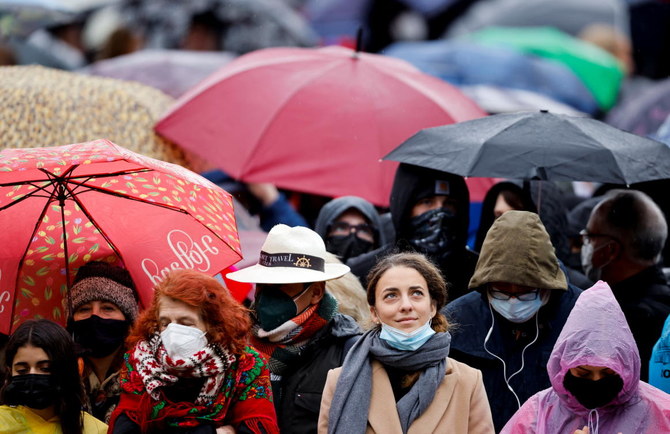
People at St. Peter’s Square before Pope Francis delivers his traditional Christmas Day Urbi et Orbi speech to the city and the world on Saturday. (Reuters)
4 / 6
A child waits at St. Peter’s Square before Pope Francis delivers his traditional Christmas Day Urbi et Orbi speech at the Vatican on Saturday. (Reuters)
5 / 6
People gather at St. Peter’s Square before Pope Francis delivers his traditional Christmas Day Urbi et Orbi speech from the main balcony of St. Peter’s Basilica at the Vatican, on Saturday. (Reuters)
6 / 6
People gather at St. Peter’s Square before Pope Francis delivers his traditional Christmas Day Urbi et Orbi speech at the Vatican on Saturday. (Reuters)
Short Url
Updated 25 December 2021
Follow

On Christmas, pope prays for pandemic’s end, peace dialogues

  • Pope Francis lamented ongoing conflicts in Syria, Yemen, Iraq and an “unprecedented crisis” in Lebanon
  • Only few thousand people flocked to St. Peter’s Square for Christmas address due to rise in COVID-19 cases

ROME: Pope Francis prayed Saturday for an end to the coronavirus pandemic, using his Christmas Day address to urge health care for all, vaccines for the poor and for dialogue to prevail in resolving the world’s conflicts.
Amid a record-setting rise in COVID-19 cases in Italy this week, only a few thousand people flocked to a rain-soaked St. Peter’s Square for Francis’ annual “Urbi et Orbi” (“To the city and the world“) Christmas address. Normally, the square would be packed with tens of thousands of holiday well-wishers.
At least they could gather this year. Italy’s 2020 holiday lockdown forced Francis to deliver a televised address from inside the Apostolic Palace to prevent crowds from forming in the square. Although Italy this week counted more than 50,000 cases in a single day for the first time, the government has not ordered another lockdown.
The pope’s Christmas Day speech gives him an opportunity to draw a global audience’s attention to conflicts big and small. This year was no different. Francis lamented ongoing conflicts in Syria, Yemen and Iraq, newly flaring tensions in Ukraine and Ethiopia, and an “unprecedented crisis” in Lebanon.

“Let us look to Iraq, which still struggles to recover from a lengthy conflict,” he said in his address.

“Let us think of the people of Syria, who for more than a decade have experienced a war that has resulted in many victims and an untold number of displaced persons.”

“We have become so used to them (conflicts) that immense tragedies are now being passed over in silence; we risk not hearing the cry of pain and distress of so many of our brothers and sisters,” he said from the loggia of St. Peter’s Basilica as Swiss Guards stood at attention in the square below.
Francis warned of the pandemic tendency to withdraw and isolate, urging instead dialogue to try to resolve the world conflicts. He prayed in particular for those most affected by the virus, including women and children who have suffered increased abuse during lockdowns.
“Son of God, comfort the victims of violence against women, which has increased in this time of pandemic. Offer hope to young children and adolescents suffering from bullying and abuse,” he said.
He prayed for “consolation and warmth” for older adults who are alone, as well as for health care workers who “generously devote themselves” to caring for the sick.
“Grant health to the infirm and inspire all men and women of good will to seek the best ways possible to overcome the current health crisis and its effects,” he said. “Open hearts to ensure that necessary medical care – and vaccines in particular – are provided to those peoples who need them most.”
Francis delivered his speech hours after celebrating a “Midnight Mass” service for some 2,000 people, a fraction of the basilica’s capacity. The service actually began at 7:30 p.m., a nod to the 85-year-old pope’s endurance and a hold-over from last year, when the service had to end before Italy’s nationwide COVID-19 curfew.
For the second day in a row, Italy on Friday set a daily pandemic record with 50,599 new cases. Another 141 people died, bringing Italy’s official death toll in the pandemic to 136,386.
With the arrival of the omicron variant in Italy, the Vatican secretary of state this week imposed a new vaccine mandate on Vatican staff, extending it to all employees except those who have recovered from COVID-19.
Previously, only employees who dealt with the public directly had to be vaccinated, such as the staff of the Vatican Museums and the Swiss Guards. Other Vatican employees could access their offices with regular testing. Now, there is no test-out exemption.


Locals in Niger say ‘terrorists’ killed 25 near Mali

Updated 4 sec ago
Follow

Locals in Niger say ‘terrorists’ killed 25 near Mali

  • “Twenty-five self-defense militia fell on Thursday in terrorist ambushes,” a former mayor said
  • The surrounding Tillaberi region is an area of operations of the Sahel branch of the Daesh militant group

ABIDJAN: Local sources in western Niger said “terrorists” killed 25 members of a militia in several villages near the Mali border.
“Twenty-five self-defense militia fell on Thursday in terrorist ambushes,” a former mayor in the commune of Anzourou told AFP — a toll confirmed by a leader from a local civil association.
“There were 25 young self-defense fighters who lost their lives and three others who were wounded and evacuated” to hospitals in Tillaberi town and Niamey, the latter source said.
The surrounding Tillaberi region is an area of operations of the Sahel branch of the Daesh militant group.
Conflict-monitoring NGO ACLED said that in 2025 Tillaberi became the deadliest region in the central Sahel, with more than 1,200 deaths recorded.
It blamed the violence mainly on the Daesh in the Sahel group, followed by the Nigerien army and the Al-Qaeda-linked Group to Support Islam and Muslims (JNIM).
The association source said the victims came from four neighboring villages — Doukou Makani, Doukou Djinde, Doukou Saraou and Doukou Koirategui.
The Anzourou district is made up of around 50 villages and hamlets in Tillaberi, which borders near the area between Niger, Burkina Faso and Mali, long the scene of deadly militant attacks.
Niger has been run by a military junta since a coup in July 2023.
For the last decade, the country has been blighted by deadly militant attacks. Since the beginning of the year, there have been nearly 2,000 deaths, according to ACLED.
With the Nigerien army struggling to contain the attacks, it has tolerated the creation of self-defense militias by villagers, leading to bloody clashes with militants.
In December last year, the military regime in Niamey announced a “general mobilization” and the “requisition” of people and property to better fight the Islamists.
Niger has created a 6,000-strong joint force with Mali and Burkina Faso, countries also run by the military and facing militant violence.