

On Christmas, pope prays for pandemic’s end, peace dialogues

1 / 6
Pope Francis delivers his Christmas Urbi et Orbi blessing in St. Peter's Square at The Vatican on December 25, 2021. (AFP)
2 / 6
Pope Francis stands on the main balcony of St. Peter’s Basilica to deliver his traditional Christmas Day Urbi et Orbi speech to the city and the world from the Vatican on Saturday. (Reuters)
3 / 6
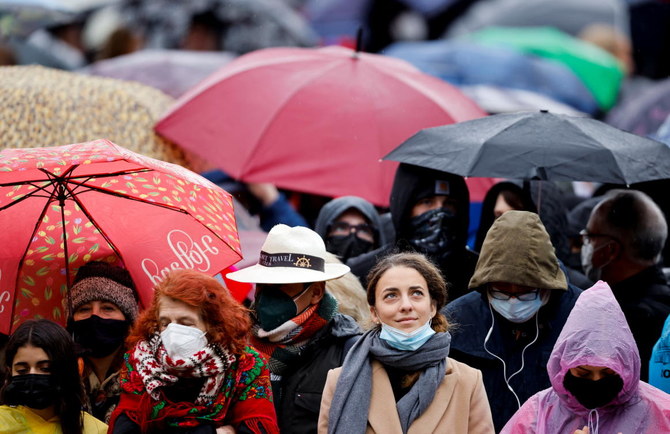
People at St. Peter’s Square before Pope Francis delivers his traditional Christmas Day Urbi et Orbi speech to the city and the world on Saturday. (Reuters)
4 / 6
A child waits at St. Peter’s Square before Pope Francis delivers his traditional Christmas Day Urbi et Orbi speech at the Vatican on Saturday. (Reuters)
5 / 6
People gather at St. Peter’s Square before Pope Francis delivers his traditional Christmas Day Urbi et Orbi speech from the main balcony of St. Peter’s Basilica at the Vatican, on Saturday. (Reuters)
6 / 6
People gather at St. Peter’s Square before Pope Francis delivers his traditional Christmas Day Urbi et Orbi speech at the Vatican on Saturday. (Reuters)
Short Url
Updated 25 December 2021
Follow

On Christmas, pope prays for pandemic’s end, peace dialogues

  • Pope Francis lamented ongoing conflicts in Syria, Yemen, Iraq and an “unprecedented crisis” in Lebanon
  • Only few thousand people flocked to St. Peter’s Square for Christmas address due to rise in COVID-19 cases

ROME: Pope Francis prayed Saturday for an end to the coronavirus pandemic, using his Christmas Day address to urge health care for all, vaccines for the poor and for dialogue to prevail in resolving the world’s conflicts.
Amid a record-setting rise in COVID-19 cases in Italy this week, only a few thousand people flocked to a rain-soaked St. Peter’s Square for Francis’ annual “Urbi et Orbi” (“To the city and the world“) Christmas address. Normally, the square would be packed with tens of thousands of holiday well-wishers.
At least they could gather this year. Italy’s 2020 holiday lockdown forced Francis to deliver a televised address from inside the Apostolic Palace to prevent crowds from forming in the square. Although Italy this week counted more than 50,000 cases in a single day for the first time, the government has not ordered another lockdown.
The pope’s Christmas Day speech gives him an opportunity to draw a global audience’s attention to conflicts big and small. This year was no different. Francis lamented ongoing conflicts in Syria, Yemen and Iraq, newly flaring tensions in Ukraine and Ethiopia, and an “unprecedented crisis” in Lebanon.

“Let us look to Iraq, which still struggles to recover from a lengthy conflict,” he said in his address.

“Let us think of the people of Syria, who for more than a decade have experienced a war that has resulted in many victims and an untold number of displaced persons.”

“We have become so used to them (conflicts) that immense tragedies are now being passed over in silence; we risk not hearing the cry of pain and distress of so many of our brothers and sisters,” he said from the loggia of St. Peter’s Basilica as Swiss Guards stood at attention in the square below.
Francis warned of the pandemic tendency to withdraw and isolate, urging instead dialogue to try to resolve the world conflicts. He prayed in particular for those most affected by the virus, including women and children who have suffered increased abuse during lockdowns.
“Son of God, comfort the victims of violence against women, which has increased in this time of pandemic. Offer hope to young children and adolescents suffering from bullying and abuse,” he said.
He prayed for “consolation and warmth” for older adults who are alone, as well as for health care workers who “generously devote themselves” to caring for the sick.
“Grant health to the infirm and inspire all men and women of good will to seek the best ways possible to overcome the current health crisis and its effects,” he said. “Open hearts to ensure that necessary medical care – and vaccines in particular – are provided to those peoples who need them most.”
Francis delivered his speech hours after celebrating a “Midnight Mass” service for some 2,000 people, a fraction of the basilica’s capacity. The service actually began at 7:30 p.m., a nod to the 85-year-old pope’s endurance and a hold-over from last year, when the service had to end before Italy’s nationwide COVID-19 curfew.
For the second day in a row, Italy on Friday set a daily pandemic record with 50,599 new cases. Another 141 people died, bringing Italy’s official death toll in the pandemic to 136,386.
With the arrival of the omicron variant in Italy, the Vatican secretary of state this week imposed a new vaccine mandate on Vatican staff, extending it to all employees except those who have recovered from COVID-19.
Previously, only employees who dealt with the public directly had to be vaccinated, such as the staff of the Vatican Museums and the Swiss Guards. Other Vatican employees could access their offices with regular testing. Now, there is no test-out exemption.


Italian police fire tear gas as protesters clash near Winter Olympics hockey venue

Updated 08 February 2026
Follow

Italian police fire tear gas as protesters clash near Winter Olympics hockey venue

  • Police vans behind a temporary metal fence secured the road to the athletes’ village, but the protest veered away, continuing on a trajectory toward the Santagiulia venue

MILAN: Italian police fired tear gas and a water cannon at dozens of protesters who threw firecrackers and tried to access a highway near a Winter Olympics venue on Saturday.
The brief confrontation came at the end of a peaceful march by thousands against the environmental impact of the Games and the presence of US agents in Italy.
Police held off the violent demonstrators, who appeared to be trying to reach the Santagiulia Olympic ice hockey rink, after the skirmish. By then, the larger peaceful protest, including families with small children and students, had dispersed.
Earlier, a group of masked protesters had set off smoke bombs and firecrackers on a bridge overlooking a construction site about 800 meters (a half-mile) from the Olympic Village that’s housing around 1,500 athletes.
Police vans behind a temporary metal fence secured the road to the athletes’ village, but the protest veered away, continuing on a trajectory toward the Santagiulia venue. A heavy police presence guarded the entire route.
There was no indication that the protest and resulting road closure interfered with athletes’ transfers to their events, all on the outskirts of Milan.
The demonstration coincided with US Vice President JD Vance’s visit to Milan as head of the American delegation that attended the opening ceremony on Friday.
He and his family visited Leonardo da Vinci’s “The Last Supper” closer to the city center, far from the protest, which also was against the deployment of US Immigration and Customs Enforcement agents to provide security to the US delegation.
US Homeland Security Investigations, an ICE unit that focuses on cross-border crimes, frequently sends its officers to overseas events like the Olympics to assist with security. The ICE arm at the forefront of the immigration crackdown in the US is known as Enforcement and Removal Operations, and there is no indication its officers are being sent to Italy.
At the larger, peaceful demonstration, which police said numbered 10,000, people carried cardboard cutouts to represent trees felled to build the new bobsled run in Cortina. A group of dancers performed to beating drums. Music blasted from a truck leading the march, one a profanity-laced anti-ICE anthem.
“Let’s take back the cities and free the mountains,” read a banner by a group calling itself the Unsustainable Olympic Committee. Another group called the Association of Proletariat Excursionists organized the cutout trees.
“They bypassed the laws that usually are needed for major infrastructure project, citing urgency for the Games,” said protester Guido Maffioli, who expressed concern that the private entity organizing the Games would eventually pass on debt to Italian taxpayers.
Homemade signs read “Get out of the Games: Genocide States, Fascist Police and Polluting Sponsors,” the final one a reference to fossil fuel companies that are sponsors of the Games. One woman carried an artificial tree on her back decorated with the sign: “Infernal Olympics.”
The demonstration followed another last week when hundreds protested the deployment of ICE agents.
Like last week, demonstrators Saturday said they were opposed to ICE agents’ presence, despite official statements that a small number of agents from an investigative arm would be present in US diplomatic territory, and not operational on the streets.