

Saudi Arabia, Pakistan ‘can play important role’ in improving conditions in Afghanistan

1 / 3
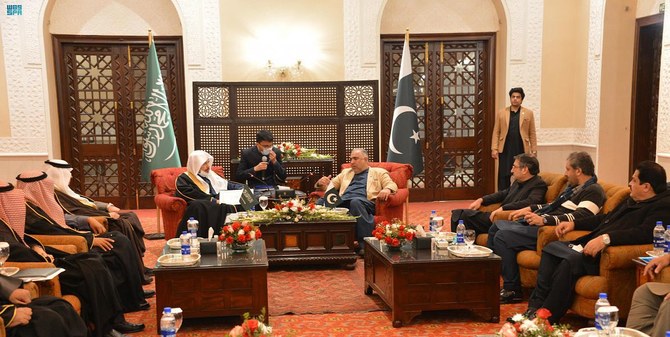
Saudi Shoura Council Speaker Sheikh Abdullah Al-Asheikh meets with the Speaker of Pakistan’s National Assembly Asad Qaiser in Islamabad on Thursday. (SPA) 
2 / 3
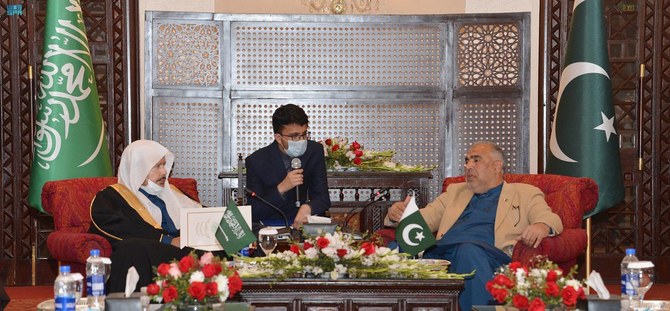
Saudi Shoura Council Speaker Sheikh Abdullah Al-Asheikh meets with the Speaker of Pakistan’s National Assembly Asad Qaiser in Islamabad on Thursday. (SPA) 
3 / 3
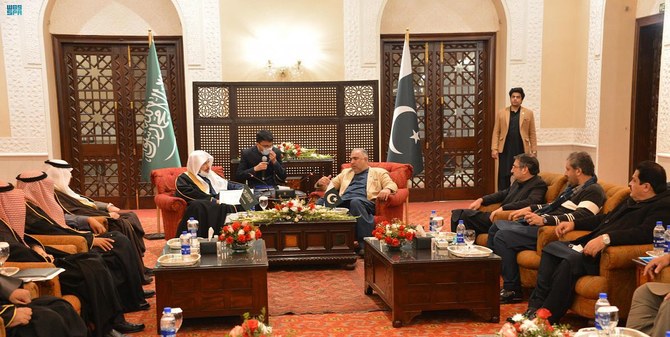
Saudi Shoura Council Speaker Sheikh Abdullah Al-Asheikh meets with the Speaker of Pakistan’s National Assembly Asad Qaiser in Islamabad on Thursday. (SPA) 
Short Url
Updated 23 December 2021
Follow

Saudi Arabia, Pakistan ‘can play important role’ in improving conditions in Afghanistan

  • Saudi Shoura Council, Pakistan National Assembly speaker discuss boosting ties

ISLAMABAD: Saudi Shoura Council Speaker Sheikh Abdullah Al-Asheikh met with the Speaker of the National Assembly of Pakistan Asad Qaiser in Islamabad on Thursday. 

Al-Asheikh praised the solid relations connecting Saudi Arabia with Pakistan, noting that they are historical, deep-rooted ties that all are inspired to enhance through meetings and agreements that can draw a practical path to realize the aspirations and hopes of the two brotherly peoples and countries.

He added that Saudi-Pakistani ties are not only friendly, but also brotherly, which has resulted in joint visions and shared perspectives on various issues, referring to the continuous and historical stances of the Kingdom in supporting issues of mutual interest with Pakistan.

He also expressed his gratitude and appreciation for Qaiser’s invitation to visit Pakistan to exchange opinions and ideas on various cooperation files and parliamentary action between the Shoura Council and National Assembly, and activating the role of joint parliamentary committees.

For his part, Qaiser referred to the distinguished level achieved by the relations and bonds between Pakistan and Saudi Arabia in various fields.

He also praised the efforts of Saudi Arabia, under the leadership of King Salman and Crown Prince Mohammed bin Salman in caring for the Two Holy Mosques.

Qaiser also expressed appreciation for the high level reached by the parliamentary relations between the National Assembly and the Shoura Council, commending Al-Asheikh’s keenness to enhance cooperation.

He also praised the Kingdom’s support for Islamic peoples and causes, such as the humanitarian support for the Afghan people, stressing that Pakistan and Saudi Arabia can play an important role in improving conditions in Afghanistan and contribute to overcoming the crisis facing its people.

Discussions also covered various issues of mutual interest, cooperation aspects and enhancing coordination at the parliamentary level in Islamic, regional and international events.

Several members and officials from the Shoura Council attended the session alongside the Kingdom’s Ambassador to Pakistan Nawaf bin Said Al-Malki.

The delegation’s visit comes just days after Pakistan hosted the 17th Extraordinary Session of the Organization of Islamic Cooperation Council of Foreign Ministers on Dec. 19, at the Parliament House in Islamabad. The session was called by Saudi Arabia.  

Saudi Foreign Minister Prince Faisal bin Farhan attended the OIC session on the Afghan crisis. During the conference, he stressed the need to ensure that Afghanistan does not turn into a shelter for terrorist and extremist groups, adding that the deterioration of the humanitarian situation will affect regional stability. 

The Saudi minister denounced Daesh terrorist attacks in Afghanistan. He added that the collapse of Afghanistan would lead to chaos that will have regional and international ramifications.

Participating OIC nations established a fund to channel humanitarian assistance to Afghanistan in partnership with other international actors.

OIC Secretary-General Hissein Brahim Taha also announced the appointment of Tariq Ali Bakheet as his special envoy on Afghanistan, to follow up on the implementation of the resolution of the Council of Foreign Ministers, particularly for coordinating efforts for the supply of humanitarian assistance to the Afghan people. 

The special envoy will coordinate delivery of humanitarian assistance and support, and is mandated to pursue economic and political engagement with Afghanistan.


Saudi Arabia champions AI and sustainable growth at UN tourism meeting in Kuwait

Updated 6 sec ago
Follow

Saudi Arabia champions AI and sustainable growth at UN tourism meeting in Kuwait

  • Saudi Tourism Minister says tourism today accounts for approximately 10 percent of the world economy, contributing about $10 trillion to global GDP 


KUWAIT CITY: Saudi Arabia’s Tourism Minister Ahmed Al-Khateeb has called for stronger international cooperation to build a tourism ecosystem that is integrated, resilient, and future-ready, the Saudi Press Agency reported Thursday.

In a opening address at the 52nd UN Tourism Regional Commission for the Middle East in Kuwait City, he noted that tourism is “no longer a peripheral activity but a massive engine of economic development.”

“With an estimated contribution exceeding $10 trillion to global GDP, tourism today accounts for approximately 10 percent of the world economy,” said Al-Khateeb, speaking as president of the 26th UN Tourism General Assembly. The three-day conference opened on Feb. 10 a.

He pointed to the Middle East’s exceptional recovery, which recorded a 39 percent increase in international arrivals in 2025 compared to 2019, welcoming nearly 100 million visitors last year.

The minister highlighted Saudi Arabia’s driving force behind these regional statistics, noting that the Kingdom now represents approximately 30% of the Middle East tourism market in both visitor numbers and spending.

“We are proud that Saudi tourism’s uninterrupted growth has become a driving force for regional tourism, and we look forward to continuing our close cooperation with UN Tourism to share our expertise with the world,” he said.

Focus on AI

Addressing the meeting’s central theme of Artificial Intelligence (AI), Al-Khateeb emphasized the need for responsible innovation. He described AI as a key enabler for growth but stressed that the “human touch” defining the hospitality sector must be maintained and the workforce protected.

On the sidelines of the regional commission, the minister met with counterparts from across the region to explore ways to promote regional cooperation and alignment to enhance resilience and build tourism industries that can drive inclusive economic and social development.

Al-Khateeb also met with leading investors from Kuwait to discuss investments in the Kingdom’s tourism sector and explore new opportunities to leverage Saudi Arabia’s integrated investment ecosystem, designed to enable regional and international investors to achieve sustainable, long-term value.

The 52nd UN Tourism Regional Commission for the Middle East is the first held in the region since the 26th UN Tourism General Assembly, hosted in Riyadh last November. 

That assembly resulted in the historic “Riyadh Declaration on the Future of Tourism,” which established a global consensus on sustainability, inclusive growth, and the responsible adoption of human-centric AI for the next fifty years.