

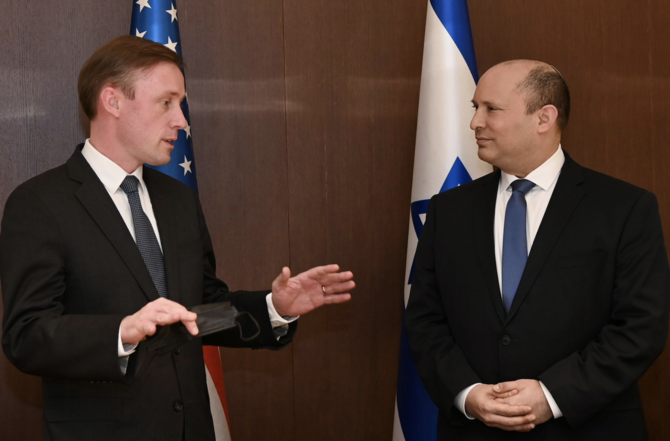
Israel PM meets US national security adviser on Iran

The US national security adviser held talks Wednesday with Israeli Prime Minister Naftali Bennett on Wednesday. (@WHNSC)
Short Url
Updated 23 December 2021
Follow

Israel PM meets US national security adviser on Iran

  • US and Israeli delegations discussed concerns over Iran’s nuclear program, its activities in the region
  • Tehran's support for proxy groups was also discussed

JERUSALEM: The US national security adviser held talks Wednesday with Israeli Prime Minister Naftali Bennett, who warned that negotiations in Vienna on Iran’s nuclear program had “profound ramifications” for Israeli security.
Bennett’s government has remained firmly opposed to ongoing international efforts to revive a 2015 accord that saw Iran agree to curbs on its nuclear activities in exchange for sanctions relief.
Jake Sullivan, national security adviser to President Joe Biden, said his visit to Israel had come at “a critical juncture.”
“It’s important that we sit together and develop a common strategy, a common outlook, and find a way forward that fundamentally secures your country’s interests and mine,” Sullivan said, according to an Israeli government statement.
He did not directly mention Iran but the Israeli statement said the meeting focused on the Vienna talks.

Later, Sullivan and his Israeli counterpart Eyal Hulata led a meeting of delegations from both countries, a joint statement said.
They discussed the need to confront “all aspects of the threat posed by Iran, including its nuclear program, destabilising activities in the region, and support for terrorist proxy groups,” the statement added.
The US and Israel “are aligned in their determination to ensure that Iran never gets a nuclear weapon,” it said.
Bennett has called for the nuclear deal negotiations to be halted, accusing Iran of “nuclear blackmail” and charging that revenue it gained from sanctions relief would be used to acquire weapons to harm Israelis.
Lead US Iran negotiator Rob Malley told CNN Tuesday that there are only “some weeks” left to revive the deal if Tehran continues its nuclear activities at the current pace.
Negotiations to restore the pact known as the Joint Collective Plan of Action resumed in November.
Washington was a party to the original agreement, but withdrew under president Donald Trump in 2018.
The Biden administration has warned it may soon be too late to revive the JCPOA.
“It really depends on the pace of their nuclear process,” said Malley, the US special envoy for Iran.
“If they halt the nuclear advances, we have more time.
“If they continue at their current pace, we have some weeks left but not much more than that, at which point the conclusion will be there’s no deal to be revived,” he said.
Iran says it only wants to develop a civil nuclear program.
Sullivan is also scheduled to meet Palestinian president Mahmud Abbas in Ramallah, in the Israeli-occupied West Bank.


Women main victims of Sudan conflict abuses: minister to AFP

Updated 20 min 1 sec ago
Follow

Women main victims of Sudan conflict abuses: minister to AFP

  • Khalifa said sexual violence has been reported on both sides, but she insisted it is “systematic” among the RSF
  • Her ministry has documented more than 1,800 rapes between April 2023 and October 2025

PORT SUDAN: Women are the main victims of abuse in Sudan’s war, facing “the world’s worst” sexual violence and other crimes committed with impunity, a rights activist turned social affairs minister for the army-backed government told AFP.
The Sudanese army and the paramilitary Rapid Support Forces (RSF) have been locked in a brutal conflict since April 2023 that has killed tens of thousands of people, displaced around 11 million and been marked by widespread sexual violence.
Sulaima Ishaq Al-Khalifa said abuses against women routinely accompanied looting and attacks, with reports of rape often perpetrated as “the family witnessed” the crime.
“There is no age limit. A woman of 85 could be raped, a child of one year could be raped,” the trained psychologist told AFP at her home in Port Sudan.
The longtime women’s rights activist, recently appointed to the government, said that women were also being subjected to sexual slavery and trafficked to neighboring countries, alongside forced marriages arranged to avoid shame.
Khalifa said sexual violence has been reported on both sides, but she insisted it is “systematic” among the RSF, who she says use it “as a weapon of war” and for the purposes of “ethnic cleansing.”
Her ministry has documented more than 1,800 rapes between April 2023 and October 2025 — a figure that does not include atrocities documented in western Darfur and the neighboring Kordofan region from late October onwards.
“It’s about... humiliating people, forcing them to leave their houses and places and cities. And also breaking... the social fabrics,” Khalifa said.
“When you are using sexual violence as a weapon of war, that means you want to extend... the war forever,” because it feeds a “sense of revenge,” she added.

- ‘War crimes’ -

A report by the SIHA Network, an activist group that documents abuses against women in the Horn of Africa, found that more than three-quarters of recorded cases involved rape, with 87 percent attributed to the RSF.
The United Nations has repeatedly raised alarm over what it describes as targeted attacks on non?Arab communities in Darfur, while the International Criminal Court (ICC) has opened a formal investigation into “war crimes” by both sides.
Briefing the UN Security Council in mid-January, ICC deputy prosecutor Nazhat Shameem Khan said investigators had uncovered evidence of an “organized, calculated campaign” in El-Fasher — the army’s last stronghold in Darfur captured by the RSF in late October.
The campaign, Khan added, involved mass rapes and executions “on a massive scale,” sometimes “filmed and celebrated” by the perpetrators and “fueled by a sense of complete impunity.”
Darfur endured a brutal wave of atrocities in the early 2000s, and a former Janjaweed commander — from the militia structure that later evolved into the RSF — was recently found guilty by the International Criminal Court of multiple war crimes, including rape.
“What’s happening now is much more ugly. Because the mass rape thing is happening and documented,” said Khalifa.
RSF fighters carrying out the assaults “have been very proud about doing this and they don’t see it as a crime,” she added.
“You feel that they have a green light to do whatever they want.”
In Darfur, several survivors said RSF fighters “have been accusing them of being lesser people, like calling them ‘slaves’, and saying that when I’m attacking you, assaulting you sexually, I’m actually ‘honoring’ you, because I am more educated than you, or (of) more pure blood than you.”

- ‘Torture operation’ -

Women in Khartoum and Darfur, including El-Fasher, have described rapes carried out by a range of foreign nationals.
These were “mercenaries from West Africa, speaking French, including from Mali, Burkina Faso, Nigeria, Chad, as well as Colombia and Libya” — allegedly fighting alongside the RSF, Khalifa added.
Some victims were abducted and held as sexual slaves, while others were sold through trafficking networks operating across Sudan’s porous borders, said Khalifa.
Many of these cases remain difficult to document because of the collapse of state institutions.
In conservative communities, social stigma also remains a major obstacle to documenting the scale of the abuse.
Families often force victims into marriage to “cover up what happened,” particularly when pregnancies result from rape, according to the minister.
“We call it a torture operation,” she said, describing “frightening” cases in which children and adolescent girls under 18 are forced into marriage.