Afghan Taliban stop Pakistan army from fencing international border

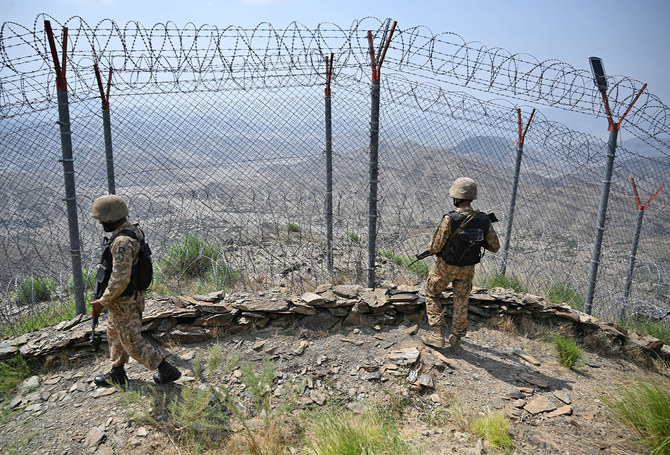
Pakistani troops patrol along Pakistan-Afghanistan border fence at Big Ben post in the Khyber district of the Khyber Pakhtunkhwa province, Pakistan, on August 3, 2021. (AFP/File)
Short Url
Updated 22 December 2021
Follow

Afghan Taliban stop Pakistan army from fencing international border

  • Afghan defense ministry official says Taliban forces stopped the Pakistani military from erecting an ‘illegal’ border fence on Sunday
  • The border incident happened the day Islamabad was hosting the OIC summit to discuss the humanitarian situation in Afghanistan

KABUL/PESHAWAR: Taliban soldiers in Afghanistan disrupted the erecting of a security fence by the Pakistani military along the border between the two countries, Afghan officials said on Wednesday.
Pakistan has fenced most of the 2,600 km (1,615 mile) border despite protestations from Kabul, which has always contested the British-era boundary demarcation that splits families and tribes on either side.
Afghan defense ministry spokesman Enayatullah Khwarazmi said Taliban forces stopped the Pakistani military from erecting an “illegal” border fence along the eastern province of Nangarhar on Sunday.
He played down the incident, saying everything was now normal. The Pakistan army did not respond to a request for comment.
A video circulated on social media showed Taliban soldiers had seized spools of barbed wire and one senior official warning Pakistani soldiers stationed in security posts in the distance not to try to fence the border again.
Reuters could not verify the video independently.
Taliban spokesman Bilal Karimi said they were investigating the incident.
Taliban and Pakistani forces came face-to-face over the border incident, two Taliban officials told Reuters on the condition of anonymity, and the situation was tense.
They added that following the incident there was cross border mortar fire from Pakistani territory further north along the frontier into Afghanistan’s Kunar province on Wednesday.
It was unclear if the incidents are linked. The officials said Afghan military helicopters could be seen patrolling the area.
The fencing was a main reason behind the souring of relations between previous US-backed Afghan governments and Islamabad. The current standoff indicates the matter remains a contentious matter for the Taliban, despite its close ties to Islamabad.
Foreign governments have long alleged that Pakistan supported the insurgent movement as it fought the US backed government and Western troops — a charge Islamabad denies.
The lawless mountainous border was historically fluid before Pakistan began erecting a metal fence four years ago, of which it has completed 90 percent.=
The border incident happened the day foreign delegates from around the world gathered in Islamabad for a summit of the Organization of Islamic Cooperation to discuss the unfolding humanitarian disaster in Afghanistan.


Islamabad dismisses claims about paying up to 8 percent interest on foreign loans as ‘misleading’

Updated 22 February 2026
Follow

Islamabad dismisses claims about paying up to 8 percent interest on foreign loans as ‘misleading’

  • Pakistan has long relied on external loans to help bridge persistent gaps in public finances and foreign exchange reserves
  • Pakistan’s total external debt, liabilities stand at $138 billion at an overall average cost of around 4 percent, ministry says

KARACHI: Pakistan’s finance ministry on Sunday dismissed as “misleading” claims that the country is paying up to 8 percent interest on external loans, saying the overall average cost of external public debt is approximately 4 percent.

Pakistan has long relied on external loans to help bridge persistent gaps in public finances and foreign exchange reserves, driven largely by a narrow tax base, chronic trade deficits, rising debt-servicing costs and repeated balance-of-payments pressures.

Over the decades, successive governments have turned to multilateral and bilateral lenders, including the International Monetary Fund, the World Bank and the Asian Development Bank, to support budgetary needs and shore up foreign exchange reserves.

The finance ministry on Sunday issued a clarification in response to a “recent press commentary” regarding the country’s external debt position and associated interest payments, and said the figures required contextual explanation to ensure accurate understanding of Pakistan’s external debt profile.

“Pakistan’s total external debt and liabilities currently stand at $138 billion. This figure, however, encompasses a broad range of obligations, including public and publicly guaranteed debt, debt of Public Sector Enterprises (both guaranteed and non-guaranteed), bank borrowings, private-sector external debt, and intercompany liabilities to direct investors. It is therefore important to distinguish this aggregate figure from External Public (Government) Debt, which amounts to approximately $92 billion,” it said.

“Of the total External Public Debt, nearly 75 percent comprises concessional and long-term financing obtained from multilateral institutions (excluding the IMF) and bilateral development partners. Only about 7 percent of this debt consists of commercial loans, while another 7 percent relates to long-term Eurobonds. In light of this composition, the claim that Pakistan is paying interest on external loans ‘up to 8 percent’ is misleading.

The overall average cost of External Public Debt is approximately 4 percent, reflecting the predominantly concessional nature of the borrowing portfolio.”

With respect to interest payments, public external debt interest outflows increased from $1.99 billion in Fiscal Year (FY) 2022 to $3.59 billion in FY2025, representing an increase of 80.4 percent, not 84 percent as reported. In absolute terms, interest payments rose by $1.60 billion over this period, not $1.67 billion, it said.

According to the State Bank of Pakistan’s records, Pakistan’s total debt servicing payments to specific creditors during the period under reference were as follows: the IMF received $1.50 billion, of which $580 million constituted interest; Naya Pakistan Certificates payments totaled $1.56 billion, including $94 million in interest; the Asian Development Bank received $1.54 billion, including $615 million in interest; the World Bank received $1.25 billion, including $419 million in interest; and external commercial loans amounted to nearly $3 billion, of which $327 million represented interest payments.

“While interest payments have increased in absolute terms, this rise cannot be attributed solely to an expansion in the debt stock,” the ministry said. “Although the overall debt stock has increased slightly since FY2022, the additional inflows have primarily originated from concessional multilateral sources and the IMF’s Extended Fund Facility (EFF) under the ongoing IMF-supported program.”

Pakistan secured a $7 billion IMF bailout in Sept. 2024 as part of Prime Minister Shehbaz Sharif’s efforts to stabilize the South Asian economy that narrowly averted a default in 2023. The government has since been making efforts to boost trade and bring in foreign investment to consolidate recovery.

“It is also important to note that the increase in interest payments reflects prevailing global interest rate dynamics. In response to the inflation surge of 2021–22, the US Federal Reserve raised the federal funds rate from 0.75-1.00 percent in May 2022 to 5.25–5.50 percent by July 2023. Although rates have since moderated to around 3.75 percent, they remain significantly higher than 2022 levels,” the finance ministry said.

“The government remains committed to prudent debt management, transparency, and the continued strengthening of Pakistan’s macroeconomic stability,” it added.