

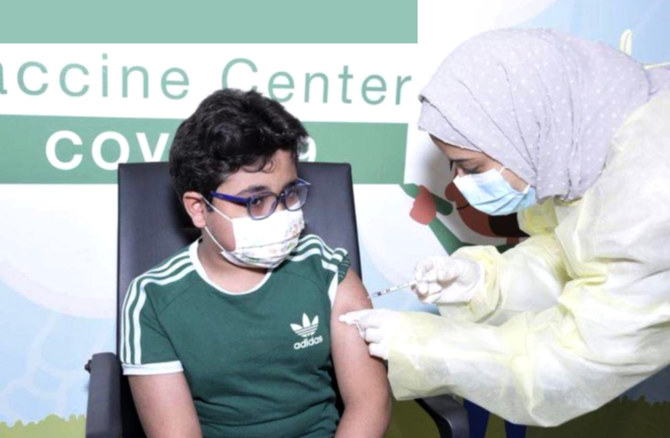
Saudi Arabia promotes safety of COVID-19 vaccine for those aged 5-11

The decision came after ‘months of clinical trial investigations’ involving 4,500 children aged 5-11. (Health Ministry at @SaudiMOH)
Short Url
Updated 21 December 2021
Follow

Saudi Arabia promotes safety of COVID-19 vaccine for those aged 5-11

  • Saudi Arabia reports new daily cases at highest since Aug. 30

JEDDAH: On Tuesday, Dec. 21, Saudi Arabia’s Ministry of Health officially began its inoculation program for children aged 5-11 against COVID-19.

Earlier in November, the Saudi Food and Drug Authority approved the use of the Pfizer-BioNTech vaccine for the age group after completing the necessary studies to ensure safety and efficacy after referring to several international authorities.
According to Dr. Aya El-Sayed, pediatrician and neontology fellow, the Kingdom’s decision to begin the inoculation program came after “months of pediatric clinical trial investigations involving 4,500 children aged 5-11 from the US FDA (Food and Drug Authority).”
El-Sayed added: “Pfizer released new data on Oct. 22 stating that its vaccine is safe and is about 91 percent effective at preventing COVID-19 in that young age group.”
Twenty pediatric clinics have been established at King Abdulaziz International Airport in Jeddah, with the venue decorated to appeal and encourage the young, with more clinics set to open in the next coming days across the Kingdom.
According to the ministry, priority will go to the vulnerable and immunocompromised. Appointment availability for remaining categories will be announced later.
On Oct. 20, the Kingdom made the decision to postpone school attendance, instead having children and students learn from their homes.
This delay was the result of ongoing studies about the viability and safety of different vaccines on children, as reported by the Saudi Press Agency.
El-Sayed stressed the importance of vaccinating children for them to go back to school and socialize safely with their classmates and teachers.

HIGHLIGHT

Twenty pediatric clinics have been established at King Abdulaziz International Airport in Jeddah, with the venue decorated to appeal and encourage the young, with more clinics set to open in the next coming days across the Kingdom.

“Just like adults, children also get sick, and that is why our goal as medical practitioners is to reassure parents of the safety of the Pfizer vaccine, and eliminate the risk of unnecessary implications of the virus,” said El-Sayed.
While rare, complications such as multisystem inflammatory syndrome appear to be linked to the disease occurring in children infected with the virus.
A systematic review of case studies published in Translational Pediatrics Journal have shown that overall incidence of MIS-C is low, while children present the majority of cases diagnosed.
“The most important thing (is) to prevent some complications that only present in children, (such) as MIS-C, a condition where different body parts become inflamed, including the heart, lungs, kidneys, brain, skin, eyes, or gastrointestinal organs, that occurs after infection by 4-6 weeks,” said El-Sayed.
She went on to add that the COVID-19 vaccine side effects are similar to other precautionary vaccines with side effects, including flu like symptoms, fever, headache, and fatigue.
As the omicron variant circulates across the globe causing an increase in the number of hospitalizations and nearly 100 deaths worldwide, the need for inoculating children has become a priority, a statement that was reiterated by Saudi Arabia’s Ministry of Health spokesman, Dr. Mohammed Al-Abd Al-Aly, at Sunday’s joint press conference.  
The confirmed cases of COVID-19 in the Kingdom more than doubled in the past 2 days, and the ministry stressed the importance of receiving the necessary doses and booster shots.
For months, health experts have reiterated the importance of receiving the vaccine doses to help raise herd immunity and ensure numbers of infections decline.
The ministry announced 222 new cases on Tuesday. The last time the Kingdom reported similar numbers was Aug. 30, when 221 cases were reported.
In addition, 106 new recoveries were reported, raising the total number of recoveries to 540,284. One COVID-19 related death raised the death toll to 8,865.


Shaping future society: How intellectual forums contribute to cultural development

Updated 56 min 37 sec ago
Follow

Shaping future society: How intellectual forums contribute to cultural development

  • The Philosophy Forum, organized in Riyadh this week for the fifth year, witnessed the attendance of both local and international thinkers

RIYADH: Modern nations do not transform on technological progress alone, but evolve through various factors such as values, religion, culture and assumptions that guide how societies interpret development.

Philosophy is one aspect of understanding civilization. Although it is often seen as abstract or far from reality, it plays an essential role in shaping a nation’s understanding of modernization.

It impacts how people see progress and discuss cultural identity, along with measuring the ethical implications of joining the global mindset.

Yet, by examining the philosophical thoughts that shape national narratives, people gain a deeper understanding of why societies adopt certain ideologies for development, resist others, and struggle to balance tradition with innovation.

Saudi Arabia, for example, defines its place on the global stage and navigates the complex tensions between heritage, aspiration and global responsibility through its own philosophy.

The Philosophy Forum, organized in Riyadh this week for the fifth year, witnessed the attendance of both local and international thinkers. During the conference, some Arab philosophers shared their beliefs in the idea that there is no absolute truth; while other philosophers differed, considering the Arab view on truth, culture and relativism.

“We must distinguish between the existence of relativity in science — the world is changing because it is relative — and our belief in absolute truths within our culture. For example, the only truly absolute thing in the world is death, which is mentioned in the Holy Qur’an,” Essam Gameil, professor of logic and critical thinking at Cairo University, told Arab News on the sidelines of the forum.

He added: “Our morals are unchanging; ethical principles are fixed. For example, respecting others is a fundamental principle; how can it be altered?

“Some concepts can be changed within the framework of science, but not in the humanities, not in religion, not in ethics. There are constants.

“It is the moral principles and rules that drive me forward,” Gameil said, adding that philosophy was created to solve issues that occurred in society during the time of Aristotle and Plato.

“It appeared to solve social problems … it was created to address lying, deception and more. Socrates was a moral philosopher and nothing else,” he said.

Gameil described Saudi Arabia as an example of “an extraordinary leap” in the Arab world in terms of development and philosophy.

He said that the Kingdom’s interest in philosophy and its organization of a major conference in the field stems from a crucial concept discovered by the Saudi leadership, which is that humanity has two aspects: A spiritual aspect and a material aspect, represented by the body.

“Studies typically focus on the body — artificial intelligence, engineering, and so on — but have often neglected the spiritual dimension. Philosophy is a human science; the more you emphasize it, the more certain concepts become firmly established and ingrained,” said Gameil.

Eman Al-Mulhem, a researcher in the philosophy of science at King Faisal University in Al-Ahsa, believes that the Kingdom’s situation presents three very promising paths: The philosophy and ethics of artificial intelligence, science and technology studies, and a re-reading of the Arab philosophical heritage using contemporary methodologies.

“This field is no longer a luxury, but a necessity. The question is no longer: What can a machine do? Rather, it has become: How do we preserve our humanity in a world where we share the power of decision-making with machines?” she said, highlighting the philosophy and ethics of AI.

She added: “We have a rich heritage, but we need modern tools to understand and reconstruct it, not just explain it. These fields are not only promising, but they are also capable of reshaping the role of philosophy in the Arab world.”

Al-Mulhem also works to connect Arab philosophical heritage to questions of contemporary science. She believes that philosophy is not detached from reality, but rather helps to reevaluate our relationship with science, humanity and the world.

On the question of whether Arab philosophical heritage is still suffering from global misconceptions, she said: “(It) still suffers some global misconceptions, such as being reduced to a mere extension of Greek philosophy or a stagnant tradition.”

However, the Riyadh International Philosophy Conference, which hosts philosophical minds from around the world, is helping to correct this image, she added.

“They present Arab heritage in a dynamic context, through the voices of its own scholars. At this conference, the world encounters Arab thoughts that engage in dialogue, produce ideas and critique — not as a static heritage, but as an integral part of contemporary global philosophy,” said Al-Mulhem.

“Philosophy is not far removed from humanity; it is closer than we imagine. Every question we ask, every attempt to understand the world, is a philosophical step,” she said.

“I believe that the Arab region today has a great opportunity to reclaim its role in producing knowledge, not just consuming it. And the Arab researcher is capable — given the right environment — of making a lasting impact that transcends geographical boundaries,” she added.