

Libyan candidates talk and militias mobilize

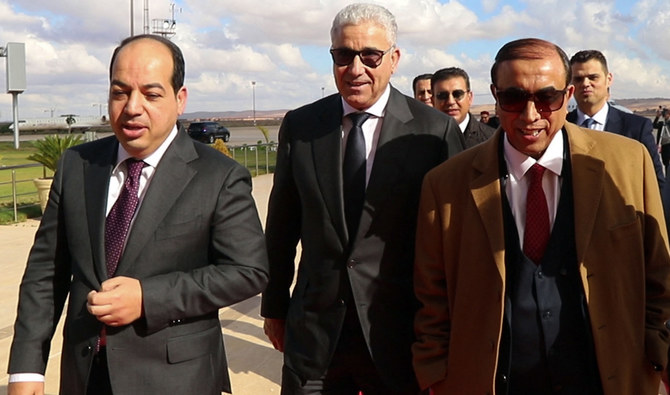
Libya's presidential candidates Ahmed Maiteeq (L) and Fathi Bashagha (C) arrive for a meeting with Libya's eastern military chief Khalifa Haftar, in the eastern city of Benghazi on December 21, 2021. (AFP)
Short Url
Updated 21 December 2021
Follow

Libyan candidates talk and militias mobilize

TRIPOLI: Libya’s political crisis deepened on Tuesday as some presidential candidates met in Benghazi to discuss how to tackle a collapsing electoral process that was meant to help end a decade of violence and chaos.

The meeting is the most prominent of several rounds of backroom talks over recent days between candidates, factions and foreign powers about delaying the vote and whether an interim government can meanwhile continue in power.

Rival armed groups mobilized in Tripoli early on Tuesday, closing roads in the south of the capital, with schools phoning parents to pick up their children.

The presidential election was meant to take place this Friday, but without any clear agreement on rules, and with bitter disputes over the eligibility of major candidates, the process has stalled and cannot go ahead.

Hadi Al-Sagheer, head of parliament’s election committee, said by phone the vote would have to be delayed because there was no longer time to carry out preparatory steps, though no postponement has yet been formally announced.

Candidates, factions and foreign powers involved in Libya are discussing the length of a delay, whether basic changes need to be made to rules and the vote’s legal basis, and whether to replace the interim government or form a breakaway administration.

The group meeting in Benghazi, including eastern commander Khalifa Haftar and the former Interior Minister Fathi Bashagha from Misrata, are aligned against the interim prime minister, Abdul Hamid Dbeibah, who is a rival candidate.

The interim government and the election process were created last year under a UN-backed roadmap to end the turmoil.


Israel’s ‘deliberate intention of preventing births among Palestinians’ meets ‘legal criteria of Genocide Convention’: Reports

Updated 10 sec ago
Follow

Israel’s ‘deliberate intention of preventing births among Palestinians’ meets ‘legal criteria of Genocide Convention’: Reports

  • Births in Gaza fell by 41% during conflict as maternal deaths, miscarriages surged
  • ‘The destruction of maternal care in Gaza reflects the deliberate infliction of conditions of life calculated to bring about the destruction of the Palestinian people, in whole or in part’

LONDON: Births in Gaza fell by 41 percent due to Israel’s war on the territory, with the conflict resulting in catastrophic numbers of maternal deaths, miscarriages and birth complications, two reports have found.

The data on pregnant women, babies and maternity care in the war-torn Palestinian enclave also revealed a surge in newborn mortality and premature births, The Guardian reported on Wednesday.

Dangerous wartime conditions and Israel’s systematic destruction of Gaza’s health systems were blamed for the alarming statistics.

The two reports were conducted by Physicians for Human Rights, in collaboration with the University of Chicago Law School’s Global Human Rights Clinic and Physicians for Human Rights — Israel.

Researchers highlighted Israel’s “deliberate intention of preventing births among Palestinians, meeting the legal criteria of the Genocide Convention.”

The reports build on earlier findings by PHR’s Israel branch. They place the testimonies of pregnant women and new mothers within the context of health data and field reports, which recorded “2,600 miscarriages, 220 pregnancy-related deaths, 1,460 premature births, over 1,700 underweight newborns, and over 2,500 infants requiring neonatal intensive care” between January and June 2025.

PHRI’s Lama Bakri, a psychologist and project manager, said: “These figures represent a shocking deterioration from pre-war ‘normalcy,’ and are the direct result of war trauma, starvation, displacement and the collapse of maternal healthcare.

“These conditions endanger both mothers and their unborn babies, newborns, and breastfed infants, and will have consequences for generations, permanently altering families.”

She added: “Beyond the numbers, what emerges in this report are the women themselves, their voices, choices and lived realities, confronting impossible dilemmas that statistics alone cannot fully capture.”

Maternal and newborn care in Gaza has been damaged by Israel’s destruction of health infrastructure, as well as fuel shortages, blocked medical supplies, mass displacement and relentless bombardment.

As a result, survival in Gaza’s overcrowded tent encampments has become the sole option for pregnant women and new mothers.

During the first six months of Israel’s war on the territory, more than 6,000 mothers were killed, at an average of two every hour, according to UN Women estimates.

It is also believed that about 150,000 pregnant women and new mothers have been forcibly displaced by the conflict.

In the first months of last year, just 17,000 births were recorded in Gaza, a 41 percent fall compared to the same period in 2022.

The researchers examined Israel’s apparent strategy to undermine Palestinian births, highlighting a targeted strike in December 2023 on the Al-Basma IVF clinic.

The attack on Gaza’s largest fertility center destroyed about 5,000 reproductive specimens and ended a pattern of 70-100 IVF procedures each month.

The strike was deliberately designed to target the reproductive potential of Palestinians, the Independent International Commission of Inquiry later found.

“Reproductive violence constitutes a violation under international law; when carried out systematically and with them intent to destroy, it falls within the definition of genocide of the Genocide Convention,” the reports said.

“The destruction of maternal care in Gaza reflects the deliberate infliction of conditions of life calculated to bring about the destruction of the Palestinian people, in whole or in part.”