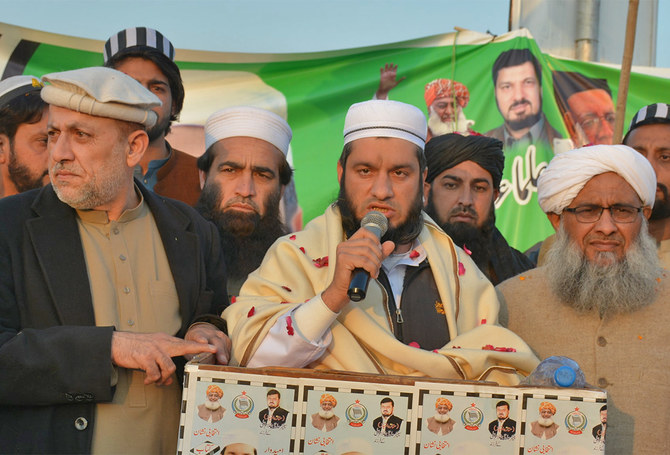

PESHAWAR: A ruling party candidate for the coveted seat of mayor of Peshawar, the capital of Pakistan’s northwestern Khyber Pakhtunkhwa province, said on Monday he would file a review of the vote count, unofficial results of which showed he had lost to an opposition party member.
Local bodies elections were held in 17 districts of Khyber Pakhtunkhwa on Sunday, in what is the first time such polls have been held in areas that used to be part of the Federally Administered Tribal Areas (FATA), which were merged with KP in 2018. In a second phase, local elections will be held in the remaining 18 districts on January 16.
Unofficial results of the polls, reported by media and local election officials, showed that Zubair Ali, the candidate from the religious political party, the Jamiat Ulema-e-Islam-Fazl (JUI-F), had won the mayor’s seat, defeating Rizwan Bangash from the ruling Pakistan Tehreek-e-Insaf (PTI) of Prime Minister Imran Khan. The PTI has been in power in KP since 2013.
Bangash told Arab News his party would request a recount of both the overall votes as well as those that were rejected due to irregularities.
“We’re optimistic to secure victory because we’re going for a review of 16,000 rejected votes and a recount of overall votes cast in favor of myself and my rival,” Bangash sai
KP spokesman for the JUI-F, Jalil Jan, congratulated the people of Khyber Pakhtunkhwa for having confidence in the party, saying the results “clearly depicted that people are fed up with the way the PTI is ruling the province.”
Dawn reported that PTI leaders attributed the party’s performance to rising inflation in the country.
“Inflation has increased, which in turn has affected the people,” KP Minister for Labor and Human Rights Shaukat Yousafzai was quoted by the news outlet as saying.
Unofficial results reported by media showed opposition parties had a combined lead over the ruling PTI for the post of mayor and chairman of 63 tehsil councils.
Sohail Ahmad, a spokesman for the provincial Election Commission of Pakistan (ECP), said the body would announce official results of the ballot on December 25.
According to a statement issued by the deputy commissioner officer of Peshawar, the results of all polling stations of Peshawar Tehsil Council had been received, but official results had to be withheld because the polling process was suspended in six polling stations over security reasons.
According to unofficial results, JUI-F’s Zubai Ali received 62,388 votes, Rizwan Bangash of the ruling PTI got 50,659 votes while Arbab Zarak Khan from the Pakistan People’s Party won 45,958 votes.
Ali had therefore won with a margin of around 11,500 votes.
A day before, over 550 women contested local government elections in Khyber Pakhtunkhwa, the election commission said.
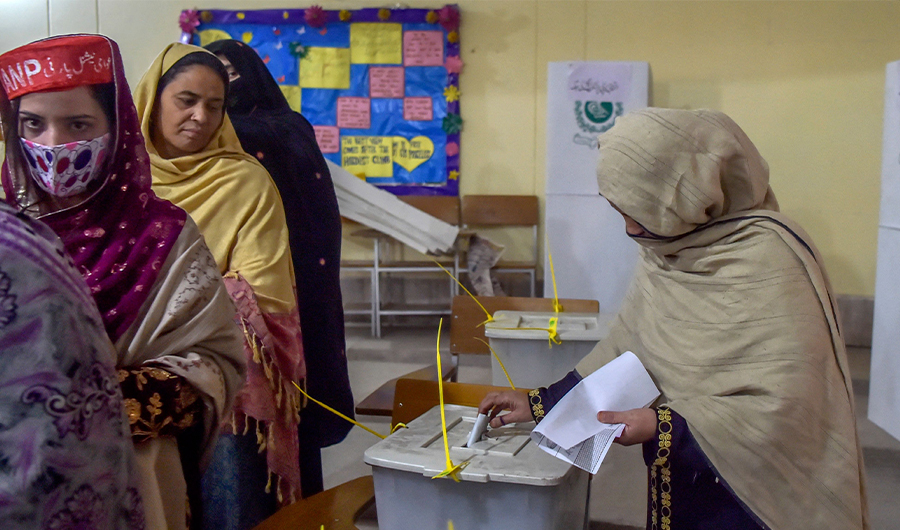
Women stand in a queue inside a polling station during a local body election in Khyber Pakhtunkhwa province of Peshawar, Pakistan, on December 19, 2020. (AFP)
Elections were held in Charsadda, Nowshera, Mardan, Peshawar as well as in Khyber, Mohmand Agency, Swabi, Kohat, Karak, Hangu, Bannu, Lakki Marwat, Tank, Haripur, Buner, Bajaur, and DI Khan, with more than 35,700 candidates in the run for tehsil council, village council and neighborhood councils.
About 3,900 women candidates were in the contest, including from FATA.
Strict security arrangements were in place as over 12.6 million voters went to the polls in the 17 districts. Nearly 80,000 law enforcers were deployed in areas where polling took place.
However, reports of violence and armed attacks related to the election left five people dead and several wounded, according to police and locals.
On Saturday, a day before the polls, mayoral candidate Umar Khitab was gunned down outside his home in Dera Ismail Khan, District Police Officer (DPO) Najamul Hasnain told media.
Additionally, the polling process had to be suspended in several polling stations in Bannu and Dara Adamkhel, a town in the Khyber tribal district, due to an attack on Federal Minister for Science Shibli Faraz in Kohat. The minister escaped unhurt.
A roadside bomb also hit the vehicle of a Awami National Party (ANP) leader in Bajaur tribal district on election day, leaving two people dead and three wounded.
People also set a polling station and ballot boxes on fire in the Darra Adam Khel area of Khyber tribal district.