

US special envoy hails Pakistan’s efforts to arrange OIC summit to help Afghanistan

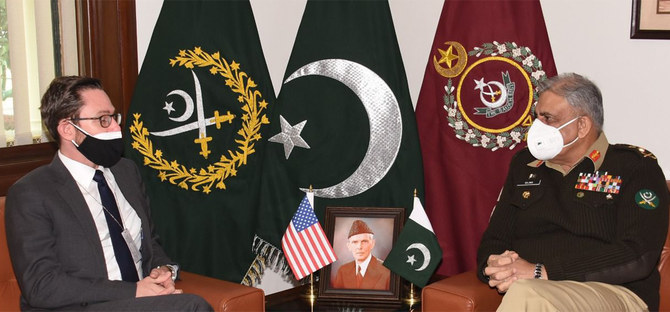
US Special Representative for Afghanistan, Thomas West (left) meets Pakistan's Chief of Army Staff, General Qamar Javed Bajwa, in Rawalpindi, Pakistan, on December 20, 2021. (ISPR)
Short Url
Updated 20 December 2021
Follow

US special envoy hails Pakistan’s efforts to arrange OIC summit to help Afghanistan

  • Special envoy on Afghanistan says OIC Council of Foreign Ministers summit “productive … with important outcomes”
  • Lauds OIC decision to set up humanitarian trust fund, appoint special envoy on Afghanistan to OIC Secretary General

Islamabad: US Special Representative for Afghanistan, Thomas West, on Monday met Pakistani chief of army staff (COAS) General Qamar Javed Bajwa and hailed Pakistan’s efforts to organize and host the 17th Extraordinary Session of the Organization of Islamic Corporation’s Council of Foreign Ministers.
The summit was held in Islamabad on Sunday with a focus on the looming economic and humanitarian crisis in Afghanistan. Around 70 delegations from OIC member states, non-members and regional and international organizations attended the summit in Islamabad. Around 20 delegations were led by foreign ministers and 10 by deputies or ministers of state.
Other than foreign ministers from Islamic countries, delegations from the European Union and the P5+1 group of the UN Security Council, including the United States, Britain, France, Russia, China and Germany, were also in attendance.
“COAS thanked the dignitary for participating in the 17th Extraordinary Session of Council of Foreign Ministers,” the Pakistan army said in a statement.
“The visiting dignitary appreciated Pakistan’s role in Afghan situation, special efforts for effective Pak-Afghan border management and pledged to play his part for further improvement in diplomatic cooperation with Pakistan at all levels. He hailed Pakistan’s efforts for organizing CFM’s 17th Extraordinary Session of OIC.”
On Sunday at the conclusion of the summit, OIC member nations said they would establish a humanitarian trust fund to channel assistance to Afghanistan, including in partnership with other international actors, and would appoint a special envoy on Afghanistan to the OIC Secretary General.
“A productive OIC session today with important outcomes — not least the creation of a humanitarian trust fund and the naming of an OIC Special Envoy,” West said on Twitter on Monday. “The US warmly welcomes the OIC’s role and contributions.”

A draft resolution shared with media after the summit said the humanitarian trust fund would be set up under the aegis of the Islamic Development Bank. The resolution called on the Bank to operationalize the fund by the first quarter of 2022 and called on OIC member states, Islamic financial institutions, donors and other international partners to announce pledges to the fund as well as provide humanitarian assistance to Afghanistan.
The OIC also decided to appoint Ambassador Tarig Ali Bakheet, Assistant Secretary General for Humanitarian, Cultural and Family Affairs at the OIC General Secretariat, as the special envoy on Afghanistan to the OIC Secretary General. Bakheet will be supported by a secretariat and the OIC Office in Afghanistan to coordinate aid and assistance efforts.
The United Nations is warning that nearly 23 million people — about 55 percent of the population of Afghanistan — face extreme levels of hunger, with nearly 9 million at risk of famine as winter takes hold in the impoverished, landlocked country.


Pakistan warns citizens in Iran to keep travel documents ready amid intensifying protests

Updated 6 sec ago
Follow

Pakistan warns citizens in Iran to keep travel documents ready amid intensifying protests

  • Iranian universities reschedule exams, allow foreign students to leave the country for one month
  • Donald Trump pledges support for Iranian protesters as ‘activists’ report more than 2,500 deaths

ISLAMABAD: Pakistan’s top diplomat to Iran on Tuesday urged Pakistani nationals to keep their travel documents handy and advised students to plan ahead after Iranian universities rescheduled examinations to allow international students to leave, as weeks-long nationwide protests further intensified.

Iran has been gripped by protests since late December after shopkeepers in Tehran’s Grand Bazaar shut their businesses to protest worsening economic conditions, triggered by the Iranian rial plunging to record lows against the US dollar.

The demonstrations quickly spread beyond the capital, with unrest reported in most of the country’s 31 provinces and involving traders, students and other groups.

Authorities have responded with arrests, use of force and Internet and mobile network disruptions, which rights groups say are aimed at curbing coordination and limiting coverage of the protests.

At least 100 Pakistani citizens, including students and pilgrims, have returned home through the Pakistan-Iran border in the southwestern province of Balochistan, a Pakistani official told Arab News on Tuesday, though many are still believed to be in the neighboring state.

“I urge all Pakistani citizens in Iran to keep their travel documents, particularly immigration-related documents such as passport and ID cards, readily available with them,” Ambassador Mudassir Tipu said in a post on X. “Those who have expired documents, or their documents are not in their possession, they may kindly urgently approach us for timely and expeditious assistance.”

In a separate post, he said Iranian universities had rescheduled examinations and allowed international students to leave the country for one month, advising Pakistani students to make their plans accordingly.

On Jan. 1, Pakistan advised its citizens to avoid traveling to Iran, citing safety concerns linked to the protests. The Pakistani embassy in Tehran also set up a crisis management unit to provide round-the-clock assistance to citizens.

Iran eased some restrictions on Tuesday, allowing international phone calls via mobile networks for the first time in days, but maintained limits on Internet access and text messaging as the death toll from the protests rose to at least 2,571 people, according to the Associated Press that quoted “activists.”

In a message on Truth Social, US President Donald Trump urged Iranian protesters to continue their anti-government demonstrations, saying “help is on its way,” without providing details. Shortly afterward, Ali Larijani, secretary of Iran’s Supreme National Security Council, accused the United States and Israel of responsibility for the deaths of Iranian civilians.

Iranian state television said officials would hold funerals on Wednesday for “martyrs and security defenders” killed during the unrest, which has intensified over the past week.